


Soreness after a bowel movement. Bright red blood on the toilet paper. A painful lump that makes sitting hard. Those who search for how to heal hemorrhoids are often already deep into trial and error, using wipes, creams, and internet advice that only partly helps.
The good news is that hemorrhoids usually respond to a very predictable treatment path. Start by making bowel movements easier. Calm irritation. Then escalate promptly if bleeding, prolapse, or pain keeps going. That approach matters because hemorrhoids don’t heal well when the area keeps getting re-injured every time you strain.
For people who need more than over-the-counter care, prescription topical treatment can help bridge the gap between home remedies and an office procedure. This page focuses on why some hemorrhoids don’t heal as expected and what changes the mechanics. If you want a fast, step-by-step action plan for calming a flare today, see how to shrink hemorrhoids fast. And if you want the full picture — every stage from home care through prescriptions, procedures, and surgery — see our complete hemorrhoid treatment guide.
Through Bummed, adults can complete a brief online intake that’s reviewed by a board-certified provider the same day, and if appropriate, receive compounded prescriptions such as Rapid Relief Hemorrhoid & Fissure Rx Cream with nitroglycerin or Long Acting Hemorrhoid & Fissure Rx Cream with diltiazem, shipped discreetly from a partner pharmacy.
Understanding What Causes Hemorrhoids
Hemorrhoids are swollen vascular cushions in and around the anus. Think of them like a traffic jam in veins that are already under pressure. When stool is hard, time on the toilet drags on, or the pelvic floor doesn’t relax well, blood flow gets congested and the tissue swells.
That swelling can happen inside the rectum or outside the anus. Internal hemorrhoids often show up as bleeding or tissue that protrudes during bowel movements. External hemorrhoids are more likely to feel tender, swollen, itchy, or sharply painful, especially if a clot forms. If you’re not sure which pattern matches what you’re experiencing, our guide to the difference between internal and external hemorrhoids can help you sort that out.
Hemorrhoids are also very common. An estimated 36 million American adults — about 1 in 5 — have been diagnosed with hemorrhoids at some point, according to NIDDK’s Burden of Digestive Diseases report.
Why pressure builds in the first place
The usual triggers are mechanical. Constipation is a major one because hard stool and straining increase pressure right where hemorrhoids live. Diarrhea can irritate the area too, especially when people wipe repeatedly or sit on the toilet longer than they realize.
Pregnancy can push the same system in the wrong direction. Hormonal changes can slow bowel function, and the growing uterus adds pressure to the pelvic veins. That combination makes hemorrhoid flare-ups more likely. Read for more on hemorrhoids during pregnancy.
GLP-1 medications can fit into this picture as well. The issue isn’t the medication directly causing hemorrhoids. It’s that some adults develop constipation, harder stools, or more difficult bowel movements while taking them, which increases strain.
Hemorrhoids often persist because the trigger is still happening. The trigger is usually difficult bowel movements, not a lack of cream.
When pelvic tension is part of the problem
Some adults do everything “right” and still feel blocked, tight, or unable to pass stool without bearing down. In those cases, pelvic floor tension may be part of the story. This plain-language resource on understanding pelvic muscle spasms is useful if your symptoms include pelvic tightness, incomplete emptying, or pain that feels deeper than surface irritation.
For a broader look at why this condition is so widespread, this guide on why hemorrhoids are so common explains how daily habits and bowel mechanics keep flare-ups going.
Your First Line of Defense At-Home Remedies
Most hemorrhoids should first be treated by reducing friction and pressure during bowel movements. That sounds simple, but it works. Conservative care helps many people improve without a procedure.
A meta-analysis of seven randomized trials found that fiber supplementation of 7 to 20 g/day reduced the risk of persistent symptoms and bleeding by 50%, and Mayo Clinic notes that with home measures, symptoms often go away within a week, as summarized in this review of hemorrhoid management and fiber evidence. For a more detailed day-by-day action plan covering sitz baths, fiber targets, and OTC choices, see how to shrink hemorrhoids fast.
What to do for the next several days
Use a short, disciplined plan instead of trying ten things at once.
-
Raise fiber gradually: Add fiber through food or a supplement so stool stays softer and bulkier. The goal is easier passage, not urgency. Here is a list of our favorite, doctor-approved fiber supplements.
-
Drink more fluids: Fiber works better when you hydrate well. Without enough fluid, extra fiber can make stool harder to pass.
-
Take warm sitz baths: Warm water can calm irritation and help the anal muscles relax after a bowel movement. Harvard Health recommends soaking for about 20 minutes after bowel movements, plus 2 to 3 additional sessions throughout the day.
-
Stop straining: If stool isn’t moving, don’t force it. Bearing down repeatedly keeps hemorrhoids swollen.
-
Limit toilet time: Sitting and scrolling turns a bowel movement into prolonged pressure on irritated veins.
This practical guide on sitz bath benefits can help if you’re not sure how to set one up or when to use it.
What usually helps and what usually doesn’t
A few habits make a noticeable difference fast. Clean gently. Pat instead of scrubbing. Don’t immediately go to wipes instead of toilet paper, as these can be irritating to the area. Wear breathable underwear. Avoid heavy lifting for a few days if it clearly worsens pressure and pain.
What usually disappoints people is relying on topical symptom relief alone while constipation continues. If stool is still hard, bleeding often returns with the next difficult bowel movement.
Practical rule: If you want hemorrhoids to heal, make every bowel movement easier than the one before.
A simple daily checklist helps:
-
Morning bowel plan: Don’t delay the urge to go.
-
Fiber plus fluids: Keep both going together.
-
Aftercare: Warm soak after bowel movements if the area feels irritated.
-
Evening review: If pain, bleeding, or swelling is still building after several days, don’t keep repeating the same plan indefinitely.
Advanced Topical Relief OTC vs Prescription Treatments
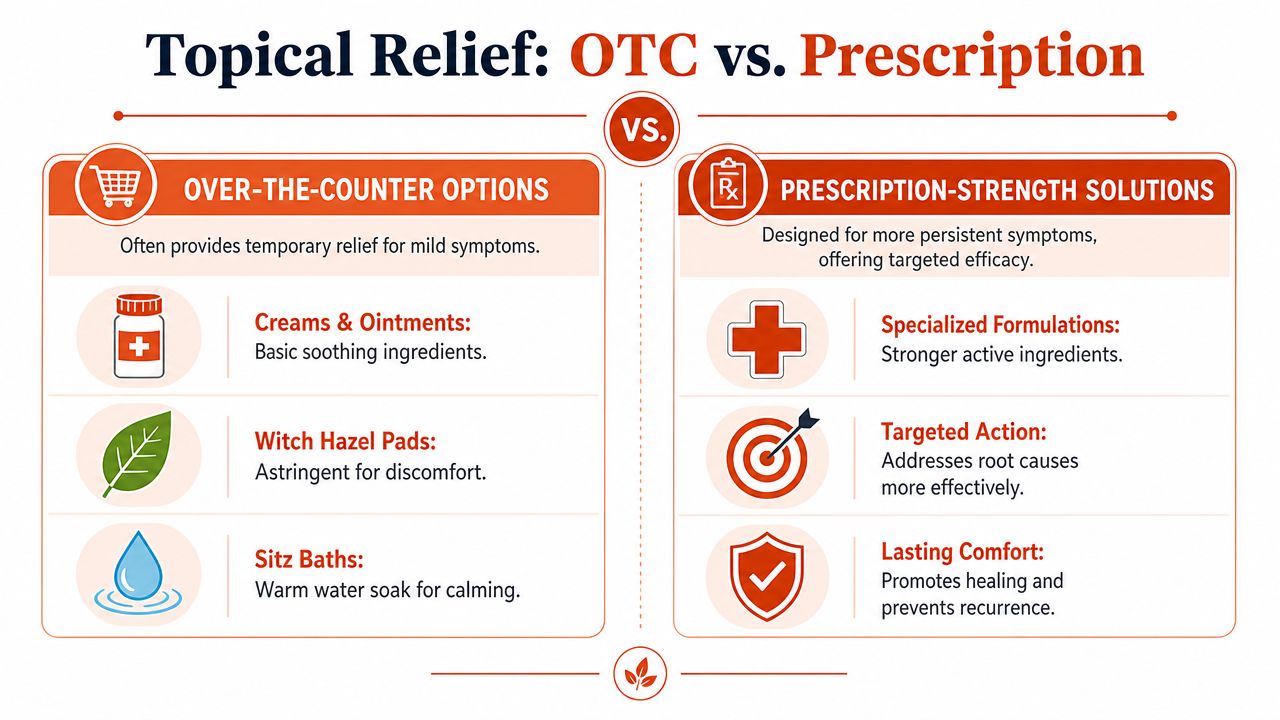
Most over-the-counter hemorrhoid products are built for symptom control. They may reduce itching, coat irritated skin, or temporarily decrease inflammation. That can be useful for a mild flare. It’s often not enough when pain is being driven by internal sphincter spasm, fissure overlap, or recurrent prolapse.
Why many OTC products stall out
Hydrocortisone, witch hazel, and anesthetic-style products can soothe the surface. They don’t reliably change the underlying mechanics. That’s especially true for itching that keeps returning. A short OTC hydrocortisone course can help temporarily, but repeating it indefinitely isn’t a real plan — if the itch cycle won’t break, a formula built for longer, more targeted use, like Anti-Itch Pruritus Ani Rx Cream, is often the more sustainable next step than another round of the same OTC steroid.
For a full ingredient-by-ingredient breakdown of what’s actually in these products and which one matches which symptom, see our best hemorrhoid cream guide.
If the internal anal sphincter stays tight, blood flow remains poor and each bowel movement can reopen the same irritated tissue. That’s why people often describe a pattern of brief relief followed by the exact same pain the next day.
A good comparison is below:
| Treatment type | What it mainly does | Trade-off |
|---|---|---|
| OTC creams and pads | Soothes itching, burning, surface irritation | Relief may be temporary if bowel strain continues |
| Warm sitz baths | Calms tissue and relaxes the area | Helpful support, but not a full plan by itself |
| Prescription topical muscle relaxants | Target sphincter tightness and improve local blood flow | Need a medical review and can have side effects |
How nitroglycerin and diltiazem differ
Topical nitroglycerin works by increasing nitric oxide availability, which helps relax the internal anal sphincter. In practical terms, that means less spasm, better perfusion, and a better healing environment for fissure-predominant pain and hemorrhoid symptoms that worsen when tight muscle traps swollen tissue. Randomized trials have shown improved fissure healing compared with placebo, though headaches can limit use in some adults.
Topical diltiazem also relaxes the internal sphincter, but by a different route. Systematic reviews have shown healing rates comparable to nitrates with fewer systemic side effects such as headache. For adults who need a steadier, more tolerable topical option, that can make diltiazem the more practical choice.
In terms of speed, this is often where prescription treatment pulls ahead of OTC care most clearly: compounded prescriptions such as nitroglycerin or diltiazem can reduce acute swelling within 24 to 48 hours in appropriate patients — a timeline OTC symptom relief typically can’t match, according to a Cleveland Clinic-based overview of hemorrhoid treatment options.
When OTC treatment only numbs or soothes, prescription therapy may work better because it changes the physiology that keeps the area from healing.
Where prescription care fits
This is the part many guides skip. If your symptoms aren’t settling with stool-softening strategies and simple topical support, prescription treatment can be a logical next step before an office procedure.
For adults with suspected sphincter-driven pain, persistent fissure-type pain, or mixed hemorrhoid and fissure symptoms, a provider may consider compounded prescriptions. For a full side-by-side of which Bummed formula fits which symptom pattern, see the prescription options section of our hemorrhoid treatment guide. The choice depends on the pattern of pain, tolerance for side effects, and whether the problem looks more inflammatory, muscular, or both.
If you’re pregnant or post-partum, you might want to consider a compounded cream consisting of nifedipine, which works by relaxing the internal anal sphincter muscle, reducing the pressure that keeps the fissure open and painful. This relaxation allows blood to flow more freely to the injured tissue, giving it the oxygen and nutrients it needs to repair. This prescription can be found in Bummed’s Sensitive Care Hemorrhoid & Fissure Rx Cream.
Bummed provides access to licensed medical providers who are well versed on the different prescription cream options and can help make a recommendation and prescribe a treatment plan for you if appropriate.
If your symptoms are specifically internal — bleeding with little pain, or tissue that protrudes during a bowel movement — our how to heal internal hemorrhoids guide covers that pattern and its treatment ladder in more detail, including office procedures. And if you’re still deciding between over-the-counter and prescription treatment more broadly, our best hemorrhoid medicine guide walks through that decision in depth.
What doesn’t work well is staying on the same short-lived OTC routine for weeks while bleeding or pain keeps recurring.
When to Escalate Care to a Provider
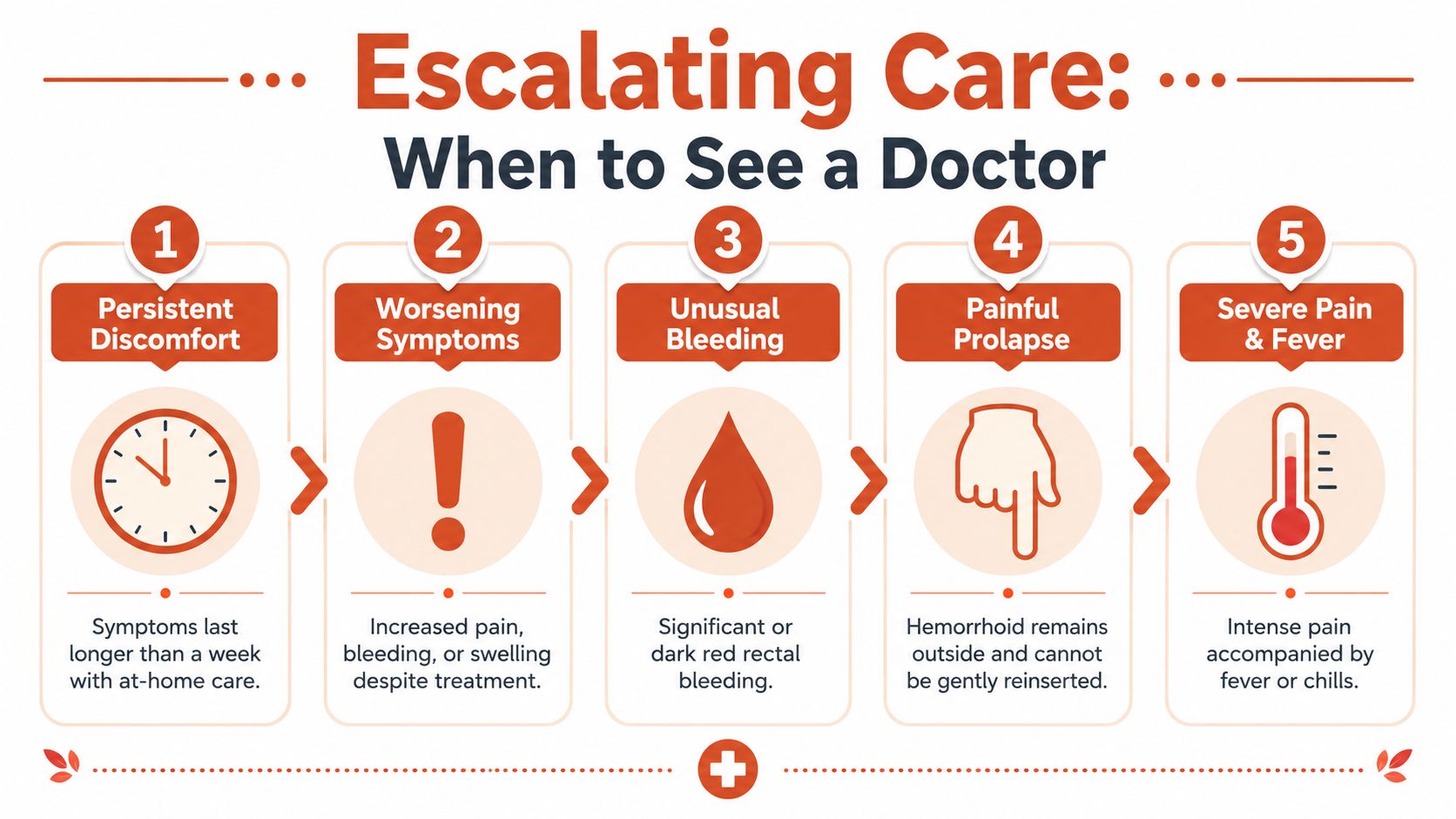
Home treatment has a limit. If symptoms keep going, the next move shouldn’t be more guessing. It should be an actual assessment.
Mayo Clinic frames self-care as short-term management, and guidance treats home care as something typically tried for about a week before procedures are considered in persistent cases, as outlined on the Mayo Clinic hemorrhoid diagnosis and treatment page.
Signs it’s time to stop self-treating
These patterns deserve medical review:
-
Symptoms past about a week: You’ve improved bowel habits, but bleeding, pain, or swelling hasn’t settled.
-
Repeated flare-ups: The same problem keeps coming back after short periods of relief.
-
Prolapse: Tissue pushes out and doesn’t reduce easily.
-
Meaningful bleeding: Especially if it’s ongoing or seems out of proportion to a small flare.
-
Severe pain: This can suggest a thrombosed external hemorrhoid or another anorectal problem that needs a different plan.
If you’re unsure whether your symptoms have crossed that line, this article on whether you should go to a doctor and what doctor treats hemorrhoids is a useful decision guide.
What a provider may recommend next
Care usually escalates in steps. Prescription treatment may be used when the goal is to reduce spasm, improve comfort, or address fissure overlap. If internal hemorrhoids continue to bleed or prolapse despite conservative care, office-based treatment becomes more relevant.
For grade I to III internal hemorrhoids that don’t respond to conservative care, rubber band ligation is the most effective office-based treatment and is preferred over infrared coagulation because it has lower failure rates, according to the ASCRS hemorrhoid management guidance.
If you’ve been told your hemorrhoids are a specific grade, our guide to stage 2 internal hemorrhoids explains what that classification means and how it affects treatment choices.
For a full walkthrough of every option at this stage — including sclerotherapy, infrared coagulation, and when surgery enters the picture — see our complete hemorrhoid treatment guide.
That doesn’t mean everyone needs a procedure. It means there is a standard next step when fiber, hydration, bowel changes, and topical management aren’t enough.
Persistent bleeding or prolapse shouldn’t be managed as a long-term DIY project. Those symptoms usually need a more definitive plan.
Telehealth can make that step easier. For many adults, a secure online consultation is the fastest way to sort out whether the next step is a prescription, an in-person exam, or direct referral for a procedure.
Building a Hemorrhoid-Proof Lifestyle
The long-term goal isn’t just getting through one flare. It’s making flare-ups less likely in the first place. That comes down to bowel consistency, less straining, and better pressure control.
First-line conservative treatment is a high-fiber regimen of 25 to 35 g/day plus increased water intake, and randomized trials found that fiber reduced the risk of persistent symptoms by 53% versus a no-fiber control, with a reported RR 0.47, 95% CI 0.32 to 0.68, as reviewed in this summary of ASCRS-aligned hemorrhoid treatment guidance.
The habits that matter most
You don’t need a perfect diet. You need a repeatable one.
-
Build fiber into normal meals: Fruit, vegetables, beans, oats, and whole grains help more than occasional “healthy” days.
-
Increase slowly: A sudden jump in fiber can leave you bloated and uncomfortable.
-
Keep water intake steady: Stool consistency depends on both fiber and fluid.
-
Move daily: Walking and regular activity support bowel motility and reduce stagnation.
-
Respect the urge to go: Delaying bowel movements often means drier, harder stool later.
For adults trying to make broader digestive changes, this guide on improve digestion naturally at home has practical ideas that pair well with hemorrhoid prevention.
Bathroom habits that quietly make things worse
The toilet shouldn’t become a sitting station. Long sessions increase pressure. So does pushing when your body isn’t ready.
A few simple rules help:
| Habit | Better approach |
|---|---|
| Sitting too long | Go when you need to, then get up |
| Repeated straining | Pause and revisit your bowel regimen |
| Ignoring constipation | Treat it early before pain starts |
| Rough wiping | Clean gently and avoid friction |
That’s how to heal hemorrhoids for the long haul. Prevent the next hard bowel movement, and you prevent a lot of the next flare.
Frequently Asked Questions About Healing Hemorrhoids
How long do hemorrhoids take to heal?
Many mild hemorrhoid symptoms improve with home treatment over the course of about a week. If you’ve been consistent with fiber, fluids, and warm soaks and you’re not improving, it’s time to get evaluated rather than repeating the same routine. For a fuller sense of what’s a normal timeline versus a sign to escalate, see our guide on how long hemorrhoids can last. As a first step, to help aid healing, you can seek online care through Bummed, where a licensed medical provider will prescribe a custom compounded prescription cream if appropriate.
Is bleeding from hemorrhoids always harmless?
No. Bright red blood can happen with hemorrhoids, but rectal bleeding shouldn’t be dismissed automatically. If bleeding is persistent, heavier than expected, or paired with worsening pain, you should speak with a provider. For a closer look at first-aid steps and what to do in the moment you notice blood, see our how to heal bleeding hemorrhoids guide.
Can hemorrhoids go away without surgery?
Yes. Many cases improve with conservative care, and others respond to prescription treatment or office-based procedures. Surgery is usually reserved for more advanced, recurrent, or mixed disease when less invasive treatment hasn’t solved the problem.
Does exercise help or make hemorrhoids worse?
Regular exercise usually helps because it supports bowel function and reduces constipation risk. The main caution is avoiding activities that clearly increase pressure or friction during a painful flare. Walking is often a good starting point.
What if over-the-counter creams aren’t helping?
That usually means either the diagnosis is incomplete or the treatment is too superficial. OTC products may soothe symptoms, but they often don’t address sphincter spasm, fissure overlap, or persistent internal hemorrhoids. That’s when prescription care, available through Bummed, or procedural evaluation becomes more appropriate.
Are hemorrhoids and anal fissures ever confused?
Very often. Both can cause pain and bleeding, and they can happen together. Fissure pain is often sharper and tied closely to bowel movements, while hemorrhoids may cause swelling, pressure, or protruding tissue. Mixed symptoms are common, which is one reason a proper assessment matters.
Are creams or suppositories better?
It depends on where the symptoms are. External irritation often responds better to a cream or ointment applied to the outer area. Internal symptoms may call for a suppository instead. If you’re not sure where the pain or bleeding is coming from, that’s a good reason to ask a provider rather than guessing.
Important Disclaimers
Bummed content is for general education and should never replace professional medical advice that considers your individual health. If you think you’re experiencing a medical emergency, call 911 or head to the nearest emergency department.
Prescription products require an online consultation with a physician who will determine if a prescription is appropriate.
If you’re dealing with hemorrhoid pain, bleeding, or fissure-like symptoms that aren’t improving with home care, Bummed offers a discreet telehealth option to help you move from trial-and-error to a treatment plan reviewed by a board-certified provider.