Stage 2 internal hemorrhoids usually cause painless bleeding and tissue that bulges out during a bowel movement but goes back inside on its own. This is an important treatment window because many people improve with conservative care, telehealth prescriptions like those offered through Bummed, or office-based treatment before surgery is ever needed.
Seeing blood on the toilet paper can be alarming. Feeling a small bulge that appears with straining and then disappears can be just as unsettling. The good news is that stage 2 internal hemorrhoids are common, treatable, and often manageable without an operation.
What matters most is making the right decision at the right time. Some people should stay focused on fiber, hydration, sitz baths, and better bowel habits. Others are better served by moving sooner to a prescription treatment or an office procedure like banding. The difference usually comes down to how often you bleed, how often the prolapse comes back, and how disruptive symptoms have become.
Your Guide to Managing Stage 2 Internal Hemorrhoids
Stage 2 internal hemorrhoids sit in the middle ground between a mild flare and a more advanced prolapse. They are not the earliest form of internal hemorrhoids, but they are still in the range where non-surgical treatment is strongly favored.
In practice, this is the stage where many adults wait too long. They see intermittent bleeding, assume it will pass, and keep pushing through constipation or straining. Then the flare returns. The prolapse becomes more noticeable. The cycle repeats.
Practical rule: If bleeding or prolapse keeps coming back despite consistent home care, it's time to talk with a provider instead of restarting the same routine again.
Stage 2 internal hemorrhoids are defined by prolapse with spontaneous reduction. That means the internal tissue slips downward during straining or a bowel movement, then returns inside without you having to push it back. That detail matters because it helps separate stage 2 from stage 3 disease, where manual reduction is needed.
There's also a practical reason this stage matters so much. Major guidance treats grades I and II as the group most likely to respond to office-based care rather than surgery. That makes stage 2 a useful intervention window. You can often get control before symptoms become more stubborn.
Most treatment plans start the same way:
Improve stool consistency with fiber, hydration, and avoiding straining.
Reduce irritation with sitz baths and gentler bathroom habits.
Consider prescription treatment when symptoms persist or keep recurring.
Escalate to office procedures when conservative treatment hasn't solved the problem.
A clear plan helps. You don't need to guess whether you should “just wait it out.” You need to know what stage 2 means, what tends to work, and when it's smart to move to the next step.
What Are Stage 2 Internal Hemorrhoids
You finish a bowel movement, notice some bright red blood, and feel a brief bulge or pressure that disappears on its own a minute later. That pattern often fits stage 2 internal hemorrhoids.
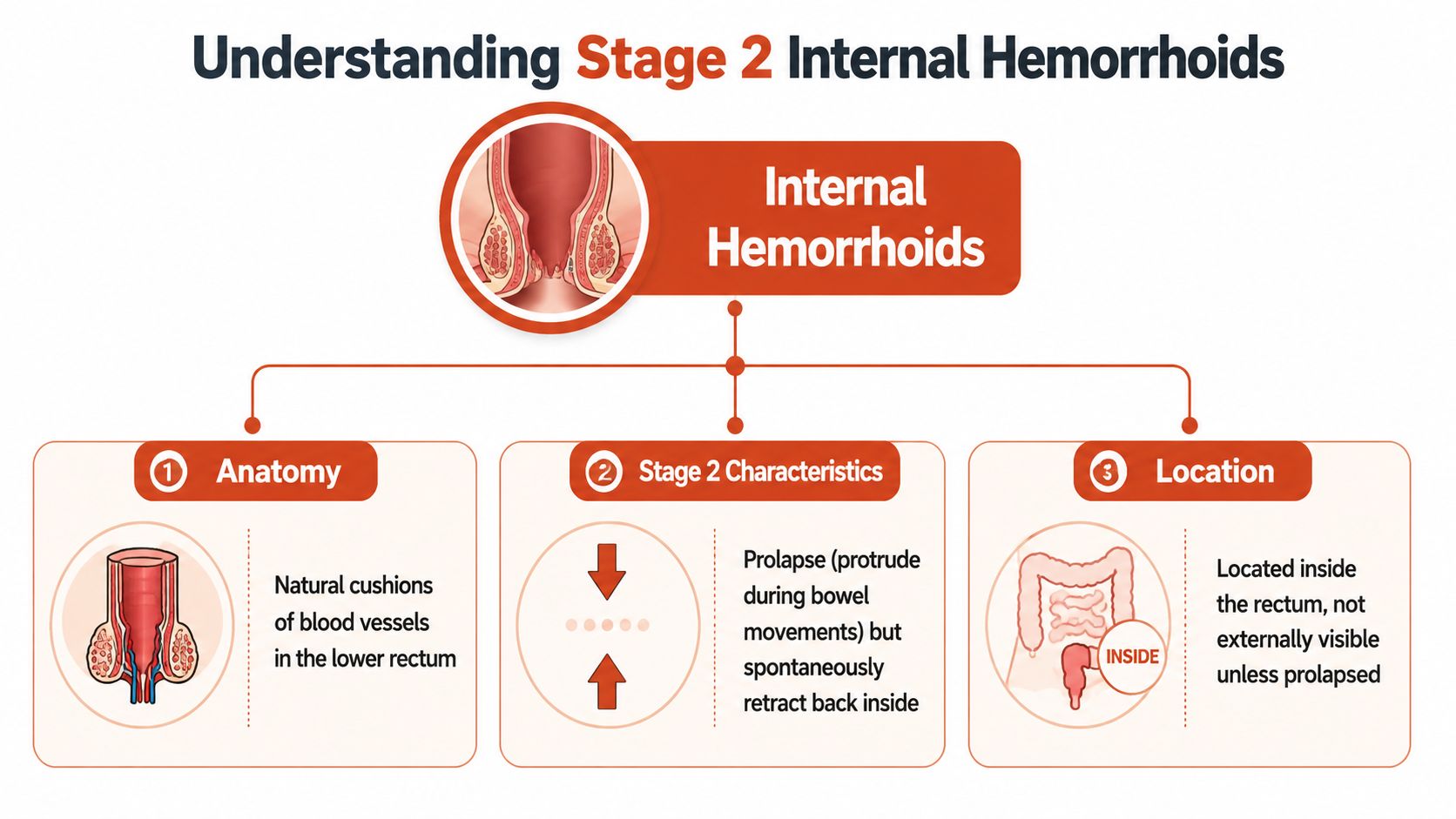
Internal hemorrhoids are normal vascular cushions inside the lower rectum. They become a problem when the tissue swells, gets irritated, and starts slipping downward during bowel movements. In stage 2, that tissue prolapses with straining but goes back inside without you having to push it back.
Doctors usually describe this using the Goligher classification. In that system, stage 2 internal hemorrhoids sit in the middle ground between mild disease that stays inside and more advanced disease that needs manual reduction or procedural treatment. That distinction matters because stage 2 is often the point where patients need to decide whether to keep working on home care or schedule an office or telehealth visit to discuss prescription treatment or a procedure. A practical overview of the hemorrhoid grading system shows how this staging guides treatment choices.
How stage 2 feels in real life
Patients rarely walk in and say, “I have grade II hemorrhoids.” They usually describe bleeding with bowel movements, a feeling that something briefly came down, or pressure that settles once they stand up or finish in the bathroom.
The key feature is temporary prolapse with spontaneous reduction. The tissue comes down during straining, then returns inside on its own. You do not need to push it back in. If you do, that points more toward stage 3.
Here is the practical difference between grades:
| Grade | What happens |
|---|---|
| Grade I | No prolapse outside the rectum |
| Grade II | Prolapse with straining, then goes back in on its own |
| Grade III | Prolapse that must be pushed back in manually |
| Grade IV | Prolapse that stays out |
If you want a clearer comparison of anatomy and symptoms, this guide on the difference between internal and external hemorrhoids explains where each type forms and how they usually feel.
Why this stage matters
Stage 2 is the point where treatment decisions become more useful and more time-sensitive. Early hemorrhoids can settle with better stool consistency, less straining, and more disciplined bathroom habits. Once prolapse starts recurring, repeating the same home routine for months often leads to the same cycle of brief improvement followed by another flare.
In practice, this is the intervention window. If symptoms are mild, happening only occasionally, and clearly improving with fiber, hydration, and avoiding prolonged toilet sitting, home care is reasonable. If bleeding or prolapse keeps returning, if the symptoms are disrupting daily life, or if you are unsure whether this is really hemorrhoids, it is smart to move up to a telehealth or in-person evaluation instead of waiting for it to become harder to control. With Bummed, you are able to connect to a licensed medical provider who specializes in anorectal care. If appropriate, they may prescribe you for a custom compounded cream featuring multiple active ingredients clinically proven to heal hemorrhoids and fissures, such as our Rapid Relief Hemorrhoid & Fissure Rx Cream or our Long-Acting Hemorrhoid & Fissure Rx Cream.
That is the key value of recognizing stage 2 correctly. It helps you choose the next step with more confidence, and it often gives you a chance to get control before the problem progresses.
Key Symptoms and Common Triggers
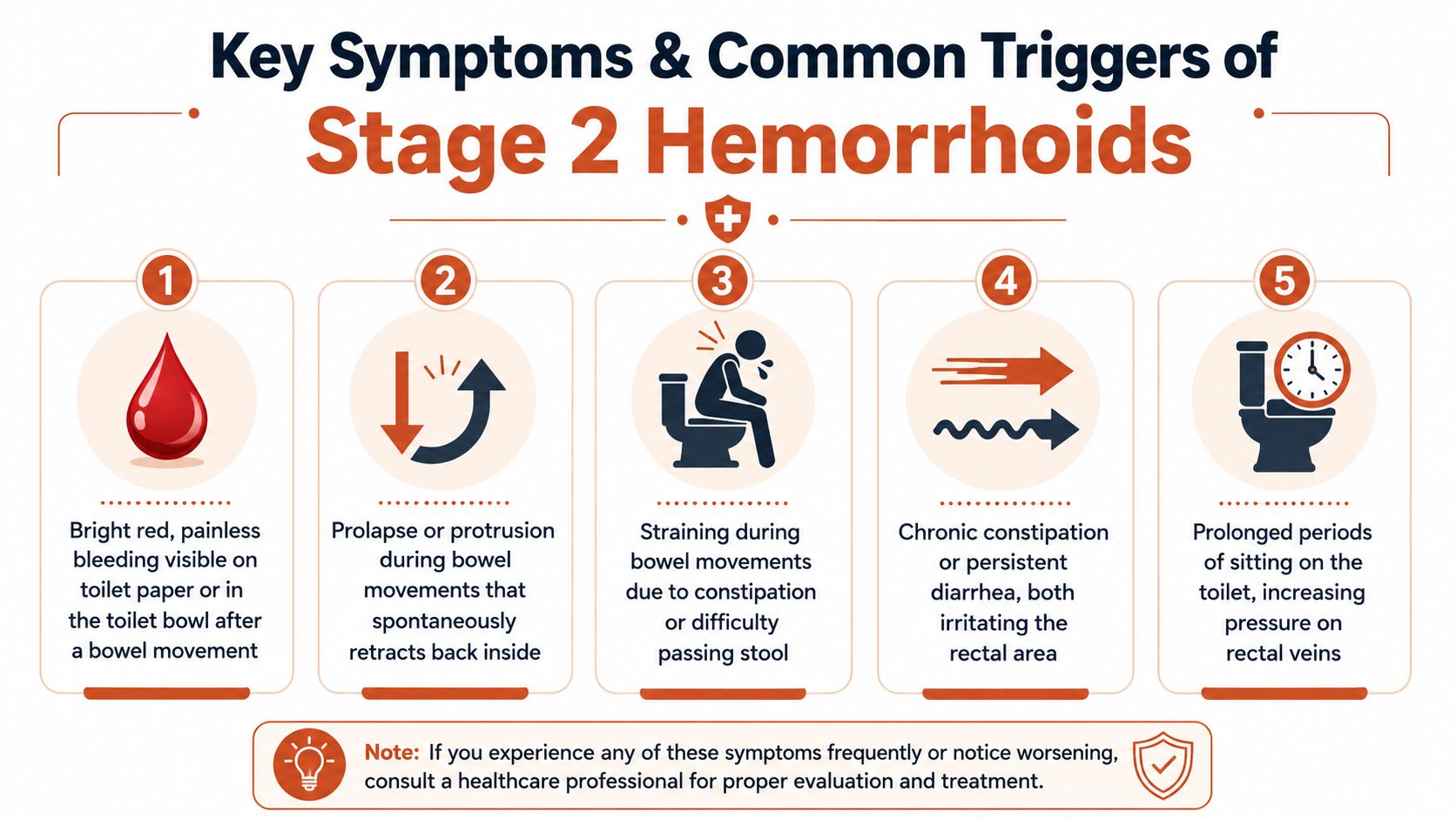
The classic symptom pattern is straightforward. Internal hemorrhoids usually cause painless bright red bleeding. People often notice it on toilet paper, on the stool, or in the bowl after a bowel movement. That's the symptom we hear about most often.
Stage 2 adds another clue. There may be a soft bulge or protrusion during a bowel movement that goes back in on its own. Some people don't describe it as a bulge at all. They describe pressure, fullness, or a sensation that something briefly “came down.”
Symptoms people often notice
Not everyone has every symptom. The most useful pattern is a combination of bleeding plus intermittent prolapse.
Painless bleeding that's bright red and tied to bowel movements
Temporary prolapse that appears with straining and retracts on its own
Fullness or pressure in the rectal area
Itching or irritation around the anus
Mucus or minor seepage in some cases
Bleeding without pain points toward internal hemorrhoids more than external hemorrhoids, but bleeding should never be self-diagnosed forever.
If constipation is part of the picture, this guide on whether constipation can cause rectal bleeding may answer a few of the most common questions.
Triggers that make stage 2 worse
Symptoms usually flare because pressure keeps building in the same area. Several habits and conditions can push stage 2 hemorrhoids from occasional to repetitive.
Straining on the toilet makes prolapse and bleeding more likely.
Constipation leads to harder stool and more forceful bowel movements.
Persistent diarrhea can also irritate the rectal tissue.
Long toilet sitting increases pressure on the hemorrhoidal cushions.
Heavy lifting can worsen pressure in people already prone to prolapse.
Pregnancy and postpartum recovery can bring on or worsen hemorrhoid symptoms.
GLP-1 related constipation can trigger the same cycle of hard stool and straining in adults using these medications.
A common pattern looks like this: stool becomes harder, you push more, bleeding appears, things calm down for a few days, and then the next difficult bowel movement starts it again. That cycle is the main reason stage 2 often needs more than sporadic treatment.
How Stage 2 Hemorrhoids Are Diagnosed
You notice bright red blood after a bowel movement, and something seems to bulge out briefly but slips back in on its own. That pattern is often the point where diagnosis matters most, because stage 2 is the window where good conservative care may still work, but missed warning signs can delay the right treatment.
A clinician starts with the story. The details matter. Bleeding with bowel movements, temporary prolapse that reduces on its own, how often symptoms happen, whether there is pain, and what your bowel habits look like all help separate stage 2 internal hemorrhoids from fissures, external hemorrhoids, or problems that need a different workup.
What a provider looks for
Diagnosis is not based on symptoms alone forever. Internal hemorrhoids are common, and many people have them without realizing it, so a symptom pattern can point in the right direction without proving the whole diagnosis.
A proper in-office evaluation may include:
Visual inspection of the anal area
A digital rectal exam when it makes sense clinically
Anoscopy or another office exam to confirm internal hemorrhoids and assess prolapse
In practice, the exam is usually quick. It also helps determine the decision patients often want answered right away: is this something to keep treating at home, or is it time for prescription treatment or an office procedure?
When telehealth fits, and when it does not
Telehealth can be a reasonable starting point if the symptoms are classic and there are no red flags. That usually means recurrent bright red bleeding with bowel movements, mild irritation or pressure, and tissue that comes out only during straining and goes back in by itself. In that setting, history matters a lot, and a careful online intake can help a licensed provider decide whether initial treatment is appropriate.
If you are unsure which specialist is best for an exam or office treatment, this guide on what doctor deals with hemorrhoids explains who typically handles hemorrhoid care.
Telehealth is not the right endpoint if bleeding is heavy, symptoms are worsening, pain is significant, you feel a persistent lump that does not reduce, or the history is not typical for hemorrhoids. Those cases deserve an in-person exam.
A prescription can also be part of diagnosis-based treatment when the presentation fits. One example is Bummed's Long-Acting Hemorrhoid & Fissure Rx Cream, which contains diltiazem and may be used in selected patients when a clinician thinks prescription support makes sense.
A Complete Guide to Treatment Options
A typical stage 2 hemorrhoid problem goes like this. Bleeding improves for a few days, then returns after constipation, travel, or a long stretch of sitting on the toilet. That pattern matters because stage 2 is often the window where simple measures still work, but repeated flares can also signal that it is time to step up treatment instead of restarting the same plan. Bummed's formulations are general safe for long-term use for those experiencing this pattern.
Treatment usually works best in stages. Correct the bowel pattern first. Add prescription treatment if symptoms keep coming back or there is associated spasm or fissure-type irritation. Move to an office procedure if bleeding or prolapse continues despite doing the basics well.
Start with the basics and do them consistently
Stage 2 hemorrhoids often settle down if bowel movements become softer and straining drops. In practice, the problem is consistency. Good habits for two days will not offset repeated constipation or ten-minute toilet sessions later in the week.
The home plan is straightforward:
Fiber plus water helps produce stools that pass with less pressure.
Short toilet time reduces venous swelling from prolonged sitting and straining.
Sitz baths can calm burning or irritation after bowel movements.
Going when the urge comes helps prevent stool from drying out and becoming harder to pass.
If fiber intake is low, use a plan you can maintain. This guide to getting more fiber is a practical place to start, and our hemorrhoid prevention strategies explain the daily habits that lower the chance of another flare.
When prescriptions make sense
Prescription treatment is reasonable when symptoms are recurring even though bowel habits have improved, or when the story includes anal spasm, fissure-type pain, or persistent irritation that simple over-the-counter products have not settled.
Nitroglycerin, diltiazem, or nifedipine may be appropriate in selected patients, depending on symptoms, medical history, and whether there are signs that a fissure is contributing to the flare.
One popular telehealth option is Bummed's Long-Acting Hemorrhoid & Fissure Rx Cream featuring diltiazem, or Bummed's Rapid Relief Hemorrhoid & Fissure Rx Cream, featuring nitroglycerin, depending on the treatment plan a physician determines is appropriate after consultation. The choice depends on the history you provide and whether a provider believes a prescription fits your symptoms.
When to move to an office procedure
Many patients stay in home-treatment mode too long. If bleeding keeps happening, tissue repeatedly protrudes with bowel movements, or symptoms improve only briefly before returning, an office procedure becomes a practical next step.
The American Society of Colon and Rectal Surgeons states that most patients with symptomatic grade I to II hemorrhoids can be treated effectively with office procedures, and identifies rubber band ligation as the most effective office-based treatment, with a strong recommendation based on moderate-quality evidence in the 2024 ASCRS hemorrhoid management guidance.
Other office options include infrared coagulation and sclerotherapy. For stage 2 disease, rubber band ligation usually gets the most support when conservative care has been done consistently and still has not solved the problem.
Making the treatment decision
The key question is usually simple. Are you still in the range where home care has a fair chance, or have your symptoms shown that you need more than home care?
Use this framework:
| Situation | Usually reasonable next step |
|---|---|
| First flare, mild bleeding, occasional symptoms | Home care and bowel habit correction |
| Repeated flares despite consistent home care | Prescription treatment or office consultation |
| Frequent bleeding or recurrent prolapse | Office-based procedure, often banding |
| Persistent prolapse or more advanced disease | In-person specialist evaluation |
The trade-off is practical. Home care is low risk and often enough early on, but it requires consistency and patience. Office procedures are more direct and often more effective for recurring stage 2 symptoms, but they involve an exam and a procedure visit. Specialists can often take months to get an appointment. Surgery is usually reserved for more advanced or stubborn disease because recovery is harder, and stage 2 internal hemorrhoids usually do not need that as a first step.
How to Prevent Hemorrhoid Flare-Ups
A common stage 2 pattern goes like this. Bleeding settles, you feel better for a week or two, then one constipated day or one long stretch of sitting on the toilet brings the symptoms back. Prevention matters because stage 2 hemorrhoids sit in a useful intervention window. Good bowel habits can keep many flare-ups under control, but repeated symptoms often mean it is time to stop relying on prevention alone. At Bummed, if you are prone to recurrences, we recommend keeping our creams on hand, if a medical provider has prescribed them for you.
The main goal is simple. Reduce pressure on the hemorrhoidal tissue day after day, not just during a flare.
Build a bowel routine that protects the area
The patients who do best usually make a few boring changes and stick with them.
Go when the urge is there instead of holding bowel movements for later.
Keep toilet time brief. If nothing is happening after a few minutes, get up and try again later.
Do not strain to finish. Straining is one of the fastest ways to trigger bleeding and prolapse.
Use a footstool if it helps straighten your anorectal angle and reduce pushing.
Walk most days because regular movement often improves stool consistency and bowel regularity.
Diet is part of prevention, but the plan has to be realistic. Add fiber gradually, drink enough fluid for that fiber to work, and choose foods you will continue to eat. This guide to getting more fiber is a practical place to start.
Know when prevention is enough and when it is not
This is the part many articles skip. Prevention is appropriate when symptoms are occasional, mild, and clearly tied to a trigger like travel, constipation, or a short lapse in routine. It is less useful when bleeding keeps returning, prolapse happens often, or you have already been consistent with fiber, fluids, and better toilet habits.
If home measures stop the flare and keep it away, stay with them. If symptoms keep cycling back, the better next step is often a telehealth prescription, office evaluation, or procedure discussion rather than another month of trying the same routine.
Recurrent bleeding deserves a plan.
For more day-to-day habit changes, this article on how to prevent hemorrhoids covers practical ways to lower flare risk.
Pregnancy, postpartum recovery, and constipation linked to GLP-1 medications need earlier attention. In those settings, preventing strain from the start is often more effective than waiting for bleeding or prolapse to become a pattern.
Frequently Asked Questions about Stage 2 Hemorrhoids
Can stage 2 internal hemorrhoids go away on their own
A flare can settle down, especially if constipation and straining improve. But the tendency to flare often remains unless you change the bowel habits that triggered it. If bleeding or prolapse keeps coming back, it's reasonable to get evaluated instead of assuming it will keep resolving on its own.
Do stage 2 hemorrhoids usually need surgery
Usually not. Stage 2 hemorrhoids are in the range where non-surgical treatment is often effective. That may include home care, prescriptions, or office-based procedures. Surgery is generally reserved for more advanced or more stubborn cases.
What is the hallmark symptom of stage 2 internal hemorrhoids
The pattern most strongly associated with internal hemorrhoids is painless bright red bleeding. Stage 2 also includes prolapse during straining or a bowel movement that retracts without manual help.
How do we know it's stage 2 and not stage 3
The key difference is what happens after the tissue protrudes. In stage 2, it goes back inside on its own. In stage 3, you have to push it back in manually. That detail often changes the treatment conversation.
How long should we try home treatment before seeking more help
There isn't one fixed timeline that applies to everyone. The practical questions are whether the bleeding is recurring, whether prolapse is happening repeatedly, and whether symptoms are disrupting daily life. If you're repeating the same home routine and the hemorrhoid keeps returning, that's a good reason to talk with a provider. We recommend starting with the providers at Bummed who specialize in anorectal health.
When should we seek immediate or in-person care
Some symptoms need prompt evaluation and should not be managed as routine hemorrhoids alone.
Seek urgent or in-person care if you have:
Heavy bleeding
Severe pain
A prolapse that does not go back in
Black stools
Symptoms that don't fit the usual pattern
Rectal bleeding isn't always caused by hemorrhoids. A provider should evaluate unusual, worsening, or persistent symptoms.
Can telehealth help with stage 2 internal hemorrhoids
It can, when the symptom pattern is typical and there are no red flags. A detailed online intake can help a physician decide whether prescription treatment is appropriate or whether you need an in-person exam instead. Telehealth is especially useful for adults who want faster guidance, privacy, and a clear next step.
Important Disclaimers
Bummed content is for general education and should never replace professional medical advice that considers your individual health. If you think you're experiencing a medical emergency, call 911 or head to the nearest emergency department.
Prescription products require an online consultation with a physician who will determine if a prescription is appropriate.
If you want a discreet next step, Bummed offers anorectal telehealth care for adults, including online evaluation for hemorrhoid symptoms and prescription treatment when appropriate.