


A flare starts, you reach for the cream that helped last time, and for a few days it seems like the problem is fading. Then a week later, or a month later, the itching, swelling, pressure, or bleeding returns. That cycle is exhausting, and it often leaves people asking the same question: why do hemorrhoids keep coming back when they were already “treated”?
The short answer is that hemorrhoids usually return when the pressure and blood flow problems that caused them in the first place never fully changed. The symptoms may calm down, but the setup for another flare is still there. In our experience, the repeat triggers are usually some combination of constipation, straining, and too much sitting.
The good news is that recurring hemorrhoids are not random. They usually follow a pattern. Once you learn your pattern, you can stop treating every flare like a surprise and start building a plan that lowers the chance of another one.
That Familiar Frustration When Hemorrhoids Return
You finally feel normal again. Sitting is easier. The burning has settled down. You stop thinking about your hemorrhoids every time you go to the bathroom.
Then a busy week happens.
Maybe you travel, eat differently, get constipated, sit through long meetings, or ignore the urge to go because you’re rushing. Suddenly the same familiar symptoms are back. Many adults go through this exact pattern, and it can feel confusing because the flare seems to come “out of nowhere.” Usually, it didn’t.
Recurring hemorrhoids often behave less like a one-time injury and more like a condition that reactivates when the same triggers return. One common example is the person who feels better after using a cream, but never fixes the constipation underneath it. Another is the desk worker who gets mild relief, then spends long hours sitting and flares again. A third is the person who keeps pushing during bowel movements because the stool is hard and slow to pass.
Main idea: A recurring flare usually means the symptom improved, but the pressure pattern behind it did not.
That distinction matters. It changes the question from “Why is this treatment failing?” to “What keeps loading stress onto these veins?”
There’s also an emotional side to this. People often blame themselves for not eating perfectly or for needing treatment again. We don’t think that’s helpful. A better approach is to treat recurrence like a puzzle with clues. Your stool pattern, your sitting time, your toilet habits, your medications, your age, and your daily routine all matter.
Once you identify the trigger, prevention gets much more specific. That’s when the cycle starts to break.
The Vicious Cycle of Recurring Hemorrhoids
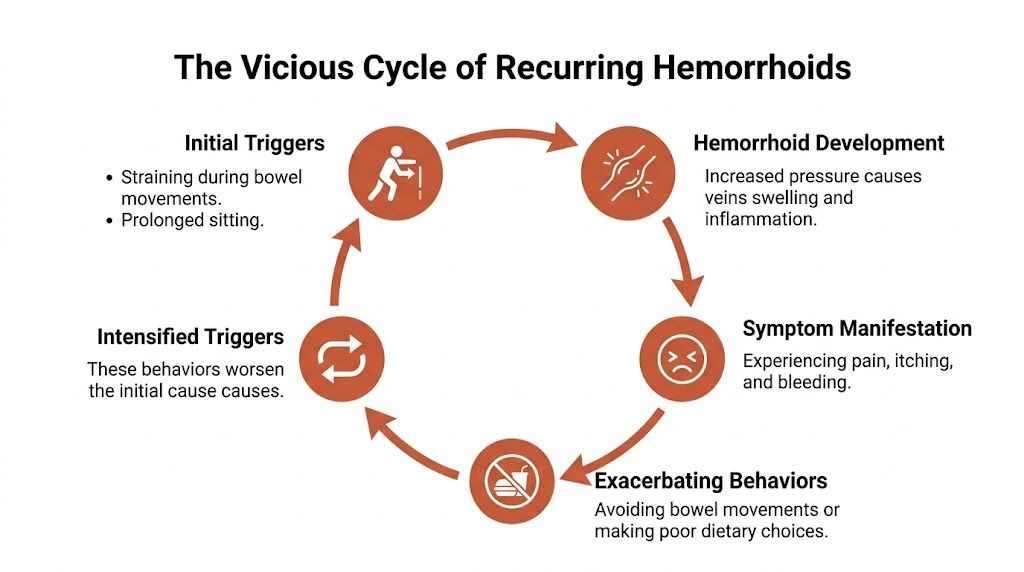
A recurring hemorrhoid flare usually follows a familiar pattern. Symptoms calm down, daily life resumes, then one stretch of constipation, a few long days of sitting, or repeated straining loads pressure back onto the same tissue.
Hemorrhoids involve the blood vessels and supporting tissue inside the anal canal. The National Institute of Diabetes and Digestive and Kidney Diseases describes hemorrhoids as swollen, inflamed veins in the anus or lower rectum. That helps explain why recurrence is so common. Veins work like crowded highways. If pressure keeps forcing traffic into the same lane, congestion returns.
Why hemorrhoids behave like backed up veins
The first driver is pressure. Straining during bowel movements, hard stool, sitting for long periods, and heavy lifting can all raise pressure in the veins around the rectum and anus. Recurrence is common when treatment calms the flare but does not address the abnormal blood flow and pressure affecting those veins in the first place.
That is why symptom-chasing often backfires. A cream may reduce burning or itching. A sitz bath may settle irritation. Even a flare that seems to disappear can leave the same pressure pattern untouched. Then the next constipation episode, travel week, desk marathon, or gym strain recreates the same problem.
If bleeding is part of the pattern, it helps to understand when constipation can cause rectal bleeding and when bleeding needs medical evaluation.
A lot of patients get stuck here because they ask, “Why did it come back if it got better last time?” The answer is usually mechanical, not mysterious. The swelling went down, but the force that caused the swelling kept showing up.
Why age can change the pattern
The second driver is support. Hemorrhoidal tissue is not just a vein. It is also a cushion held in place by connective tissue. Over time, that support can weaken, so the tissue is more likely to bulge, prolapse, and get irritated again when pressure rises.
Recurrence is not always about doing one thing “wrong.” Sometimes the same amount of straining that caused mild trouble years ago now causes a more noticeable flare because the tissue has less structural support than it used to.
A simple comparison helps. If pressure is the traffic jam, support tissue is the guardrail. When both are stressed, symptoms return more easily.
Recurring hemorrhoids often act like a road that keeps flooding. You can mop up the water each time, but if the drainage problem stays the same, the flooding comes back.
That is the cycle to break. Relief matters, but long-term control comes from identifying which force keeps reloading pressure onto your hemorrhoids. For one person it is hard stool. For another it is toilet straining. For another it is hours of sitting with very little movement. Once you stop chasing only the symptom and start tracing the pattern behind it, prevention gets much more specific.
Pinpointing Your Personal Hemorrhoid Triggers
A flare often feels random when you are living through it. In clinic, though, a pattern usually shows up. The key is to stop asking only, “How do I calm this down today?” and start asking, “What keeps loading pressure onto these veins in my case?”
That shift matters because hemorrhoids rarely return for exactly the same reason in every person. Veins in the rectal area work like crowded highways. When traffic backs up again and again, swelling returns. For one person, the traffic jam starts with hard stool. For another, it starts with long sitting. For someone else, it is repeated straining, even if they think the pushing is mild.
A simple symptom journal can help. Track bowel movements each week, stool texture, time spent on the toilet, and whether symptoms show up after travel, work marathons, or skipped meals.

Constipation and hard stools
Constipation is often the clearest trigger, but it is easy to miss because people define it too narrowly. You can have a bowel movement every day and still be constipated if the stool is hard, dry, small, or difficult to pass. From a colorectal standpoint, stool quality matters as much as frequency.
Hard stool changes the mechanics of the whole trip through the anal canal. It stretches tissue, increases friction, and invites pushing. If that sounds familiar, it helps to work on bowel movement quality, not just “going more often.” This guide on improving gut motility and bowel regularity can help you sort out that pattern.
A useful question is: after I go, do I feel finished, or do I feel like I had to force it and still did not empty well? That answer tells you a lot.
Long sitting and venous pooling
Sitting for hours does not create hemorrhoids from nothing, but it can keep pressure parked in one place. The body likes movement. When your day is mostly chair, car, couch, and toilet, blood flow can become more sluggish and symptoms may build gradually.
This is one reason people get confused. They expect a flare to come from one dramatic event. In reality, some flares are built gradually through repetition. A week of deadlines, long commutes, and very little walking can irritate the area enough to set off bleeding, swelling, or itching.
Look for timing clues:
-
Workday pattern: Do symptoms show up after long desk days?
-
Travel pattern: Do car rides or flights seem to trigger irritation?
-
Toilet pattern: Do you stay seated longer than needed because you are reading or scrolling?
-
Weekend pattern: Do flares follow stretches of inactivity?
Straining and toilet habits
Straining is the trigger people recognize fastest, but many still underestimate how often they do it. Repeated “small pushes” count. So does sitting on the toilet waiting for something to happen. Each episode raises pressure on tissue that is already prone to swelling.
The body usually gives a clear signal here. If a bowel movement feels like work, pressure is part of the problem.
Try to identify your version of straining. Is it pushing against hard stool? Rushing because you are late? Sitting too long because you do not feel done? Ignoring the urge earlier, then forcing it later? Those are different problems, and they need different fixes.
That is the part many articles skip. “Eat more fiber” is useful advice, but it is incomplete if fiber is not your main issue. If your real trigger is 20 extra minutes on the toilet with your phone, or ten hours of sitting with no walking breaks, your prevention plan becomes more precise only when you name that trigger clearly.
Why symptom relief feels convincing
There’s a very human reason people rely on topicals. Hemorrhoid symptoms are immediate and distracting. When something burns or bleeds, it’s natural to want the fastest possible relief. They generally don’t think first about venous pressure or stool mechanics. They think, “How do I make this stop today?”
That instinct makes sense. It just doesn’t solve recurrence.
The Gastroenterology Medical Clinic article on recurring hemorrhoids notes that patients often default to topical treatments for temporary relief without addressing root causes like diet, straining, or prolonged sitting. It also highlights that effective management requires identifying personal triggers and tailoring lifestyle changes.
What creams can do and what they can’t
Here’s the cleanest way to understand this:
-
What topicals can do: Soothe inflamed tissue, reduce discomfort, and make healing periods easier.
-
What topicals can’t do: Fix constipation, stop repeated straining, or reverse the daily pressure pattern that keeps veins swelling.
-
Where they fit best: As one tool inside a broader plan.
For some adults, a prescription option can be a better short-term tool than a random over-the-counter mix, especially when symptoms are more stubborn. If you’re comparing options, it helps to understand how prescription cream for hemorrhoids and fissures that actually works fits into a larger care plan.
Temporary relief is useful. Mistaking it for prevention is what keeps the cycle going.
The goal isn’t to stop using symptom relief when you need it. The goal is to stop expecting symptom relief to do a job it was never designed to do.
Building Your Long-Term Prevention and Management Plan
A long-term plan works best when it matches the pattern behind your flare-ups.
That sounds obvious, but many people do the opposite. They wait for pain or itching, treat the symptom, feel better, then slide back into the same bathroom habits, work posture, or eating pattern that irritated the hemorrhoids in the first place. It is a little like resetting a smoke alarm without looking for the source of the smoke. Relief matters. Pattern recognition prevents repeat episodes.
A useful plan starts with one question: What usually happens in the day or two before your symptoms return? For some people, the answer is hard stool and straining. For others, it is long stretches of sitting, heavy lifting, frequent diarrhea, or repeated toilet sessions with a phone in hand. Hemorrhoid veins work like crowded highways. The more pressure they face, and the longer that pressure lasts, the more likely they are to swell again.
Build around your main trigger
Start by tracking your own pattern for two to three weeks. Keep it simple. Write down bowel movements, stool consistency, time spent on the toilet, sitting time, exercise, and any bleeding, itching, or swelling. The goal is not perfection. The goal is to catch your personal sequence.
Once you see the pattern, match the fix to the trigger.
| Primary Trigger | What is usually happening | Best first response |
|---|---|---|
| Hard stool or skipped bowel movements | More pressure is needed to pass stool | Focus on stool softness, hydration, regular timing, and fiber you can stick with |
| Straining even with daily bowel movements | Toilet posture or rushing is working against you | Use a footstool, avoid forcing, and leave if nothing is happening after a few minutes |
| Long workdays sitting | Rectal veins stay under pressure too long | Stand up regularly, walk briefly, and shorten unnecessary toilet sitting |
| Travel, stress, or routine changes | Your bowel pattern becomes less predictable | Create a backup routine before symptoms start |
| Frequent loose stool or irritation | Repeated wiping and inflammation keep tissue sensitive | Address the cause of diarrhea and reduce friction |
Aim for easy passage, not just “more fiber”
Many patients hear “eat more fiber” so often that the advice loses meaning. A better target is stool that comes out without a fight. Fiber helps because it can hold water in the stool and make bowel movements more predictable, but the right amount and form vary from person to person.
Food first works well for some adults. Others do better with a consistent supplement because it is easier to repeat than a perfect diet every day. If constipation tends to show up during travel, stressful weeks, or medication changes, take note and try to stick to your routine around fluids, supplements, etc.
Three habits matter more than people expect:
-
Go when your body signals. Repeatedly delaying a bowel movement often leads to drier, harder stool later.
-
Drink fluids consistently. Fiber without enough fluid can leave stool harder, not softer.
-
Watch effort, not just frequency. A daily bowel movement still counts as a problem if every trip involves pushing.
Reduce pressure during the parts of the day that add up
The toilet is one pressure point. Your chair is another.
If you sit for work, set a timer to stand and walk for a minute or two at regular intervals. That small break changes the pressure pattern on the veins around the rectum. In the bathroom, keep sessions short. A footstool can help straighten the anorectal angle so stool passes more easily, and leaving your phone outside removes one of the biggest reasons people stay seated too long.
A simple rule helps here: if stool is not coming out with gentle effort, stop trying and come back later.
Make the plan realistic enough to survive a bad week
Many prevention plans fail because people create an ideal routine for calm weeks, then lose it during deadlines, travel, illness, or family stress. Your plan needs a “messy life” version.
Pick one anchor habit in each category. One for bowel regularity. One for movement. One for toilet habits. For example: take fiber with breakfast, walk for five minutes after lunch, and limit toilet time to a few minutes. A small plan you repeat beats an ambitious one you abandon.
If symptoms start breaking through despite these changes, or if you are seeing bleeding and are not sure whether it is really from hemorrhoids, it helps to review when hemorrhoid symptoms mean it is time to seek in-person care.
Long-term control usually comes from matching the routine to your trigger, then repeating it often enough that your veins get a break from the same old pressure cycle.
When to Consider Advanced Treatment Options
A common pattern looks like this. You clean up your routine, the flare settles down, then the bleeding or swelling keeps returning anyway. At that point, the question changes from “What cream should I try next?” to “Is the tissue itself now part of the problem?”

When home strategies aren’t enough
Hemorrhoids are veins and supporting tissue that have been under repeated pressure. Veins work like highways. If one stretch keeps getting backed up, you can lower traffic, but sometimes that section has already stretched and weakened enough that it keeps causing trouble. That is when office treatment or surgery may help.
A clinician may suggest an office procedure such as rubber band ligation or infrared coagulation for internal hemorrhoids. Larger external hemorrhoids, frequent prolapse, or symptoms that keep disrupting daily life may push the conversation toward surgery.
The key idea is simple. A procedure can remove or shrink the tissue causing today’s symptoms. It does not erase the pattern that irritated that tissue in the first place.
That matters because many people fall into symptom-chasing. They treat each flare as a one-off event, feel better for a while, then get blindsided when it returns. Better results usually come from pairing treatment with a very specific question: what keeps reloading pressure onto your veins? For one person it is straining against hard stool. For another it is long sitting, heavy lifting, repeated diarrhea, or pregnancy-related pressure. The treatment choice helps more when you also name your trigger clearly.
If you are still bleeding, having prolapse, or dealing with repeated flares despite a solid prevention plan, it is reasonable to ask a colorectal specialist or other qualified clinician whether the next step should target the tissue directly. If you are not even sure the bleeding is from hemorrhoids, review when it’s time to seek in-person care for hemorrhoids.
Red flags that deserve prompt care
Some symptoms need medical evaluation sooner rather than later:
-
Heavy bleeding, especially more than light spotting
-
Severe or rapidly worsening pain
-
A new lump or a lump that is changing
-
Bleeding or bowel changes that do not match your usual flare pattern
-
Symptoms that keep returning after treatment without a clear explanation
Advanced treatment can be the right next step. It works best as part of a personalized plan that matches the procedure to the hemorrhoid type and matches prevention to your real trigger pattern.
Frequently Asked Questions About Recurring Hemorrhoids
Can constipation from GLP-1 medications trigger hemorrhoids
Yes. If a GLP-1 medication slows your bowels and stool sits longer in the colon, more water gets pulled out of it. The result is harder stool, more pushing, and more pressure on the hemorrhoidal veins. Veins here work like crowded exit ramps. The more traffic backs up, the more swelling and irritation you feel.
The trap is symptom-chasing. Many people wait until there is pain, itching, or bleeding, then treat the flare instead of the slowdown that started it. A better approach is to notice your personal pattern early. Are you skipping the urge to go, drinking less, eating differently, or pushing harder since starting the medication? That answer matters more than a generic tip sheet.
How long can you use prescription hemorrhoid cream
Use it exactly as your provider prescribed. That matters because some creams are meant to calm a short flare, while others need closer supervision based on their ingredients and your skin. Most of Bummed’s creams are safe for longer-term use.
If symptoms return every time you stop the cream, that usually means the medicine is quieting inflammation without changing the pressure problem underneath it. In plain terms, the cream can soothe the fire, but it does not remove the spark. If your flare pattern keeps repeating, ask a more specific question: what is still irritating the area. Hard stool, long toilet sitting, frequent diarrhea, heavy lifting, and prolonged sitting can each keep the cycle going.
Can hemorrhoids come back after banding or another procedure
Yes, they can.
A procedure treats the hemorrhoid tissue that is there now. It does not automatically stop the habits or pressures that irritated the tissue in the first place. If straining, stool inconsistency, prolonged sitting, or another trigger continues, the same area can get stressed again over time.
That does not mean the procedure failed. It means treatment and prevention do different jobs. One handles the swollen tissue. The other lowers the day-to-day pressure that keeps re-injuring those veins.
When should you seek care through telehealth or in person
Telehealth is often a good first step if you want help sorting out whether your symptoms sound more like hemorrhoids, a fissure, skin irritation, or constipation-related strain. It can also help if you need guidance on a flare that keeps following the same pattern and you want a plan that matches your trigger, not just your symptoms.
In-person care makes more sense if bleeding is more than light spotting, pain is severe, there is a new or changing lump, or your symptoms no longer match your usual flare pattern.
Recurring hemorrhoids can feel random, but they usually follow a pattern. Once you identify your pattern, pressure after hard stool, pressure from sitting, pressure from repeated irritation, prevention gets much more practical.
If you want a convenient next step, Bummed offers discreet telehealth care for hemorrhoids and related anorectal concerns. You can complete a brief online intake, have your symptoms reviewed by a board-certified provider, and, if appropriate, receive a custom prescription treatment shipped from a partner pharmacy.
Bummed content is for general education and should never replace professional medical advice that considers your individual health. If you think you’re experiencing a medical emergency, call 911 or head to the nearest emergency department.
Prescription products require an online consultation with a physician who will determine if a prescription is appropriate.