



Some people notice postpartum hemorrhoids the first time they sit down carefully after delivery. Others feel them during that first bowel movement, when everything already feels tender and the idea of pushing is the last thing they want. The mix of soreness, swelling, itching, and fear can make a very normal part of recovery feel isolating fast.
It also catches many adults off guard because nobody talks about it much. You may have expected bleeding, cramps, stitches, or general pelvic soreness. You may not have expected painful rectal swelling to become one of the hardest parts of the day. The good news is that postpartum hemorrhoids are common, treatable, and often improve with the right care.
The Postpartum Problem Nobody Talks About
Postpartum recovery is full of tasks that sound simple until your body reminds you it’s still healing. Sitting. Walking. Going to the bathroom. Laughing. Even shifting in bed can feel like a project when hemorrhoids join the list.
That can feel embarrassing, but it shouldn’t. Postpartum hemorrhoids are a highly common complication, occurring in about 40% of pregnant women and women in the postpartum period, with the most common timing in the third trimester and the first 1 to 2 days after delivery, according to a peer-reviewed review in Perianal Diseases in Pregnancy and After Childbirth. In other words, this isn’t unusual bad luck. It’s a very common part of pregnancy and postpartum healing.
Why this feels so disruptive
Hemorrhoids can seem small compared with everything else your body has been through. But the location matters. A small amount of swelling in that area can make basic daily functions feel sharp, burning, or heavy.
Many people also delay getting help because they assume they just have to wait it out. Some do improve with home care, and that’s reassuring. But you also deserve support if you’re uncomfortable now, like Bummed’s Sensitive Care Rx cream that contains soothing ingredients to help during recovery.
You are not overreacting if postpartum hemorrhoids are affecting how you sit, rest, or use the bathroom. This is a real recovery issue, not a cosmetic one.
What we want you to know first
A lot of confusion comes from not knowing what’s normal. Is the lump supposed to be there? Is bleeding expected? Is it okay to use creams if you’re breastfeeding? When should you stop trying home remedies and contact a provider?
Those questions matter. Clear answers can lower anxiety and help you act sooner, which usually means less straining, less irritation, and a smoother recovery.
What Causes Hemorrhoids After Birth
Postpartum hemorrhoids happen because the veins in and around the rectum have been under a lot of pressure, much like a traffic jam in a narrow area. Blood flow slows, pressure builds, and the veins swell.
That pressure can start during pregnancy and peak around labor and the early postpartum period. A major review of hemorrhoidal disease explains that pregnancy-related pressure, venous compression, and constipation-related straining are key drivers of hemorrhoids in this setting, which helps explain why symptoms often flare during and after birth rather than appearing out of nowhere later on in recovery, as described in this review of hemorrhoidal disease mechanisms.
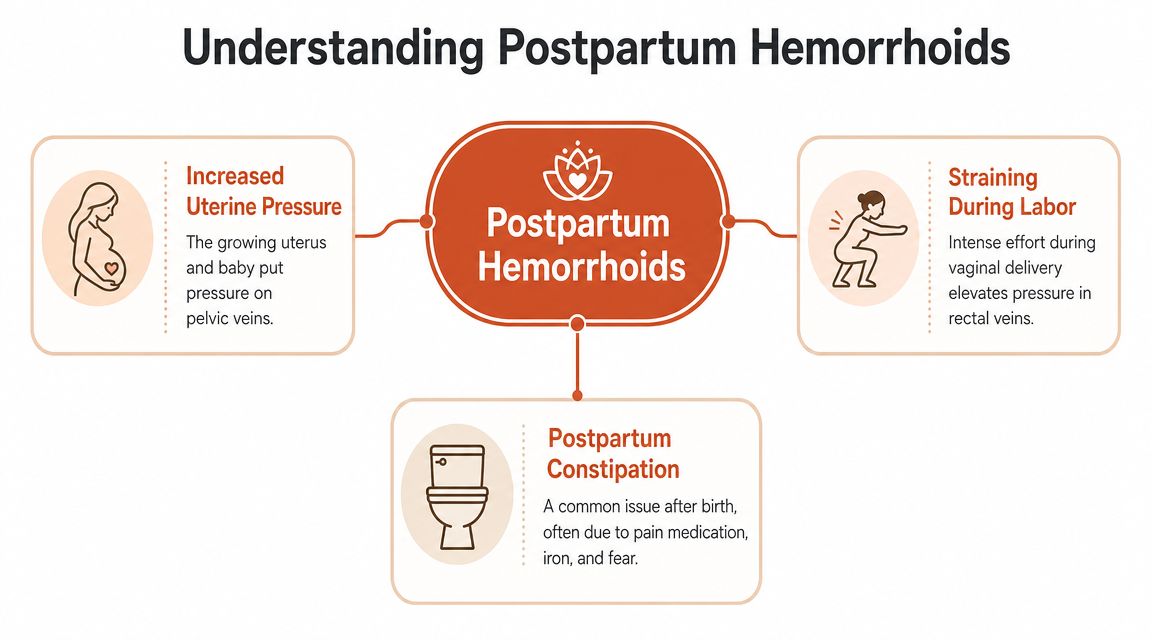
The main pressure points
Three things usually work together:
-
Pregnancy itself adds pressure. As the uterus grows, it can increase pressure in the pelvic area and affect venous return.
-
Pushing during labor can intensify that strain. A long period of bearing down can make already swollen veins bulge more.
-
Constipation after delivery keeps the cycle going. Hard stool and straining can irritate tissue that is already inflamed.
If you want more detail on the pregnancy side of this process, what causes hemorrhoids during pregnancy breaks down how pressure and constipation set this up before delivery even happens.
Some postpartum pain that looks like a hemorrhoid is actually a fissure, or the two occur together. If your pain feels sharper or more like tearing than pressure, our best treatment for anal fissure guide may be more relevant.
Internal and external hemorrhoids
People often get confused because not all hemorrhoids feel the same.
| Type | Where it is | What you may notice |
|---|---|---|
| Internal hemorrhoids | Inside the rectum | Bleeding, pressure, or tissue that seems to bulge during a bowel movement |
| External hemorrhoids | Under the skin around the anus | A tender lump, itching, swelling, soreness when sitting or wiping |
External hemorrhoids tend to get more attention because they’re easier to feel and can be quite painful. Internal hemorrhoids may be less painful at first but can still bleed or prolapse.
Why the first bowel movement can be so stressful
A lot of adults assume the hemorrhoid itself is the whole problem. Often, the bigger problem is what happens next. You’re sore, maybe dehydrated, maybe taking pain medication, and understandably nervous about straining. That can lead to holding stool longer, which makes it harder, which then makes the next bowel movement more painful.
Practical rule: the less you strain, the less pressure you keep putting on already swollen veins.
That’s why treatment usually starts with bowel support and swelling relief, not procedures.
How to Find Relief at Home
For many people, the first goal is simple. Get through the day with less pain and make bowel movements easier.
Home care is greatly enhanced when it includes options like telehealth, which can be particularly beneficial in addressing both calming swollen tissue and preventing constipation. Bummed offers same-day treatment through a private platform, with medication delivered directly to your door.
What usually helps most
Warm water is one of the simplest tools. A sitz bath or a shallow soak can relax the area and reduce irritation after bowel movements. Cold can help too. A wrapped ice pack or cold compress may temporarily numb pain and decrease swelling.
Witch hazel pads are another common option because they can feel soothing on irritated skin. Some adults also use over-the-counter topical creams for short-term comfort, especially when itching or burning is the main issue. For a full ingredient breakdown of OTC options, see our best hemorrhoid cream guide.
For a step-by-step fast-relief action plan, see how to shrink hemorrhoids fast. And for a full walkthrough of clean, correct application technique, see how to apply hemorrhoid cream.
The bowel movement part matters just as much
If stool stays hard, hemorrhoids keep getting re-irritated. That’s why the boring advice is often the most effective.
Try to build your routine around these basics:
-
Fiber from food helps soften stool and makes it easier to pass.
-
Water intake supports stool consistency, especially if you’ve been sweating, bleeding, or forgetting to drink enough while recovering.
-
Going when you feel the urge matters. Waiting can make stool drier and tougher to pass.
-
Less time on the toilet helps reduce pressure on rectal veins.
-
No straining if possible is the big one. Exhaling gently and letting things move without force is much easier on healing tissue.
Dr. Carmen Fong, Bummed’s Chief Medical Officer, teaches patients a simple rule that applies especially well postpartum: go when you have to go, and don’t go when you don’t. That means not ignoring the urge (delaying makes stool harder), not forcing it (straining adds pressure to already-swollen tissue), and not camping on the toilet (sitting longer than about 5 minutes increases pressure in the anal veins). If nothing happens after a few minutes, get up. Your body isn’t ready yet — that’s not failure, that’s good pelvic floor hygiene.
If You Haven’t Had a Bowel Movement in 3 to 5 Days
Postpartum bowel hesitancy is common, and it’s normal to need a nudge past the basics. A reasonable approach usually escalates in steps:
- Start with a stool softener or fiber. A stool softener like docusate can reduce strain and make passage easier without forcing anything.
- Try an osmotic laxative next, if needed. Something like polyethylene glycol (MiraLAX) draws water into the stool and supports a bowel movement without harsh stimulation.
- Save stimulant laxatives for last. These can cause cramping and generally shouldn’t be used regularly without provider guidance, especially while breastfeeding.
If none of these steps help within a few days, that’s a reasonable point to check in with a provider rather than continuing to wait it out.
Small adjustments that make a real difference
Sometimes comfort comes from reducing friction, not just treating inflammation.
-
Use gentle cleanup. Soft toilet paper, a peri bottle, or fragrance-free wipes can be less irritating than repeated dry wiping.
-
Change positions often. Long periods of sitting can worsen pressure and throbbing.
-
Choose soft support. A cushion or side-lying rest position may make downtime more tolerable.
-
Keep the area dry. Moisture and rubbing can make itching worse.
When a treatment stings, dries out the area, or makes you dread using it, stop and reassess. Relief should feel like relief.
When home care is enough and when it isn’t
A lot of postpartum hemorrhoids improve with conservative care. Many cases resolve within 6 to 12 weeks after delivery with conservative treatment, while symptoms that persist beyond about a month or are severe may warrant a consultation with a provider, as noted in this postpartum hemorrhoid guidance. If hemorrhoids haven’t improved after about 4 weeks of conservative care, minimally invasive treatment becomes a realistic option for a meaningful share of patients. Rubber band ligation, in particular, is a preferred first-line procedure for appropriate internal hemorrhoids, with strong symptom relief reported at one month. That doesn’t mean a procedure is the likely outcome — most postpartum hemorrhoids still resolve with conservative care — but it’s worth knowing what the next step looks like if home care and prescription topicals aren’t enough.
That timing matters because it helps separate normal healing from a problem that needs more support. Severe pain, significant bleeding, or tissue that keeps prolapsing should move you out of wait-and-see mode. A firm, intensely painful lump near the anus is often a thrombosed hemorrhoid — a blood clot that’s formed inside the tissue. It’s different from ordinary postpartum swelling and usually needs prompt medical attention to manage the pain, sometimes including a minor procedure.
Here’s a general sense of what that timeline tends to look like:
| Time After Birth | What to Expect |
|---|---|
| First 5 days | Usually the peak of discomfort — swelling and sensitivity are most intense as healing begins |
| First 2 weeks | Symptoms typically start improving — swelling decreases, pain becomes less constant |
| 6 to 12 weeks | Most hemorrhoids have fully resolved for most people |
| Beyond 12 weeks | Lingering discomfort at this point is worth a conversation with a provider |
Every recovery is different, but this gives you a general sense of what “normal” tends to look like.
Safe Medication Options While Breastfeeding
Many individuals often struggle at this point. They know hemorrhoids are common. They know they can try sitz baths, fiber, and witch hazel. But when symptoms are strong enough to need medication, the next question comes fast. What’s okay to use while breastfeeding?
That question deserves a careful answer, and unfortunately the guidance people find online is often broad. Flo notes a significant gap in postpartum-specific treatment nuance for breastfeeding and recovery-stage patients, especially around which topical options make sense and how to handle constipation when pain medication makes straining worse, as discussed in this overview of postpartum hemorrhoid treatment gaps.
The safest starting mindset
In general, local treatments applied to a small area are often easier to evaluate than medicines taken by mouth, because they act mainly where you use them. But “over the counter” does not automatically mean “the right fit for postpartum recovery.”
The practical way to think about topical products is to ask:
-
What symptom am I treating most. Pain, itching, swelling, or burning?
-
Is the skin intact or very irritated. Broken or highly inflamed skin may react differently.
-
How long am I planning to use this. Some ingredients are more appropriate for short-term use than longer courses.
-
Am I also constipated. If yes, a cream alone probably won’t solve the main trigger.
Common categories people ask about
For prescription-strength relief specifically, ingredient choice matters more than people expect. For breastfeeding mothers, nitroglycerin is generally avoided. Diltiazem is the ingredient we recommend instead in this setting, which is why Bummed’s Long-Acting Hemorrhoid & Fissure Rx Cream — formulated with diltiazem rather than nitroglycerin — is often the more appropriate prescription option during breastfeeding recovery. Nifedipine is another option we recommend for pregnancy or postpartum, found in Bummed’s Sensitive Care Hemorrhoid & Fissure Rx Cream.
Witch hazel is often used for soothing and cooling. Barrier-style ointments may reduce rubbing and irritation. Some adults ask about hydrocortisone-containing products for itching or inflammation, while others look for numbing ingredients for painful external hemorrhoids. For patients who need something more targeted, diltiazem and nifedipine are both prescription options often preferred over nitroglycerin during breastfeeding recovery.
Those choices can make sense in some situations, but postpartum care is rarely one-size-fits-all. If symptoms involve both internal and external irritation, or if constipation is driving the problem, the right plan may need more than one tool.
If you’re comparing options, pregnancy & breastfeeding safe hemorrhoid cream can help you understand how prescription topicals fit into the picture for adults who need a more specific approach.
The goal isn’t to collect more products. It’s to choose the fewest treatments that address the real problem safely.
Why expert guidance matters here
Breastfeeding safety is one concern. Tissue healing is another. So is practicality. A medication can be technically reasonable but still unhelpful if it burns, is hard to apply, or doesn’t address constipation that’s causing repeat flare-ups.
That’s why a provider’s guidance is useful when symptoms are lingering or your questions are specific. You shouldn’t have to guess your way through the pharmacy aisle while also recovering from birth.
If you want a reliable, ingredient-level reference for breastfeeding safety beyond general guidance, LactMed is the National Institutes of Health’s database specifically built for this — it’s a good starting point before you ask a provider follow-up questions.
One caution worth knowing: avoid self-treating postpartum hemorrhoid pain with ibuprofen, naproxen, or aspirin if bleeding is part of the picture, since these can intensify bleeding. Codeine-containing pain medications can also worsen constipation, which tends to aggravate hemorrhoids further. If pain relief and hemorrhoid symptoms are both part of your recovery, it’s worth asking your provider which combination makes sense for you.
If you’re weighing your full range of options, our best hemorrhoid medicine guide covers OTC-versus-prescription decisions in depth, and our hemorrhoid treatment guide walks through every stage if symptoms need to escalate further.
How to Apply Prescription Cream Correctly
If a provider prescribes a compounded cream, technique matters as much as the formula itself. The typical routine is a pea-sized amount applied inside the anus 3 to 4 times a day — many prescriptions include finger cots to make application cleaner and easier. Wash your hands first, clean the area gently with warm water, pat dry, and apply consistently rather than skipping doses when things feel better. Regular use tends to work better than using more product less often. For more, read this guide on how to apply hemorrhoid cream.
How Telehealth Provides Discreet Prescription Care
You finally get the baby down for a nap, then realize sitting still hurts, wiping burns, and the idea of packing up for another appointment feels impossible. That is a common point where telehealth can help. For postpartum hemorrhoids that are uncomfortable but not clearly dangerous, online care can fill the gap between home remedies and prescription treatment.
There are still situations that need in-person evaluation right away. Heavy bleeding, fever, pus, pain that feels severe or out of proportion, or a new hard, very painful lump should be assessed directly. Telehealth works best when the problem sounds straightforward and a clinician can safely guide the next step from your history.
When telehealth makes sense
A telehealth visit is often a good fit if your symptoms have not settled with basic care and you want a more specific plan without an office trip. Common examples include:
-
Itching or burning that keeps hanging on despite home treatment
-
External swelling or pain that flares with bowel movements
-
Questions about prescription creams during postpartum recovery
-
Concerns about breastfeeding safety
-
A strong preference for privacy with a symptom that can feel embarrassing to discuss face to face
What a telehealth visit can actually help with
A good online visit is more than a quick prescription request. If the picture fits uncomplicated hemorrhoids, telehealth may lead to a prescription treatment plan that is more targeted than trial-and-error shopping. It can also help you avoid using the wrong product for too long. For example, itching, swelling, and pain do not always respond to the same medication, and breastfeeding can affect which options feel most comfortable to use.
A screen cannot replace an exam when the diagnosis is uncertain. Honest telehealth care should say that clearly and redirect you to in-person care when needed.
Here’s what that can look like in practice, from a Bummed patient:
“Finally provided relief for my postpartum anal fissure after trying so many things!! After 3 months of pain, this ointment helped almost instantly. It came quickly and is breastfeeding friendly most importantly!”
Why discretion matters after birth
Postpartum recovery already asks a lot of you. Add soreness, bleeding, sleep deprivation, and the awkwardness of talking about anal pain, and it is easy to put this problem off. Telehealth lowers that barrier. You can answer questions from home, often on your own schedule, and get clear guidance without sitting in a waiting room with a newborn.
If you want to see how that process usually works, how to get prescribed through an online hemorrhoid visit walks through the steps. One option is a telehealth service focused on anorectal conditions that offers online intake reviewed by a board-certified provider, with prescription treatment if appropriate.
The best care plan is the one you can actually follow. For many postpartum patients, private access from home is what turns delayed care into treated care.
Frequently Asked Questions About Postpartum Hemorrhoids
How do I know if I have postpartum hemorrhoids
Common clues include itching, burning, soreness, bright red blood on toilet tissue, or a tender lump near the anus. Internal hemorrhoids may cause bleeding or pressure without a lump you can easily feel. If symptoms don’t fit that pattern or you’re unsure, a provider should assess you.
Will postpartum hemorrhoids go away on their own
Many do improve over time, especially when swelling goes down and bowel movements become easier. Home care gives that process a better chance by reducing irritation and straining. If symptoms keep going or get worse, don’t assume time alone will fix it.
How long do postpartum hemorrhoids usually last
Some improve fairly quickly, while others linger through the early recovery period. Earlier in the article, we noted that many cases improve within the usual postpartum healing window, but persistent symptoms deserve a check-in rather than endless waiting.
What makes them worse
The biggest aggravators are constipation, hard stool, repeated straining, long periods sitting on the toilet, and irritation from frequent wiping. Dehydration and pain-related fear of bowel movements can also keep the cycle going.
Are postpartum hemorrhoids always external
No. Some are external and easy to feel as tender swelling. Others are internal and may show up more as bleeding, pressure, or tissue that briefly bulges with a bowel movement.
Is bleeding from hemorrhoids normal
Small amounts of bright red blood can happen with hemorrhoids, especially after wiping or passing stool. But significant bleeding, repeated bleeding, or bleeding that seems to be increasing should be evaluated by a provider. Rectal bleeding should never be dismissed automatically.
What can I do before a bowel movement if I’m scared it will hurt
Focus on making stool softer and the process gentler. Hydrate, keep up fiber, go when the urge comes, and avoid sitting and straining for long periods. Some people find that warm water, a calm setup, and not rushing helps reduce muscle tension.
Can constipation medicine help
It can, especially if hard stool is the main reason your hemorrhoids keep flaring. The right choice depends on your symptoms, what other medications you’re taking, and where you are in recovery. A provider or pharmacist can help you choose an option that fits your situation.
When should I contact a provider right away
Contact a provider promptly for severe pain, significant bleeding, fever, pus, or a symptom pattern that feels different from a typical hemorrhoid flare. Seek emergency care if you think you’re having a medical emergency.
This guide draws on insight from both Bummed’s Chief Medical Officer, colorectal surgeon Dr. Carmen Fong, and her book Constipation Nation, and OB-GYN input on pregnancy-specific safety considerations.
If postpartum hemorrhoids are lingering, painful, or hard to manage with home care alone, Bummed offers discreet online evaluation for anorectal conditions, including prescription treatment when appropriate. Bummed content is for general education and should never replace professional medical advice that considers your individual health. If you think you’re experiencing a medical emergency, call 911 or head to the nearest emergency department. Prescription products require an online consultation with a physician who will determine if a prescription is appropriate.