


Complete healing was achieved in 94.5% of patients treated with topical nifedipine combined with lidocaine after 6 weeks of therapy, compared with 16.4% in the control group. Prescription nifedipine ointment is a highly effective and well-tolerated treatment for healing anal fissures because it relaxes the anal sphincter muscle, improves blood flow, and many patients start feeling relief within a week.
For patients looking for a practical prescription option, Bummed offers nifedipine through its Sensitive Care Hemorrhoid & Fissure Rx for $65 for a 3-month supply. Sensitive care also includes lidocaine and bupivacaine for extended pain relief.
A lot of people come to this treatment after a familiar cycle. A bowel movement causes a sharp tear. The pain leads to tightening. The tightening makes the next bowel movement worse. Then the area never seems to fully settle down.
That pattern is exactly why nifedipine ointment can help when fiber, stool softeners, and time alone haven’t been enough. It doesn’t just numb the area. It targets one of the main reasons fissures persist, which is muscle spasm.
We often use nifedipine when the problem is fissure-predominant pain and when a patient wants a treatment that can be both effective and easier to tolerate than nitrate-based options. In practice, the combination matters. A well-designed compounded prescription can calm pain quickly while also giving the tissue a better chance to heal.
Your Guide to Nifedipine Ointment
Nifedipine ointment is a topical prescription used most often for anal fissures, and sometimes as part of treatment for related anorectal pain and irritation. It belongs to a group of medicines called calcium channel blockers. On the skin and internal anal sphincter, that means one practical thing. It helps the muscle relax.
When that sphincter stays too tight, the fissure behaves like a paper cut that keeps getting pulled open. Every bowel movement irritates the same spot again. Good treatment has to break that cycle.
Why this medication gets used so often
For the right patient, nifedipine ointment is appealing for three reasons:
- It treats the cause, not just the pain. It reduces sphincter spasm, which gives the tissue a better environment for healing.
- It can also be paired with pain-relieving ingredients. That matters because people often need symptom relief right away, not only long-term healing.
- It tends to be well tolerated. That makes it useful for patients who haven’t done well with other topical options, or who may be pregnant or postpartum.
The Cleveland Clinic overview of anal fissures and Mayo Clinic guidance on anal fissure care both describe the same core problem. Fissures are painful tears that often persist because the anal sphincter remains tight and blood flow is reduced. Nifedipine ointment addresses that physiology directly.
Where compounded treatment fits
Nifedipine doesn’t have to work alone. In compounded prescriptions, providers can pair it with ingredients that address different parts of the problem at the same time. That can include fast numbing for pain, longer-lasting local comfort, and support for inflamed tissue.
That multi-action approach is often more practical than relying on a single ingredient, especially when the patient has both severe pain and a fissure that has been lingering. For example, Bummed’s Sensitive Care Hemorrhoid & Fissure Rx includes nifedipine and is available for $65 for a 3-month supply, giving patients a longer-use option that can support consistent treatment. It includes other active ingredients that help to heal and relieve pain, infection and inflammation.
The clinical evidence behind nifedipine for anal fissures comes mainly from ointment and gel formulations, not standard creams. Ointments tend to stay in place better and maintain closer contact with irritated tissue just inside the anal opening, which matters for a medication that needs sustained contact to relax the sphincter muscle effectively. That’s part of why Bummed’s Sensitive Care is compounded as an ointment rather than a standard cream, to match the formulation the research actually supports.
How Nifedipine Ointment Promotes Healing
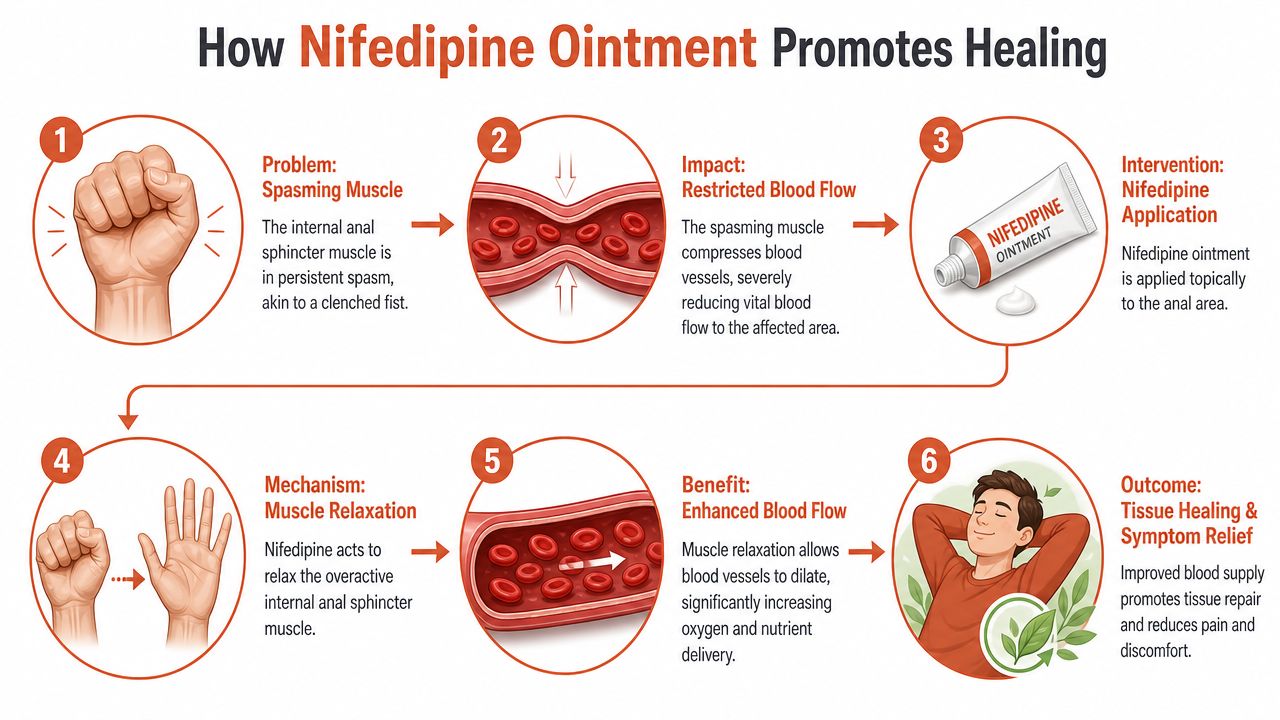
A common pattern looks like this. A bowel movement causes a small tear, the internal sphincter tightens in response, blood flow drops, and the wound stays irritated instead of closing. Patients often describe it as a cycle they cannot break on their own.
Nifedipine helps by interrupting that cycle at the muscle level.
The simple version of the science
Nifedipine is a calcium channel blocker. Applied topically, it reduces the calcium-driven signal that keeps smooth muscle contracted. In the anal canal, that means less internal sphincter spasm, lower resting pressure, and better blood supply to the fissure.
That matters because fissures often fail to heal for mechanical reasons, not only because the skin is injured. The tissue is being held under tension, and the local circulation is restricted. Reduce the squeeze, and the area has a better chance to repair.
The practical effects usually show up in a few connected ways:
- Less spasm-related pain, especially after bowel movements
- Improved perfusion to the fissure, which supports healing
- Less re-tearing, because the tissue is not being pulled as tightly with every spasm
A review in PubMed Central describes topical nifedipine as a form of chemical sphincter relaxation for anal fissure treatment, including use of 0.5% nifedipine ointment applied circumferentially 1 cm inside the anus near the internal anal sphincter every 8 hours for 8 weeks in acute fissure management through this PubMed Central review.
Why compounded treatment often works better in real life
In practice, healing is not only about lowering pressure. It is also about getting a patient through the painful first phase so they can keep using the medication, avoid guarding, and pass stool without fear. That is where a compounded prescription can be more useful than a single-ingredient product.
Nifedipine is often the anchor ingredient because it addresses the underlying pressure problem and is generally well tolerated. A prescriber can then add other ingredients for fast local numbing or added comfort, depending on the symptom pattern. That multi-action approach treats the cause and the day-to-day symptoms at the same time, which is often more realistic for someone with a very painful chronic fissure.
A product like Sensitive Care Hemorrhoid & Fissure Rx Cream is one example of a compounded formula built around nifedipine for fissure and hemorrhoid care, and the only one available online through telehealth, under the care of licensed medical providers.
If your clinician is choosing between calcium channel blocker options, diltiazem treatment for fissures is another topical option in the same medication family, found in Bummed’s Long-Acting Hemorrhoid & Fissure Rx Cream. The decision usually comes down to prior response, side effects, and which formula the patient is most likely to use consistently.
The Evidence for Nifedipine’s Effectiveness
A common chronic fissure scenario is straightforward. Pain starts with a bowel movement, the internal sphincter tightens in response, blood flow drops, and the tear stays open. A useful treatment has to interrupt that cycle, not just numb the area for an hour.
That is why nifedipine remains a standard prescription option. It has clinical support for healing fissures, and it is often easier for patients to stay on than nitroglycerin-based treatment. In practice, that matters. A medication only works if the patient can keep using it long enough for the tissue to close.
What the clinical data show
One controlled trial of chronic anal fissure found that topical nifedipine combined with lidocaine achieved complete healing in 94.5% of treated patients after 6 weeks, compared with 16.4% in the control group, according to this PubMed study report.
The same trial also documented a drop in anal resting pressure, which supports the main physiologic goal of treatment. The ointment reduced the muscle tension that keeps the fissure ischemic and painful. From a colorectal standpoint, that is the point. Lower pressure gives the wound a better chance to heal.
Recurrence data were also reassuring in that study. A small number of patients had the fissure come back within a year, and some healed with another course of topical treatment. That pattern fits what many of us see clinically. If the fissure responds and the bowel habits improve, repeat surgery is often avoidable.
How it compares with other topical options
Comparative studies suggest nifedipine performs well against other common topical choices. In acute fissure, one trial reported higher remission rates and faster pain relief with nifedipine than with diltiazem.
Speed matters here.
Patients who get pain relief earlier are usually less afraid of the next bowel movement. That reduces guarding and straining, both of which can keep the fissure cycle going.
Nifedipine is also commonly favored over glyceryl trinitrate, or nitroglycerin, when headache risk is a concern. Healing rates can be comparable, but tolerability often decides which prescription a patient will continue. For a full side-by-side comparison of nifedipine, diltiazem, nitroglycerin, and the different formulations available, see our guide to anal fissure cream. That is one reason many clinicians build a compounded fissure treatment around nifedipine. It addresses the pressure problem well, and it usually pairs smoothly with other ingredients that add local pain control or symptom relief.
That multi-action approach is often more useful than a single-ingredient ointment. The patient needs less pain, less spasm, and enough comfort to keep applying the medication consistently. For a broader overview of where compounded topicals fit in care, this guide to the best treatment for anal fissure explains the options in plain language.
How to Use Nifedipine Ointment Correctly
Good medication can still disappoint if the application is inconsistent or too timid. With fissures, technique matters because the goal is to get the ointment to the muscle area that is staying tight.
A practical way to apply it
For adults, a typical dose of a nifedipine and lidocaine cream is to apply a pea-sized amount to inside of anus 3 to 4 times a day. Finger cots are included in your Bummed order for easy application.
Most patients do best with this sequence:
- Wash your hands first. Clean hands reduce irritation and contamination.
- Apply after a bowel movement when possible. That gives the medicine longer contact time.
- Use the prescribed amount. More isn’t better if it only creates mess and skin irritation.
- Place it just inside and around the opening if instructed. The target is the internal sphincter region, not deep insertion.
- Repeat on schedule. Consistency keeps the muscle from tightening back up.
What patients often get wrong
The most common mistake is stopping too early because pain improves before the fissure is fully healed. Early relief is a good sign, but it isn’t proof that the tear has closed.
Another mistake is applying it only to the outer skin when the provider intended a small internal application as well. That can limit the effect because the medication works best when it reaches the area near the sphincter.
If you’re unsure about placement, this step-by-step guide on how to apply diltiazem cream is useful because the application principles for topical anorectal creams are very similar.
Safety Side Effects and Pregnancy Considerations
A common office conversation goes like this. A patient reads that nifedipine is a blood pressure medication, then asks whether putting it on a fissure could cause lightheadedness or make blood pressure fall. That is a reasonable question.
Topical nifedipine is used because the main job is local. It helps relax the tight internal anal sphincter that keeps the fissure trapped in a cycle of pain, spasm, and poor blood flow. In a well-designed compounded prescription, that local muscle-relaxing effect can be paired with ingredients that calm pain and irritation at the same time, like with hydrocortisone and metronidazole, found in Bummed’s creams. That matters because fissures rarely cause just one problem.
What side effects are actually expected
Most patients do well with topical nifedipine. The side effects we discuss most often are mild local irritation, a brief warming or burning sensation after application, and occasional headache or lightheadedness. Systemic effects such as meaningful blood pressure lowering appear to be uncommon with short-term topical use, but they are still worth watching for in people who are sensitive to blood pressure changes or already take antihypertensive medication.
The practical trade-off is straightforward. A multi-ingredient compounded ointment can treat several symptoms at once, but every added ingredient changes the side-effect profile.
Long-term safety data are still limited in everyday use. A recent publication discussing this gap notes that short-term safety is reassuring, while real-world data on extended use remain thinner than patients and prescribers would like through this PubMed record discussing the safety data gap.
Call your prescriber if you develop marked dizziness, faintness, rash, worsening pain, or bleeding that is increasing rather than settling down.
Pregnancy and postpartum use
Pregnancy and the postpartum period are common times for fissures to show up. Constipation, straining, pelvic pressure, and hormone-related bowel changes all contribute. In that setting, topical treatment is often appealing because it works at the site of the problem and may reduce the need for more invasive treatment while tissue heals.
Pregnancy does change the prescribing conversation. Safety depends on the full formula, not just nifedipine by itself. We consider the stage of pregnancy, breastfeeding status, symptom severity, prior response to treatment, and whether the compound also includes ingredients such as lidocaine or steroids.
The right next step is an individualized prescription review, especially during pregnancy or postpartum recovery. If you are unsure how to start that process, this guide on how to get prescribed the right treatment explains what clinicians usually need to know before choosing a compounded nifedipine formula.
Getting Your Custom Nifedipine Prescription
You finally decide to get help after another painful bowel movement, and the next question is practical. What exactly should be prescribed?
The answer depends on what is keeping the fissure active. Some patients mainly need the internal sphincter to relax so blood flow can improve. Others also need better short-term pain control, less irritation, and support for inflamed tissue while the skin closes. That is why many colorectal clinicians prescribe a compounded formula instead of relying on a single ingredient alone.
Why providers use compounded options
Nifedipine ointment is commonly prepared by compounding pharmacies in different strengths, often adjusted to the patient and the prescriber’s treatment plan. In practice, that flexibility matters. A formula that feels comfortable, spreads well, and causes fewer side effects is easier to use consistently, and consistent use is what gives the fissure a chance to heal.
The base also matters. Ointments are not just carrying cream. The vehicle affects how the medication sits on the tissue, how irritating it feels, and how well patients tolerate twice-daily use. Patients do not need to manage those pharmacy details, but prescribers should.
Why a multi-action prescription can work better than a single ingredient
A fissure usually hurts for more than one reason. The muscle is tight. The tear is inflamed. The area becomes sensitive, so each bowel movement re-triggers pain.
Nifedipine addresses a central part of the problem by relaxing the internal sphincter and improving the local conditions needed for healing. In many cases, that makes it the anchor ingredient. A compounded prescription can then add other medications for specific goals, such as lidocaine for faster numbing, bupivacaine for longer-lasting comfort, or a carefully selected anti-inflammatory when swelling is part of the picture.
That combination is often more useful than a single-ingredient product because it treats both the symptom burden and the reason the fissure is not closing.
At Bummed, one example is Sensitive Care Hemorrhoid & Fissure Rx Cream. In our approach, nifedipine is used as a key ingredient within a broader compounded formula so the prescription can calm pain while also reducing the sphincter spasm that keeps the cycle going. We offer Sensitive Care for $65 for a 3-month supply, giving patients an option that supports longer, more consistent treatment. Patients dealing with constipation alongside fissure symptoms can also explore The Constipation Rx.
What getting treatment looks like
Getting a prescription should be straightforward. Bummed offers telehealth care through an online process for getting prescribed the right treatment. Adults complete a secure intake, a board-certified provider reviews the history, and if the presentation fits, a prescription is sent to a partner pharmacy for compounding and discreet shipping.
That model works well for anorectal problems because embarrassment often delays care. Earlier treatment can prevent a short flare from turning into a stubborn fissure that keeps reopening.
Frequently Asked Questions About Nifedipine Ointment
How quickly does nifedipine ointment start helping
Many patients start to feel improvement within a week. Pain often settles before the fissure is fully healed, so keep using it exactly as prescribed unless your provider tells you to stop.
Is nifedipine ointment better than nitroglycerin
For many patients, nifedipine is easier to tolerate. Both are used to relax the sphincter, but nifedipine is often chosen when a patient wants to avoid the headache issues that can come with nitrates. Bummed providers will review your medical history and symptoms to determine what treatment path is best for you.
Can I use nifedipine ointment every day
Daily use is common when it is prescribed that way, but the safe duration depends on the exact formula and your symptoms. Bummed’s prescription creams are generally safe for daily use.
What if I miss a dose
Use the next dose when you remember unless it’s almost time for the following scheduled dose. Don’t double up. The main goal is to get back to steady, consistent use.
Can I use over-the-counter hemorrhoid products with it
Sometimes yes, but not automatically. Layering products can irritate the skin or duplicate ingredients. Ask your provider before mixing prescription fissure treatment with over-the-counter creams, suppositories, or wipes.
How much cream should I use
Use the amount written on your prescription. One common adult dosing approach for nifedipine is to apply a pea-sized amount to inside of anus 3 to 4 times a day. Your compounded prescription may differ depending on its ingredients.
Does nifedipine ointment help hemorrhoids too
It can help when hemorrhoid symptoms overlap with spasm, irritation, or fissure-type pain, but its main role is in fissure care. If hemorrhoids are the primary issue, the rest of the formula matters a lot. Bummed’s formulations are meant to treat both hemorrhoids and fissures.
When should I contact my provider
Reach out if pain is getting worse, bleeding is increasing, you feel a new lump, you develop a rash, or the medication doesn’t seem to be helping. Persistent anorectal pain isn’t something to just push through.
Bummed content is for general education and should never replace professional medical advice that considers your individual health. If you think you’re experiencing a medical emergency, call 911 or head to the nearest emergency department.
Prescription products require an online consultation with a physician who will determine if a prescription is appropriate.
If you’re dealing with fissure pain, bleeding, or irritation that isn’t improving, Bummed offers online access to board-certified providers who can review your symptoms and determine whether a custom compounded prescription is appropriate.