
You go to the bathroom, wipe, and see bright red blood. Or maybe the bigger problem is pain. Not a vague ache, but a sharp, tearing pain that makes you dread the next bowel movement. Most adults immediately wonder the same thing. Is this a hemorrhoid, an anal fissure, or something more serious?
The confusion makes sense. These conditions affect the same area, can happen after constipation or straining, and often show up with bleeding. But the difference between hemorrhoids and anal fissures matters because the anatomy is different, the pain pattern is different, and the treatment path is different too. What helps a swollen vein doesn’t always help a tear in the anal lining heal. A quick treatment guide: Diltiazem is best for fissures and Nitroglycerin is best for hemorrhoids. Bummed has prescription creams clinically proven to heal both at the source.
The practical question isn’t just what to call it. It’s what to do next, what not to do, and when home care is enough versus when you need a provider involved. That’s where a clear framework helps.
Anatomy 101 What Are Hemorrhoids and Anal Fissures
At the simplest level, these are two different problems in the same neighborhood.
Hemorrhoids are swollen vascular cushions or veins in the rectal and anal area. They can be internal, meaning inside the rectum, or external, meaning under the skin around the anus. If you want a more detailed breakdown of location and symptoms, this guide on internal vs external hemorrhoids is useful.
An anal fissure is a small tear in the lining of the anal canal. That means it’s closer to a paper cut or split in delicate tissue than a lump or swollen vein.
The core anatomical difference
Think of hemorrhoids like pressure-sensitive veins that have become enlarged. Think of a fissure like a cut that keeps reopening every time hard stool stretches the area. That one distinction explains a lot of what patients feel.
A hemorrhoid may cause fullness, itching, swelling, or a lump. A fissure usually causes pain because raw tissue is being pulled apart during bowel movements. In many cases, people can feel or see an external hemorrhoid, while a fissure is often harder to identify on self-exam.
A widely cited review notes that hemorrhoids are substantially more common than anal fissures, with hemorrhoid prevalence in UK population data of about 13% to 36%, and one consumer-health summary noted that 50% to 85% of people may experience hemorrhoids at some point in life, while fissures are defined as tears in the anal lining and are typically called acute if they resolve within 6 weeks and chronic if they last longer than 6 weeks (clinical review on hemorrhoids and fissures).
Practical rule: If you feel a tender lump, hemorrhoids move higher on the list. If the dominant problem is cutting pain with bowel movements, fissure moves higher.
Why people mix them up
Both conditions can produce bright red blood. Both can follow constipation. Both can flare after straining. That overlap is why many adults search for ways to identify hemorrhoids or fissures before they decide whether to self-treat or get care.
The important part is this. A hemorrhoid is a pressure and vein problem. A fissure is a tear and wound-healing problem. Once you understand that, the symptom differences start to make much more sense.
Comparing Symptoms Pain Bleeding and Sensation
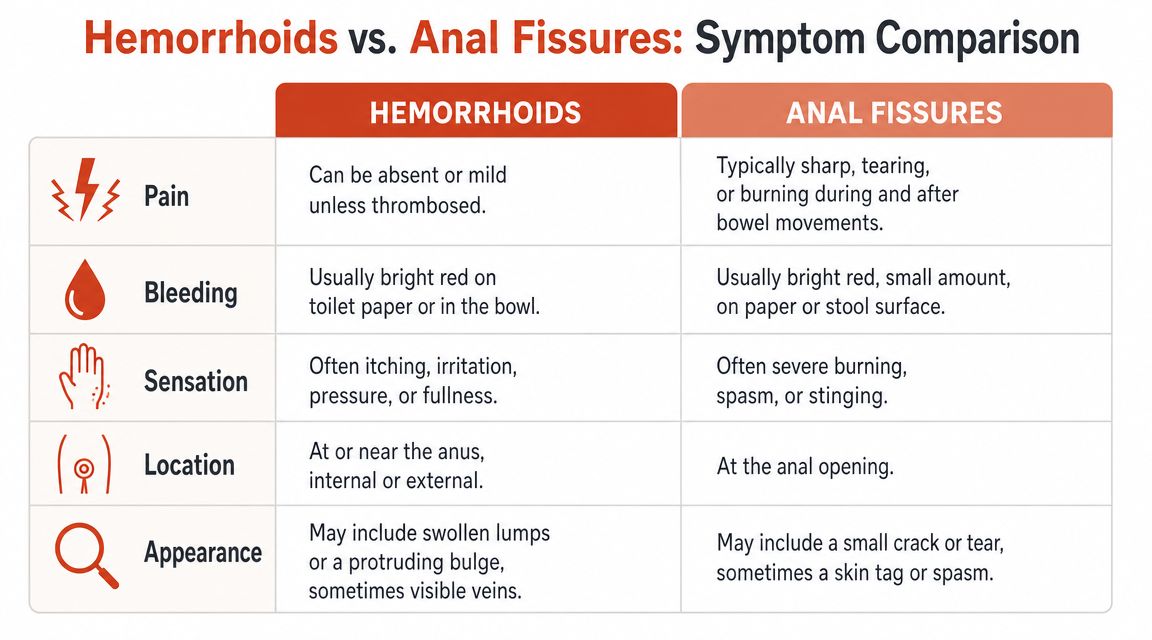
Symptom pattern is often the fastest way to sort out the difference between hemorrhoids and anal fissures. The bleeding can look similar. The pain usually doesn’t.
Here’s the side-by-side view patients find most helpful early on.
| Feature | Hemorrhoids | Anal fissures |
|---|---|---|
| Pain pattern | Often mild, aching, pressure-like, itchy, or tender | Usually sharp pain during bowel movements, often followed by lingering pain |
| Bleeding | Bright red blood may appear on toilet paper or in the bowl | Bright red blood can also happen, but it’s more likely to come with strong pain |
| Sensation | Itching, swelling, pressure, fullness, or a bulge | Burning, tearing, cutting, or spasm-like pain |
| What you may feel | A lump or prolapsing tissue is possible | Often no lump, more of a sore spot or split |
| Typical treatment direction | Reduce pressure, swelling, irritation | Help the tear heal and reduce sphincter spasm |
Pain is the biggest clue
In colorectal practice, the key distinction is the pain pattern. Anal fissures tend to cause intense, sharp pain during and after defecation, while hemorrhoids more often cause itching, swelling, or bleeding that can be less pain-dominant. The same guidance also notes that chronic fissures are usually defined by persistence beyond 6 weeks, while hemorrhoid symptoms that aren’t improving after about 1 week should be evaluated by a provider.
If a patient tells us, “It feels like I’m passing glass,” fissure rises quickly on the list. If they say, “There’s blood and itching, and I feel something swollen,” hemorrhoids become more likely.
Bleeding matters, but it doesn’t answer the whole question
Bright red blood can happen with either condition. That’s why blood alone can’t make the diagnosis. What matters is the context.
Use these clues:
-
Blood with sharp pain often points more toward fissure.
-
Blood with itching or swelling leans more toward hemorrhoids.
-
Blood that keeps happening without improvement deserves evaluation, even if the amount seems small.
-
Any uncertainty about rectal bleeding is a good reason to review a more complete guide on blood when you wipe.
Sharp pain during and after a bowel movement usually tells us more than the blood does.
What people often get wrong
Many adults assume hemorrhoids always hurt a lot. Internal hemorrhoids often don’t. Many also assume a fissure must be visible. It may not be, especially on self-exam.
That’s why symptom timing is so helpful. A fissure tends to announce itself during the bowel movement and keep reminding you afterward. Hemorrhoids are more likely to create irritation, throbbing, swelling, or pressure that isn’t tied as tightly to one moment.
Understanding the Root Causes and Risk Factors
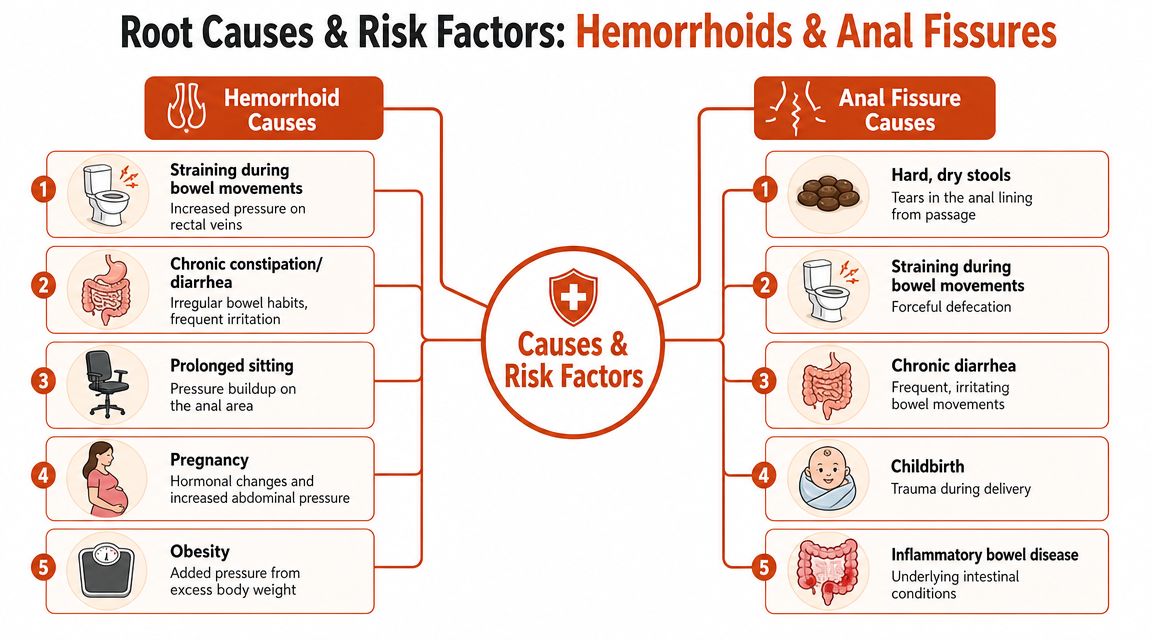
The same bowel habits that trigger one problem can trigger the other. That’s why some people keep cycling through flare-ups without ever solving the underlying issue.
Shared drivers that keep showing up
The biggest recurring theme is stool and pressure management. Hard stool, straining, repeated wiping, and long periods on the toilet can all irritate this area.
Cleveland Clinic identifies chronic constipation and straining, obstructed defecation syndrome, chronic diarrhea, childbirth, and penetration as causes of fissures. Other guides emphasize that both hemorrhoids and fissures worsen when stool consistency and pressure aren’t managed. That’s especially relevant for postpartum adults, people dealing with constipation from GLP-1 medications, and anyone who keeps having repeat flares despite generic fiber advice (Cleveland Clinic overview of anal fissure causes).
A lot of people focus on the visible symptom and miss the driver underneath it.
Why the same trigger causes different problems
Constipation is a good example. One person strains and develops swollen hemorrhoidal tissue from pressure. Another passes a hard stool and tears the anal lining. Some adults end up with both.
The same is true with diarrhea. Frequent bowel movements and repeated irritation can inflame hemorrhoids, but they can also leave the lining vulnerable to a fissure.
Here are common root causes that deserve attention:
-
Chronic constipation: Hard stools stretch and traumatize the anal canal.
-
Repeated straining: Pressure builds in hemorrhoidal veins and increases tissue injury risk.
-
Long toilet sitting: The longer you bear down or sit, the more pressure the area absorbs.
-
Postpartum changes: Pelvic pressure, stool changes, and delivery-related strain can all contribute.
-
GLP-1 related constipation: Slower bowel patterns can turn a manageable tendency into recurring pain and bleeding.
The modern issue many articles skip
GLP-1 related constipation changes the conversation. Patients often say they were “fine before” a new weight-loss medication changed stool frequency and consistency. That matters because treatment shouldn’t stop at topical relief. It needs to address the bowel pattern that keeps recreating the problem.
For many adults, the better question isn’t “Which one do I have?” It’s “What is my bowel habit doing every day that keeps setting this off?” If you want a broader look at why these problems are so common, this article on why hemorrhoids are so common adds helpful context.
Treating the flare without fixing the trigger is why so many people improve for a week and then end up right back where they started.
How Providers Diagnose Hemorrhoids and Fissures
A good diagnosis usually starts with the story, not the exam table. The timing of pain, the appearance of blood, whether there’s a lump, and what your bowel habits have been doing often narrow things down quickly.
What a provider wants to know first
Expect questions like these:
-
When does the pain happen? During the bowel movement, after it, all day, or only with wiping?
-
What does the blood look like? Bright red on paper, in the bowl, streaked on stool, or mixed in?
-
What has your stool been like lately? Hard, dry, frequent, loose, difficult to pass?
-
Do you feel a lump or swelling?
-
Is anything else going on? Fever, mucus, urgency, previous anorectal procedures, or persistent symptoms.
That history matters because not every case of anal pain or rectal bleeding is a fissure or hemorrhoid.
Why some cases need broader evaluation
Cleveland Clinic notes that fissure pain often occurs with bowel movements and that most fissures heal with self-care, but a broader differential matters because contributing conditions can include prior surgery, STIs, inflammatory bowel disease, anal cancer, and tuberculosis. A separate differential guide also notes that proctitis tends to cause a constant ache with urgency, mucus, and sometimes fever, which simple hemorrhoid-versus-fissure articles often miss (broader differential for anal pain and bleeding).
That’s why persistent bleeding, unusual discharge, fever, or a constant deep ache deserve more than guesswork.
What an in-person exam may involve
An in-person visit is often simpler than people expect. A provider may do:
-
Visual inspection to look for an external hemorrhoid, visible tear, irritation, or skin tag
-
A gentle exam if the area isn’t too painful
-
Anoscopy in some cases to look inside the anal canal
If you’re not sure what kind of specialist handles this, this guide on what doctor deals with hemorrhoids can help you choose the right next step.
For many adults, telehealth can begin the process by sorting symptom patterns, reviewing photos when appropriate, and identifying who likely needs in-person examination versus who can safely start treatment at home.
Your Guide to Modern Treatment Options
Good treatment starts with the right target. A swollen vein and a small tear can both cause bleeding, but they do not calm down for the same reasons. Patients try several over-the-counter “hemorrhoid” creams before asking the more important question: am I treating pressure and swelling, or trying to help a tear heal through ongoing spasm and constipation?
Tier one home care that helps both
The first job is making bowel movements easier to pass. That matters for both hemorrhoids and fissures, and it matters even more if symptoms started after constipation from travel, postpartum recovery, pain medicines, or a GLP-1 medication that slowed your gut down.
Start with the basics:
-
Soften stool: Aim for bowel movements that pass without pushing hard.
-
Use warm water: Sitz baths can relax irritated tissue and make the next bowel movement less painful.
-
Limit toilet time: Sitting and straining keep pressure on hemorrhoids and can reopen a fissure.
-
Reduce friction: Gentle rinsing or patting is usually better than aggressive wiping.
If symptoms are mild and clearly improving, home care is often enough. As noted earlier, treatment paths begin to separate if symptoms keep coming back, do not improve, or start behaving more like a chronic fissure than simple irritation.
Tier two targeted prescriptions
The difference between hemorrhoids and anal fissures really matters here.
Fissures often become a cycle. Pain leads to muscle tightening. Muscle tightening reduces blood flow. Poor blood flow slows healing. In that setting, treatment usually needs to do more than numb the area. It often needs to relax the anal sphincter so the tear can close.
Hemorrhoids are different. The focus is usually on reducing irritation, swelling, and pressure while you correct the bowel habit that keeps flaring them. For an ingredient-by-ingredient breakdown of hemorrhoid-focused creams, see our best hemorrhoid cream guide.
That trade-off is why using the wrong cream can waste time. A product meant for hemorrhoid irritation may not do much for a fissure driven by spasm. For the full picture of fissure-specific treatment — home care through prescriptions and procedures — see our best treatment for anal fissure guide.
A patient with private but non-emergency symptoms may choose an at-home and telehealth path first. Bummed offers online intake reviewed by a board-certified provider and, when appropriate, prescriptions for anorectal conditions including hemorrhoids and anal fissures. That can be a practical option for someone who wants guidance before deciding whether an office visit is necessary.
The right cream can help. The wrong cream can delay relief.
Tier three procedures and surgery
Some cases need more than home care and prescriptions.
For hemorrhoids, escalation may mean office treatment or surgery aimed at enlarged vascular tissue that keeps bleeding, prolapsing, or clotting. For the full range of hemorrhoid treatment options at every stage, see our hemorrhoid treatment guide. For fissures, the decision is different. If a fissure has become chronic and still has not healed after consistent bowel management and topical treatment, a procedure may be the better option because the underlying spasm is still blocking healing.
Repeating the same failed routine rarely changes the outcome. If symptoms keep cycling despite reasonable treatment, it is time to choose the next level of care instead of another over-the-counter product.
When to Seek Care and How Telehealth Can Help
Some symptoms can safely start with home care. Others shouldn’t wait.
Signs you should seek prompt in-person care
Get urgent evaluation if you have:
-
Heavy bleeding or bleeding that won’t stop
-
Fever or feeling ill along with rectal pain
-
Constant deep rectal pain rather than pain mainly tied to bowel movements
-
Mucus, urgency, or significant discharge
-
A new lump with severe pain
-
Symptoms that keep recurring or aren’t improving
These patterns can point beyond routine hemorrhoids or a simple fissure.
When telehealth makes sense
For non-emergency symptoms, telehealth is often a smart first step. It’s especially useful when the main question is whether your symptoms sound more like hemorrhoids, fissure, irritation, constipation-related trauma, or something that needs in-person evaluation.
A remote visit can help you sort through:
-
Pattern recognition based on pain timing, bleeding, stool changes, and swelling
-
Treatment matching so you don’t use the wrong category of medication
-
Escalation decisions about who can keep treating at home and who needs an exam
Telehealth also helps adults who’ve delayed care because they’re embarrassed, busy, postpartum, traveling, or dealing with constipation from a GLP-1 medication and want guidance before symptoms spiral.
A simple way to think about next steps
If symptoms are mild and clearly improving, home care may be enough.
If symptoms are unclear, persistent, or interfering with bowel movements, get evaluated.
If you’re seeing red flags, skip self-diagnosis and get in-person care.
That’s the practical framework. Relief usually comes faster when the first move is the right one.
Frequently Asked Questions
Can you have hemorrhoids and an anal fissure at the same time
Yes. That’s not unusual because constipation and straining can create both pressure on hemorrhoidal veins and a tear in the anal lining. When both are present, the fissure often explains the sharper pain, while the hemorrhoid may explain swelling or a lump.
Which is usually more painful
Anal fissures are usually more painful because they involve a tear in sensitive tissue and often trigger muscle spasm. Hemorrhoids can hurt, especially if external tissue becomes very inflamed, but the classic fissure pattern is sharper pain during and after a bowel movement. If you’re weighing OTC versus prescription options for either condition, our best hemorrhoid medicine guide walks through that decision.
How long should you try home care before getting help
For uncomplicated hemorrhoids, symptoms that aren’t improving after about 1 week should be evaluated by a provider, based on specialty guidance cited earlier. For fissures, persistence beyond 6 weeks raises concern for a chronic fissure and often changes treatment.
What kind of fiber is best
The best fiber is the one you can take consistently without making bloating unbearable. In practice, many adults do well with a gradual increase from food first, then adding a supplement if needed. The goal isn’t a perfect fiber number. The goal is stool that passes easily and predictably.
Can GLP-1 medications make either condition worse
They can contribute indirectly by worsening constipation in some adults. Harder, less frequent stools can increase straining, trigger tears, and aggravate hemorrhoids. If symptoms began after a medication changed your bowel pattern, that’s important to tell your provider.
Is bright red blood always hemorrhoids
No. Bright red blood can happen with hemorrhoids or fissures, but it isn’t specific to either one. If bleeding is persistent, unexplained, or accompanied by other symptoms like fever, mucus, urgency, or ongoing pain, you need a broader evaluation.
What usually delays healing the most
Three things cause the most trouble: ongoing constipation, repeated straining, and treating every symptom as “just hemorrhoids.” Fissures often stay active because the tear keeps reopening. Hemorrhoids often stay irritated because pressure and bowel habits never change.
If you want a private, practical next step, Bummed offers online anorectal care for adults dealing with hemorrhoids, anal fissures, itching, and constipation-related symptoms. You can complete a short intake, have it reviewed by a board-certified provider, and find out whether treatment at home, a prescription, or in-person follow-up makes the most sense.
Bummed content is for general education and should never replace professional medical advice that considers your individual health. If you think you’re experiencing a medical emergency, call 911 or head to the nearest emergency department.
Prescription products require an online consultation with a physician who will determine if a prescription is appropriate.