


You notice a small lump near the anus. It isn’t something one readily feels prepared to inspect, and it’s easy for your mind to jump to the worst conclusion. In practice, the confusion usually comes down to two common possibilities: a skin tag or a hemorrhoid.
Those two can look similar at first glance, but they behave very differently. That difference matters because the next step isn’t the same. A quiet, stable flap of skin is handled one way. A painful, swollen, bleeding bump is handled another way.
That Little Lump What Is It Really?
A common scenario goes like this: you wipe, feel something new, and then spend the next few hours searching photos and second-guessing what you found. Some people notice a soft little flap that seems to have been there for a while. Others feel a tender bulge that suddenly appeared after constipation, travel, pregnancy, heavy straining, or a long stretch of sitting.
That uncertainty is understandable. Hemorrhoids are common enough that an estimated 10 million people in the United States seek medical care for hemorrhoids each year, making them one of the most common gastrointestinal complaints seen in outpatient practice, according to this overview of hemorrhoids and skin tags.
The first clue is how it behaves
A skin tag usually acts like a leftover fold of skin. It tends to stay about the same, and many people describe it as more annoying than painful.
A hemorrhoid is different. It’s active tissue. It can swell, calm down, itch, ache, and sometimes bleed.
A lump that changes during bowel movements or flare-ups usually points in a different direction than a lump that simply sits there.
What to do first
Before you panic, focus on the basics:
-
Notice the feel: Is it soft and floppy, or firm and tender?
-
Notice symptoms: Is there pain, itching, or bleeding with bowel movements?
-
Notice timing: Did it appear after straining or constipation, or has it likely been there longer?
If you want a broader overview of related symptoms and conditions, this guide to hemorrhoids, anal fissures, and anal itching is a useful starting point.
Understanding Anal Skin Tags
An anal skin tag is a small piece of excess skin at the anal opening. It’s usually soft, flesh-colored, or slightly darker than the surrounding skin. The simplest way to think about it is a tiny fold of skin that remains after the area has stretched or healed.
How a skin tag usually feels
Most skin tags are painless and stable. They don’t usually throb, enlarge during a bowel movement, or bleed on their own. People often describe them as a soft flap, a little nub, or a loose piece of skin they notice during wiping or washing.
Because a skin tag is skin, not swollen vascular tissue, it usually doesn’t create the dramatic symptoms people associate with an active hemorrhoid.
When a skin tag becomes bothersome
A skin tag can still be irritating even when it isn’t dangerous. The main problems are practical:
-
Hygiene issues: Extra folds can make cleaning harder.
-
Friction: Underwear, exercise, and moisture can irritate the area.
-
Diagnostic confusion: Many people assume any lump must be a hemorrhoid.
Practical rule: Creams may soothe irritation around a skin tag, but they won’t make the tag disappear.
A skin tag can also be confused with other skin conditions around the anus and vulva. If you’re sorting through symptoms that involve skin texture, irritation, or color changes, this article on lichen sclerosus symptoms may help you understand what does and does not fit that pattern.
Understanding Hemorrhoids
A hemorrhoid is swollen vascular tissue in the anus or lower rectum. Cleveland Clinic describes hemorrhoids as being similar to varicose veins. That comparison is useful because it explains why they can feel full, swollen, tender, and reactive.
Internal and external hemorrhoids
Internal hemorrhoids sit inside the rectum. They may not hurt, but they can bleed during bowel movements.
External hemorrhoids sit under the skin around the anus. These are the ones more likely to cause the classic symptoms people notice right away:
-
Pain
-
Itching
-
Swelling
-
A tender lump
Why hemorrhoids feel so different
Perianal skin tags and hemorrhoids differ in tissue type, which drives their behavior. Skin tags are soft, flesh-colored excess skin that are usually painless and stable, while hemorrhoids are swollen blood vessels that can be internal or external, change size during flare-ups, and are more likely to cause pain, itching, and bleeding during bowel movements, as noted by The Minor Surgery Center’s explanation of hemorrhoid vs skin tag.
If you’re trying to sort out whether symptoms seem internal, external, or mixed, this guide to internal and external hemorrhoids can help you map what you’re feeling to the likely anatomy.
Side-by-Side Comparison Skin Tag vs Hemorrhoid
Regarding skin tag vs hemorrhoid, the most common question is: what matters most right now? The quickest answer is this. A skin tag is excess skin. An external hemorrhoid is swollen vascular tissue. That one difference explains most of the rest.
| Feature | Anal Skin Tag | External Hemorrhoid |
|---|---|---|
| Tissue type | Excess skin | Swollen blood vessel |
| Usual feel | Soft, loose, fleshy | Swollen, tender, sometimes firm |
| Size pattern | Usually stable | Can enlarge during flare-ups |
| Pain | Usually painless | Often painful or sore |
| Itching | May irritate if hygiene is difficult | Common during active irritation |
| Bleeding | Usually doesn’t bleed on its own | More likely to bleed with bowel movements |
| Color | Often flesh-colored or slightly darker | May look red, purple, or bluish |
| Common concern | Cleaning and irritation | Pain, swelling, bleeding, flare-ups |

Appearance
A skin tag usually looks like a small fold or flap. It often blends in with the surrounding skin.
A hemorrhoid often looks fuller and more inflamed. During a flare, it may appear swollen and darker in color.
Sensation
This is often the most useful clue.
A skin tag is often something you notice more than something you feel. You may become aware of it during wiping, showering, or exercise, but it usually doesn’t generate much pain by itself.
A hemorrhoid tends to announce itself. It may itch, ache, sting, or feel sore after a bowel movement. If a clot forms in an external hemorrhoid, the lump can feel particularly firm and tender.
If the main story is pain, swelling, and recent change, think hemorrhoid before skin tag.
Bleeding
Skin tags generally don’t bleed on their own. If there’s blood, we think more carefully about hemorrhoids, fissures, irritation from wiping, or another source that deserves evaluation.
Hemorrhoids are more likely to bleed, especially around bowel movements.
The practical takeaway
If the lump is soft, painless, and has stayed the same, a skin tag moves higher on the list. If the lump is new, painful, itchy, swollen, or bleeding, a hemorrhoid is more likely, and your next steps should focus on confirming that and ruling out other causes.
What Causes a Skin Tag or Hemorrhoid
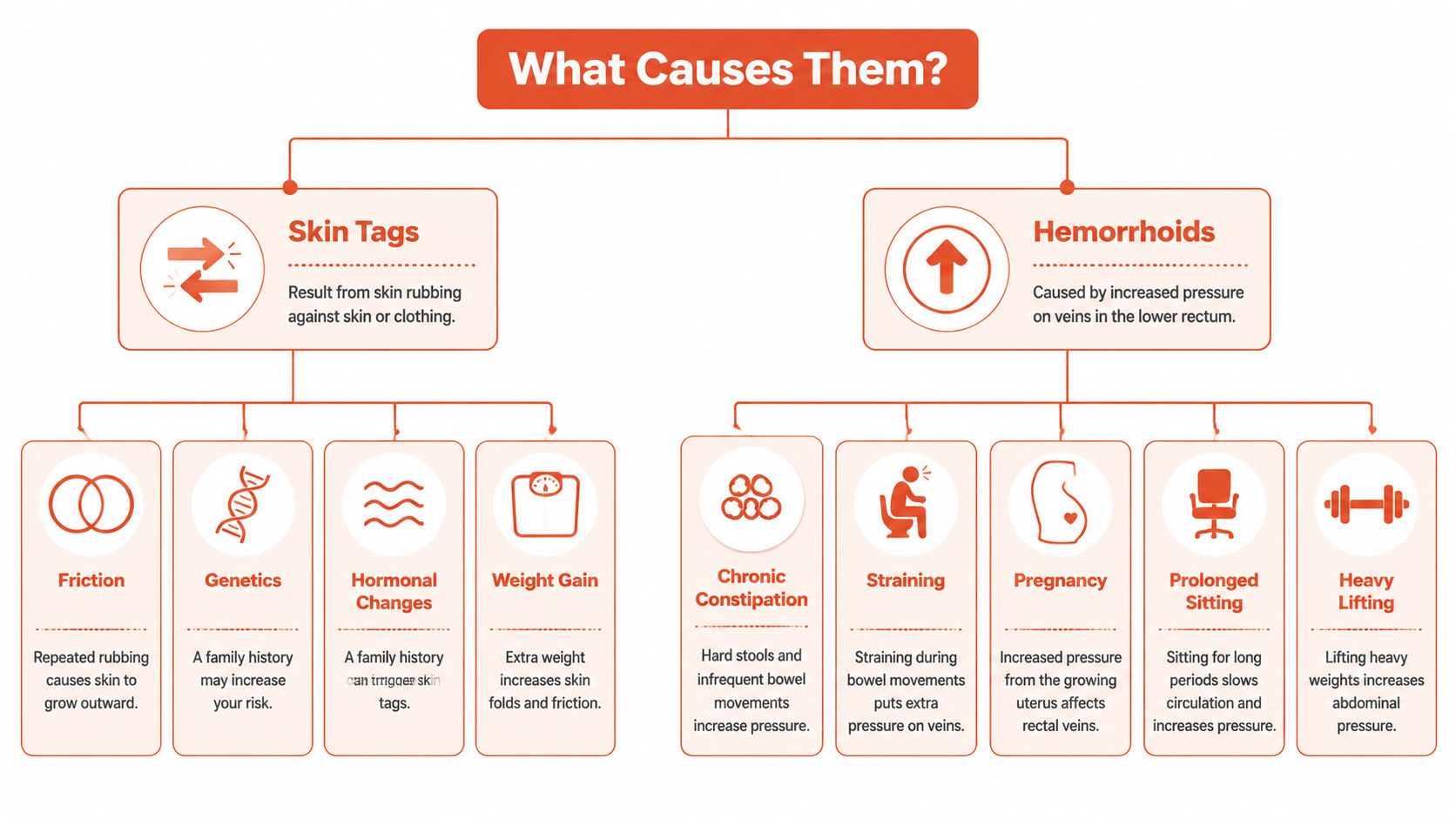
The cause often explains the diagnosis. Hemorrhoids usually develop from pressure. Skin tags often show up after the pressure episode has passed.
Why hemorrhoids happen
Hemorrhoids form when pressure builds in the veins and supporting tissue around the lower rectum and anus. In day-to-day practice, common triggers include constipation, repeated straining, pregnancy, long periods of sitting, and bowel habits that keep the area irritated.
Much like pressure on a garden hose, the more force and congestion in the system, the more likely the tissue is to swell.
Why skin tags happen
A skin tag is often the leftover after swelling or inflammation has stretched the skin. When the swelling settles, the stretched skin doesn’t always tighten back down.
That link isn’t just a theory. A classic PubMed-indexed study of external hemorrhoids found that 80% of women and 60% of men had skin tags, with frequency increasing with age. The same report noted that skin tags increased in women beginning in the second decade of life and in men in the fourth decade, and that tag size increased with age. Women generally had larger skin tags than men, according to the PubMed record of that study.
What that means in real life
If you had a painful swollen lump weeks or months ago, and now all that remains is a soft flap, that pattern strongly suggests a skin tag rather than an active hemorrhoid.
Common contributors include:
-
Past hemorrhoid flares: A resolved external hemorrhoid can leave stretched skin behind.
-
Repeated straining: This keeps the area under stress and can trigger both swelling and healing changes.
-
Pregnancy and bowel changes: Pressure shifts and constipation can set up the same cycle.
-
Daily bowel habits: Small routine changes can matter, especially when you’re supporting healthy gut function and trying to avoid repeated irritation.
Many people think a skin tag is a new disease. Often, it’s actually a footprint from an older one.
How to Get a Diagnosis When to See a Provider
Self-checking can help you form a reasonable guess, but it has limits. The anal area is small, symptoms overlap, and people often mistake skin tags, hemorrhoids, fissures, irritation, and other growths for one another.

When you can watch and monitor
It’s reasonable to monitor the area if all of the following are true:
-
The lump is soft
-
It isn’t painful
-
It hasn’t been bleeding
-
It seems stable rather than changing day to day
That pattern often fits a skin tag. Even then, if you’re not sure what you’re looking at, a provider’s opinion is still helpful.
When a provider should get involved
Don’t rely on self-diagnosis if you have:
-
Bleeding
-
Significant pain
-
A lump that suddenly appeared
-
A firm or very tender bump
-
Something that changes in size
-
Persistent itching or irritation that isn’t improving
Those signs don’t automatically mean something dangerous, but they do mean you need a clearer diagnosis.
What a real evaluation looks like
A provider usually starts with the history. When did it start? Is there pain? Is there bleeding with bowel movements? Did it come after constipation or straining?
Then comes the exam. Sometimes the diagnosis is obvious from inspection. Sometimes the area needs a closer look to distinguish hemorrhoids from skin tags or to rule out fissures, warts, or other causes.
If you’re unsure what kind of specialist typically evaluates this area, this guide to what doctor deals with hemorrhoids can help.
A good diagnosis doesn’t just name the lump. It explains what you should do next and what not to waste time treating.
Comparing Treatment and Removal Options
Once you know whether it’s a skin tag or hemorrhoid, the path gets simpler.
Skin tag treatment
Most anal skin tags don’t need medical treatment. If they don’t hurt and they aren’t interfering with hygiene, leaving them alone is often the best option.
What usually doesn’t work is treating a skin tag like a hemorrhoid. Hemorrhoid creams may calm surrounding irritation, but they won’t shrink away extra skin. If the tag is bothersome because of cleaning, friction, or appearance, removal is typically an in-person procedure performed by a provider.
Hemorrhoid treatment
Hemorrhoid care is different because the goal is to reduce swelling and calm symptoms while preventing the next flare.
What tends to help:
-
Softer bowel movements: Less straining means less pressure.
-
Hydration and fiber: These support easier stool passage.
-
Warm soaks: They can soothe irritated tissue.
-
Topical treatment: This can help with pain, itching, and swelling during a flare.
For a full ingredient-by-ingredient breakdown of OTC and prescription options, see our best hemorrhoid cream guide, or our complete hemorrhoid treatment guide for the full range of options from home care through procedures.
What usually backfires:
-
Aggressive wiping
-
Long toilet sessions
-
Ignoring constipation
-
Using random products without knowing the diagnosis
If symptoms keep returning, or if pain and bleeding are part of the story, it’s worth getting a customized plan rather than cycling through products that don’t match the problem.
Frequently Asked Questions About Skin Tags and Hemorrhoids
Can a skin tag turn into a hemorrhoid?
No. They are different tissues. A skin tag is excess skin, while a hemorrhoid is swollen vascular tissue. You can have both in the same area, which is why people get confused.
Is an anal skin tag dangerous or a sign of cancer?
Most anal skin tags are benign. Still, any new or changing growth near the anus should be evaluated if the diagnosis isn’t clear. The important point isn’t to panic. It’s to avoid guessing.
Does a skin tag mean I currently have hemorrhoids?
Not necessarily. A skin tag often means there was previous stretching, swelling, or inflammation in the area. It does not automatically mean you have an active hemorrhoid right now.
Should I try to remove a skin tag at home?
No. The area is sensitive and easily irritated. Home removal can cause pain, bleeding, and confusion about what the growth is. If removal is appropriate, a provider should handle it.
What’s the best first step if I’m not sure?
Start by paying attention to symptoms. A soft, stable, painless flap suggests one path. A painful, swollen, bleeding, or changing lump suggests another. If there’s doubt, get examined rather than trying multiple treatments blindly.
Bummed content is for general education and should never replace professional medical advice that considers your individual health. If you think you’re experiencing a medical emergency, call 911 or head to the nearest emergency department.
Prescription products require an online consultation with a physician who will determine if a prescription is appropriate.
If you’re dealing with hemorrhoid symptoms and want discreet expert care from home, Bummed offers online evaluation by a board-certified provider, with treatment prescribed if appropriate and shipped discreetly.