

You're sore, maybe a little itchy, and standing in the pharmacy aisle staring at a wall of tubes that all promise relief. Some say “cooling.” Some say “maximum strength.” Some mention hydrocortisone, phenylephrine, pramoxine, or ingredients you've never heard of. At that point, it's easy to think hemorrhoid ointment is all basically the same.
It isn't.
Some products mainly coat and protect irritated skin. Others try to temporarily shrink swollen tissue. Others are built to numb pain and itching. A few combine several of those jobs in one formula. That difference matters, because the best choice depends on what's bothering you most and whether you're dealing with hemorrhoids alone, or with something else like constipation, an anal fissure, or prolapse.
Hemorrhoids are common, but they still make many adults feel embarrassed, frustrated, or unsure where to turn. We'd rather replace guesswork with clarity. When you understand what hemorrhoid ointment can do, what it can't do, and when it's time to involve a provider, the whole situation feels a lot less overwhelming.
Your Guide to Understanding Hemorrhoid Ointment
OTC hemorrhoid ointment is usually a symptom treatment first. That means it's meant to help with things like itching, burning, pain, and swelling, not necessarily solve the reason the hemorrhoid flared up in the first place. That's why some people feel better quickly, while others use product after product and still don't feel like they've fixed the underlying problem.
Canadian digestive health guidance notes that mild hemorrhoids are often treated at home with OTC ointments, and it also recommends aiming for 25 to 30 grams of fiber per day to reduce constipation and straining. That pairing matters because bowel habits and local treatment often need to work together, not separately, as noted in this market and treatment overview.
Why so many products feel confusing
Most boxes on the shelf focus on symptoms, not strategy. One tube may help because it numbs the area. Another may feel soothing because it forms a barrier over irritated skin. Another may reduce puffiness for a while. If you don't know which mechanism you're buying, you can end up choosing based on branding instead of what your body needs.
A simple example helps. If your main issue is stinging after bowel movements, a barrier-focused ointment may help protect raw skin. If the biggest problem is sharp itch or tenderness, an anesthetic ingredient may matter more. If there's a sense of swollen pressure, a vasoconstrictor may make more sense.
Hemorrhoid ointment works best when the ingredient matches the symptom, not when the label has the loudest marketing.
What good treatment usually looks like
For many adults, relief comes from combining a few basics:
Topical symptom relief to calm the area
Less straining during bowel movements
Softer stool through fiber, fluids, and bowel-habit changes
Provider evaluation if symptoms keep coming back or don't fit the usual hemorrhoid pattern
That last point is important. A hemorrhoid ointment can be useful and still not be enough.
How Hemorrhoid Ointments Actually Work
Hemorrhoids involve swollen, irritated veins and nearby tissue. A useful way to think about them is like a small traffic jam in a very sensitive area. Blood flow, pressure, friction, moisture, and irritation all pile up at once. An ointment can't instantly erase that traffic jam, but it can reduce some of the things making the area feel miserable.

The three main jobs of an ointment
An FDA-listed maximum-strength formulation shows how different ingredient types do different jobs. It uses glycerin 14.4% and white petrolatum 15% as protectants, phenylephrine HCl 0.25% as a vasoconstrictor, and pramoxine HCl 1% as a local anesthetic. In practical terms, protectants coat the area, phenylephrine temporarily shrinks hemorrhoidal tissue, and pramoxine numbs pain and itch, as described in this DailyMed product listing.
Here's what that means in plain language:
Protectants help reduce rubbing and friction. This can matter a lot during bowel movements.
Vasoconstrictors tighten blood vessels for temporary reduction in swelling or fullness.
Local anesthetics reduce the nerve signal that makes the area feel painful, raw, or itchy.
Why one ointment can feel very different from another
Two products may both be sold as hemorrhoid ointment, but they may act nothing alike. One may feel greasy and protective. Another may give quick numbing relief. Another may be aimed more at reducing tissue swelling. That's why “Did it work?” is really the wrong first question. A better question is, “Was it designed for the symptom I have?”
A person with mainly irritated external skin often needs a different formula than someone with internal swelling or mixed symptoms.
Practical rule: Don't shop by product name alone. Shop by the active ingredients and the symptom each one targets.
Ointment is a tool, not a cure-all
Topicals can make a real difference. They're not just “comfort products.” A review in the medical literature reported that a meta-analysis of 14 randomized trials involving 1,514 patients found flavonoid-based hemorrhoid therapy reduced the risk of bleeding by 67%, persistent pain by 65%, itching by 35%, and recurrence by 47%. The same review also cited topical prescription agents such as 0.2% glyceryl trinitrate ointment and nifedipine ointment as effective options for symptom relief in specific hemorrhoid subtypes, which you can read in this peer-reviewed review article.
That's the big picture. The right ointment can help a lot. It just has to be the right kind.
To note, if you are experiencing multiple symptoms, or if you are not sure if you have a hemorrhoid or fissure, you may want to try a custom compounded prescription cream with multiple active ingredients. Bummed creams include as many as 5 active ingredients, including a painkiller, anti-inflammatory, anti-itch, and calcium channel blocker, for healing and symptom relief.
Bummed's Long-Acting Hemorrhoid & Fissure Rx Cream, for example, includes diltiazem, lidocaine, bupivacaine, metronidazole, and hydrocortisone for comprehensive healing.
Decoding Common Over-the-Counter Ingredients
Reading a hemorrhoid ointment label gets easier once you stop looking at the front of the box and start reading the “active ingredients” panel. That's where the useful information lives.
Ingredient categories that matter most
Here's a quick guide to the types of ingredients you'll commonly see in OTC hemorrhoid ointment products.
| Ingredient Category | What It Does | Common Examples |
|---|---|---|
| Protectants | Coats irritated skin and reduces friction | Petrolatum, glycerin, zinc oxide |
| Vasoconstrictors | Temporarily shrinks swollen hemorrhoidal tissue | Phenylephrine |
| Local anesthetics | Numbs pain, burning, or itching | Pramoxine, lidocaine |
| Steroid anti-inflammatory ingredients | Reduces inflammation and itch for short-term use | Hydrocortisone |
How to match ingredients to symptoms
If your skin feels raw, rubbed, or irritated after wiping, a protectant-heavy ointment often makes the most sense. These ingredients act like a protective layer over chafed skin. They don't numb much and they don't usually shrink tissue, but they can make bowel movements less aggravating.
If swelling or a feeling of pressure is your biggest complaint, a vasoconstrictor may help more. Phenylephrine is the classic example. Its job is temporary tissue shrinking, not long-term correction of the underlying problem.
For burning, itch, or tenderness that makes it hard to sit comfortably, local anesthetics can be useful. Pramoxine is a common example, and lidocaine is another numbing ingredient people often recognize. If you want a closer look at how numbing and anti-inflammatory ingredients are used together, this guide to lidocaine and hydrocortisone cream is a helpful next read.
What to know about hydrocortisone
Hydrocortisone can help calm itch and inflammation, but it isn't a “more is better” ingredient. Repeated or prolonged use can irritate or weaken delicate skin, especially in the anal area. That's one reason many providers encourage short-term use and careful product selection instead of treating every flare the same way.
A good mental model is this:
Protectants are like a skin shield
Anesthetics are like a mute button for discomfort
Vasoconstrictors are like a temporary squeeze on swollen vessels
Hydrocortisone is like a short-term inflammation calmer
Some hemorrhoid ointments feel soothing right away, but quick relief doesn't always mean the formula is the best fit for repeated flares.
Bummed creams generally include only a small amount of hydrocortisone, making them suitable for longer-term use.
Don't let the label oversimplify the problem
OTC products are often most useful for mild, short-term symptom relief. They can be a reasonable starting point, especially if you know what symptom you're trying to treat. But if you keep buying a new tube every few weeks, the issue may not be the brand. It may be that the diagnosis, ingredient choice, or overall treatment plan needs to change.
Beyond the Basics with Prescription Ointments
OTC products are usually broad, standardized formulas. Prescription options can be more targeted. That matters when symptoms are more intense, more stubborn, or not clearly explained by a simple external hemorrhoid flare.

What makes prescriptions different
A regulated hemorrhoid ointment such as Proctosedyl combines several active agents in one product: hydrocortisone 5 mg/g, framycetin sulfate 10 mg/g, cinchocaine hydrochloride 5 mg/g, and aesculin 10 mg/g. The labeling indicates use for swelling, pain, itching, and cracking around the rectum and anus, with application after bowel movements and morning/evening dosing, according to this Health Canada drug information entry.
That's a very different approach from a single-purpose OTC barrier ointment.
A prescription formula may combine:
An anti-inflammatory ingredient for swelling or itch
A numbing ingredient for pain
Other targeted agents depending on the suspected cause and pattern of symptoms
Why multi-ingredient treatment can make sense
Real symptoms often overlap. Someone may have itching, but also painful bowel movements. Or swelling, but also cracking skin. Or what seems like hemorrhoids, but also includes fissure-related spasm and irritation. In those situations, one active ingredient may only solve one piece of the puzzle.
That's where custom care becomes useful. Some telehealth services, including prescription hemorrhoid treatment through Bummed, use an online intake reviewed by a board-certified provider to determine whether a prescription is appropriate.
Prescription doesn't always mean stronger in one way
Sometimes adults assume a prescription ointment is just a more intense version of an OTC cream. Often, it's more accurate to say it's more specific. The formula may be designed for the exact mix of inflammation, pain, fissure symptoms, skin irritation, or recurrent hemorrhoid flares a person is having.
That's also why using someone else's leftover treatment isn't a good idea. The right formula for one person's postpartum irritation or recurrent external swelling may be the wrong one for another person's fissure or prolapsing internal hemorrhoid.
How to Use Hemorrhoid Ointment for Best Results
Even a well-chosen hemorrhoid ointment can disappoint if it's applied poorly. Technique matters more than many people realize, especially when skin is already irritated.
A simple application routine
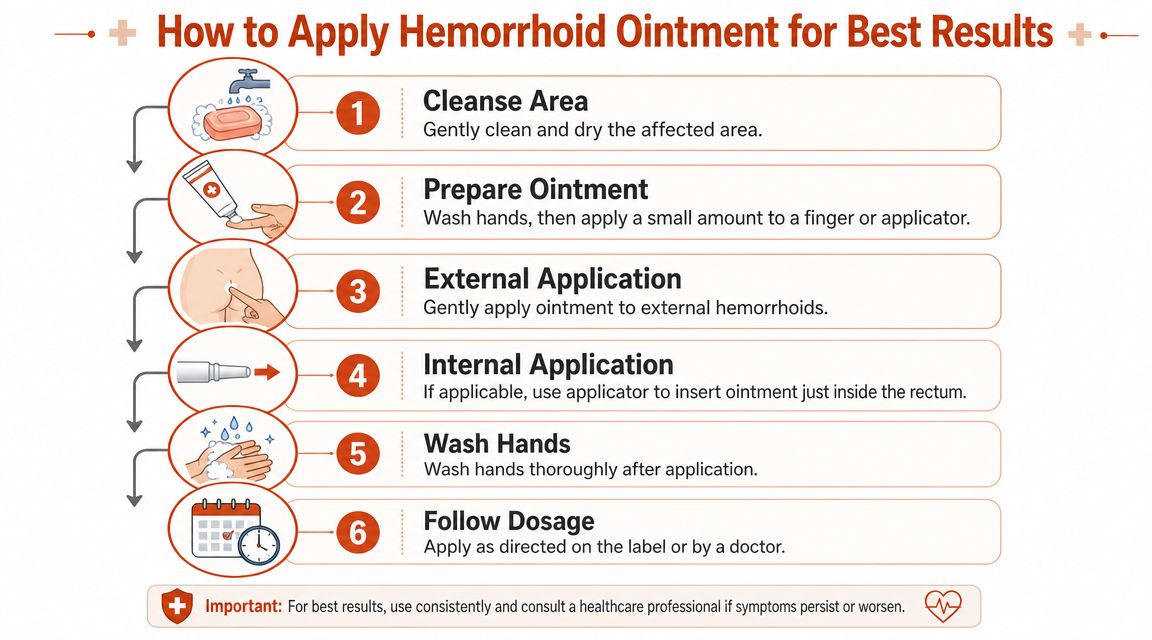
Use this step-by-step approach:
Clean gently. Wash the area with warm water or use a gentle rinse. Avoid aggressive scrubbing.
Pat dry fully. Damp skin can worsen irritation and make ointment sit poorly.
Wash your hands before touching the tube or area.
Apply a small amount to the outside of the anus if symptoms are external.
Use the applicator only if directed for internal use, and only as instructed on the label or by your provider.
Wash your hands again after application.
If a regulated product instructs application after bowel movements and on a set morning/evening schedule, follow that schedule rather than using it randomly. Consistency usually matters more than using extra product.
Common mistakes that reduce relief
A few errors come up often:
Using too much. More ointment doesn't necessarily mean more relief. It can just make the area messier and more irritated.
Applying to unclean or wet skin. That can trap moisture and stool residue against already sensitive tissue.
Stopping too soon because the first application didn't feel dramatic
Continuing too long without checking in when symptoms aren't improving
For a practical walkthrough, this guide on how to put hemorrhoid cream exactly where you need it can help.
Gentle handling matters. The anal area doesn't respond well to friction, scrubbing, or repeated wiping.
Why correct use matters
Topical treatment is part of an evidence-based hemorrhoid care pathway, not just an old home remedy. As noted earlier in the medical literature, symptom-focused therapy can meaningfully reduce bleeding, pain, and itch when it's used appropriately. Good technique won't fix the wrong diagnosis, but it does give the right treatment a fair chance to work.
Safety, Pregnancy, and Other Important Considerations
The skin around the anus is sensitive. That alone is a reason to be careful with repeated self-treatment. It's also why ingredient choice matters more during pregnancy, postpartum recovery, and in adults who keep cycling through flare after flare.
Short-term relief doesn't mean long-term safety
Some ingredients are better suited to occasional use than repeated use. Steroid-containing creams are the most common example. They can be helpful for itch and inflammation, but overuse may weaken skin. Canadian Digestive Health Foundation guidance also notes that pharmacist guidance often limits steroid cream use and says steroid creams should only be used on external hemorrhoids. The same source highlights a small pregnancy study in 88 participants involving a formulation designed for that population, which supports a more ingredient-conscious approach, especially during pregnancy and postpartum, as discussed in this Canadian Digestive Health Foundation article.
Pregnancy and postpartum deserve extra attention
Hemorrhoids often show up or worsen during pregnancy and after delivery. That doesn't mean every OTC product is automatically the right fit. Some adults assume “topical” means “safe no matter what,” but that's too simplistic. Providers often think through:
Which active ingredient is being used
How often it's being applied
How long it's been used
Whether the main issue is hemorrhoids, fissure pain, skin irritation, or all three
If you're looking for more detail on product selection in this setting, this guide to hemorrhoid creams considered safe for pregnancy can help frame the conversation.
Pregnancy and postpartum symptoms are common, but “common” doesn't mean you should have to guess about ingredients.
Sensitive skin and repeated use
Adults with recurrent itching, eczema-prone skin, or chronic irritation often need a more careful plan than “keep reapplying whatever helps a little.” Sometimes the ointment itself is fine, but frequent wiping, moisture, constipation, or an undiagnosed fissure keeps resetting the problem.
That's when a provider's input becomes especially useful. The goal isn't just temporary relief. It's choosing a treatment that matches your body and your situation without creating a second problem from overuse.
When to See a Provider About Your Hemorrhoids
One of the most frustrating parts of hemorrhoid care is wondering whether the ointment failed, or whether the problem was never something ointment could solve on its own.

Why self-treatment sometimes stops working
Topical products are usually symptom relievers, not definitive treatment for the source of hemorrhoids. Independent guidance notes they may be ineffective when hemorrhoids are severe or recurrent, and that persistent symptoms often need bowel-habit changes or escalation to a provider to address root causes like constipation or to consider procedures.
That distinction explains a lot of “nothing is working” stories. If the underlying issue is constipation, chronic straining, prolapse, fissure-related pain, or a thrombosed external hemorrhoid, another tube of ointment may not change the outcome much.
Signs it's time to stop guessing
You should contact a provider if you have:
Bleeding that keeps happening
Pain that is severe, worsening, or out of proportion
A hard, very painful lump
Symptoms that keep returning
No meaningful improvement after a short trial of OTC treatment
Uncertainty about whether it's hemorrhoids
Bleeding deserves special caution because not all rectal bleeding comes from hemorrhoids. Severe pain also raises the chance that something else is going on, such as a fissure or thrombosed hemorrhoid. For more on hemorrhoids vs fissures, read this guide.
Telehealth can be a practical next step
Many adults delay care because they don't want an awkward appointment, a long specialist wait, or another round of trial and error. A telehealth visit can make that first step easier. A provider can review your symptoms, look for patterns that suggest hemorrhoids versus another anorectal condition, and decide whether home care, a prescription, or in-person evaluation makes more sense.
That matters because the right next step is sometimes “keep using ointment,” but sometimes it's “change the formula,” “treat constipation aggressively,” or “get examined in person.”
Persistent hemorrhoid symptoms aren't a sign that you've failed self-care. They're often a sign that the diagnosis or treatment plan needs to be more specific.
Frequently Asked Questions About Hemorrhoid Ointment
Can hemorrhoid ointment cure my hemorrhoids
Not usually. Hemorrhoid ointments are designed to relieve symptoms such as pain, itching, swelling, and burning. They don't usually correct the underlying issue by themselves. Lasting improvement often also involves better bowel habits, less straining, and sometimes office-based or procedural treatment for recurrent or severe cases.
Bummed's treatments are generally more effective than OTC treatments because their prescription ingredients help to heal as well as relieve symptoms.
What is the difference between a cream and an ointment
The base is the main difference. Ointments usually contain more oil-based ingredients, so they feel greasier but often form a better protective barrier. Creams tend to absorb faster and feel lighter. In the anal area, that barrier effect can be useful, especially when skin is irritated. The active ingredients still matter more than the label alone.
How quickly should I expect relief from an ointment
That depends on what's in it. A numbing ingredient may help quickly. A protectant may feel soothing once it coats irritated skin. Swelling-related symptoms can take longer to settle. You should usually notice at least some improvement within a short period. If symptoms are unchanged, getting worse, or keep coming back, it's time to involve a provider.
Can I use hemorrhoid ointment every day
Some products are meant for short-term use, especially those that contain steroid ingredients. Daily long-term use without guidance can irritate or weaken sensitive skin. If you feel like you need ongoing treatment, it's worth asking a provider whether the diagnosis is correct and whether a different formula or treatment plan would be safer.
What if I'm not sure whether it's a hemorrhoid or a fissure
That's a very common point of confusion. In general, hemorrhoids often cause pressure, swelling, itch, or bleeding. Fissures often cause sharper pain, especially with bowel movements. But symptoms can overlap. If you're unsure, repeated self-treatment with random products usually isn't the best strategy. A provider can help sort out which condition is more likely. We recommend consulting with a Bummed provider.
Disclaimers
Bummed content is for general education and should never replace professional medical advice that considers your individual health. If you think you're experiencing a medical emergency, call 911 or head to the nearest emergency department.
Prescription products require an online consultation with a physician who will determine if a prescription is appropriate.
If you want a discreet next step, Bummed offers telehealth care focused on anorectal conditions, including hemorrhoids, with online evaluation and prescription treatment when appropriate.