

You may be reading this while sitting a little sideways in your chair, avoiding a long walk to the bathroom, or wondering why the drugstore cream that helped last time isn’t touching the problem now. That’s a frustrating place to be.
Hemorrhoids are common, but persistent symptoms can feel isolating. The good news is that needing stronger care is also common. In an analysis of U.S. healthcare data, 1.4 million people sought outpatient care for hemorrhoids annually, and 52% received at least one prescription medication. Those services generated more than $770 million in annual costs, with prescriptions accounting for $88 million (PMC analysis of hemorrhoid-related healthcare use).
Prescription hemorrhoid treatment matters because it goes beyond basic soothing. It can target inflammation, swelling, pain, and muscle spasm more directly. For many adults, modern telehealth also makes that care easier to access privately, quickly, and without rearranging an entire week.
When Over-the-Counter Isn't Enough
A lot of people start in the same place. They try witch hazel pads, sitz baths, fiber, extra water, and a cream from the pharmacy shelf. Sometimes that’s enough for a mild flare.
Sometimes it isn’t.
The pattern is familiar. The itching settles for a few hours, then comes back. The swelling improves in the morning and worsens by evening. Sitting through work, driving, exercising, or even sleeping gets harder than it should be.
That doesn’t mean you did anything wrong. It often means the irritation is stronger, deeper, or more stubborn than an over-the-counter product can handle.
Signs you may need a stronger option
Symptoms keep returning after short-term improvement
Pain or burning interferes with daily life
Swelling remains noticeable
You suspect a thrombosed external hemorrhoid, especially if there’s a firm, very painful lump
You need a treatment plan specific to your situation, such as pregnancy, postpartum recovery, or medication-related constipation
Many adults assume they should keep trying drugstore products longer. In reality, ongoing symptoms often mean it’s time for a provider to reassess the problem, not for you to keep suffering in silence.
Prescription hemorrhoid treatment can be a practical next step. It gives your provider access to stronger anti-inflammatory ingredients, targeted pain relief, and in some cases custom-compounded options that match the exact pattern of your symptoms.
That shift matters. It’s the difference between putting a cool towel on a sprain and using the right brace, medicine, and recovery plan. Both have a place. They just aren’t built for the same job.
Understanding Prescription-Strength Ingredients

Prescription products often look similar to over-the-counter creams. The significant difference is under the label. The ingredients are stronger, more targeted, or combined in ways that address the exact reason you’re uncomfortable.
Why prescription products feel different
Think of hemorrhoid symptoms as a small neighborhood problem with several causes at once. One house is inflammation. Another is swelling. A third is pain. Sometimes there’s also muscle tightness that keeps the area irritated.
An over-the-counter product may knock on one door. A custom compounded prescription option can address several at once.
Prescription hemorrhoid treatment is usually built around symptom patterns like these:
| Symptom pattern | What the treatment is trying to do |
|---|---|
| Itching and swelling | Calm inflammation and reduce tissue irritation |
| Burning and tenderness | Soothe pain and protect the area |
| Severe pain with a thrombosed lump | Reduce pressure and pain quickly |
| Recurrent flares | Use a more customized formula and application plan |
The main ingredients providers use
Hydrocortisone is one of the most common prescription ingredients. It works as an anti-inflammatory, which means it helps turn down the body’s local irritation signals. If inflamed hemorrhoid tissue is like skin that’s stuck in “alarm mode,” hydrocortisone helps lower the volume.
Prescription-strength hydrocortisone 1 to 2.5% suppresses inflammatory cytokines and reduces swelling. A meta-analysis found 72% symptom resolution within 7 days, compared with 45% for placebo (AAFP review of hemorrhoid management).
Some formulas also include a local anesthetic, such as lidocaine, to numb the area and alleviate itching or burning. While it does not address the underlying cause, it can significantly ease sitting, walking, and having a bowel movement while the rest of the treatment takes effect.
Another important prescription option is topical nitroglycerin, especially when severe pain points to a thrombosed external hemorrhoid. Nitroglycerin helps relax smooth muscle and lower pressure in the area. That can improve blood flow and reduce pain quickly. According to the same AAFP review, topical nitroglycerin can reduce severe pain by over 70% in 24 hours for 85% of patients.
Practical rule: If your main symptom is swelling and itch, anti-inflammatory treatment often matters most. If your main symptom is intense pain, your provider may think differently and choose a more targeted prescription.
Some people also need a compounded treatment. That means a pharmacy prepares a custom formula based on what your provider prescribes. This can be useful when symptoms overlap, such as hemorrhoids plus fissure-like spasm or irritation. Bummed's Rapid Relief cream is the only product on on the market that combines all three ingredients above. Bummed's Long Acting cream contains diltiazem, another powerful alternative to nitroglycerin.
A final point that often gets missed: stronger doesn’t mean “use more.” Prescription creams work best when used exactly as directed. With these products, precision matters more than quantity.
Comparing Your Hemorrhoid Treatment Options
There isn’t one single hemorrhoid treatment for every person. It helps to think in levels. Each level matches a different degree of symptoms.
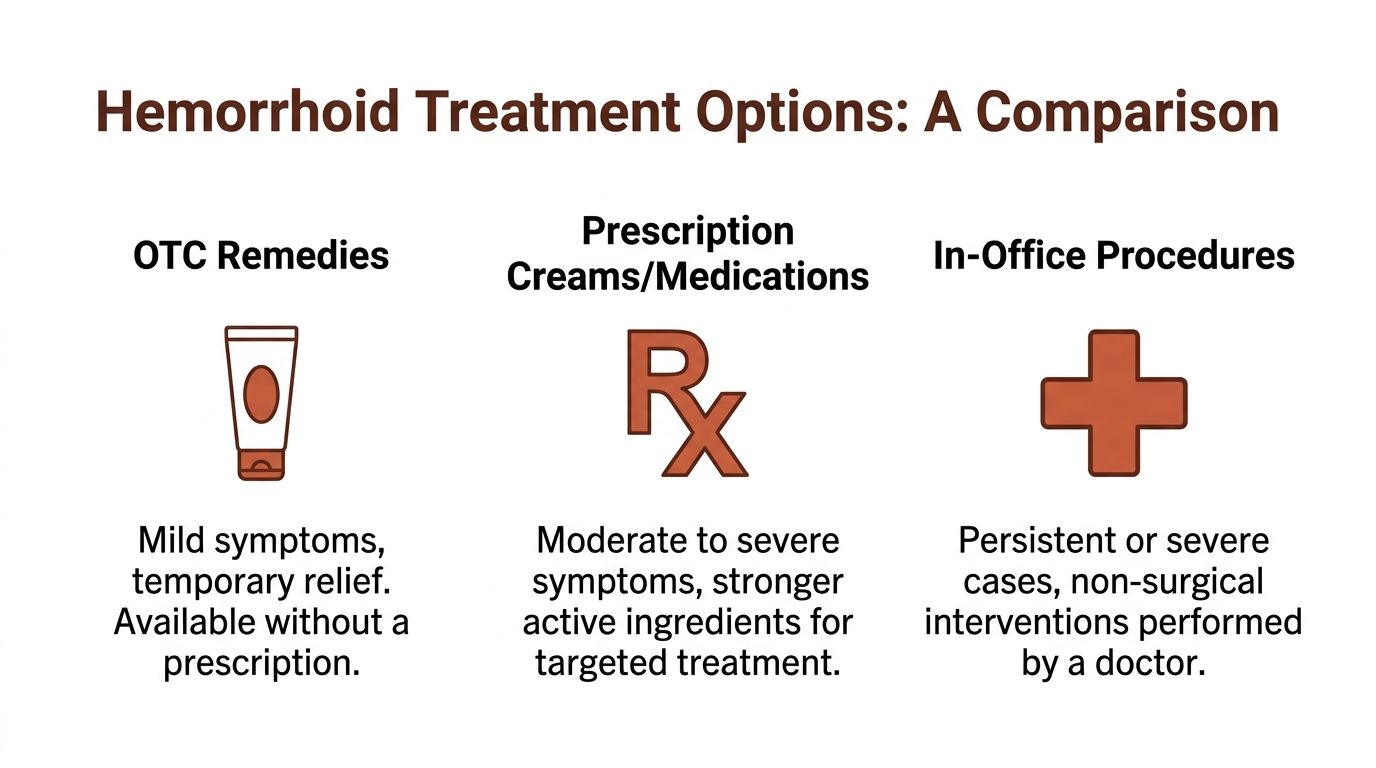
A simple treatment ladder
| Option | Best fit | Main role | Limits |
|---|---|---|---|
| OTC remedies | Mild, short-lived symptoms | Temporary soothing | May not be strong enough for persistent inflammation or pain |
| Prescription creams or medications | Moderate or stubborn symptoms | More targeted anti-inflammatory and pain relief | Need provider evaluation and careful use |
| In-office procedures | Persistent internal hemorrhoids or severe cases | Treat tissue more directly | Require in-person care |
For grade I to II hemorrhoids, pharmacological treatments, including prescription topicals, remain the leading option.
How to think about the right level of care
OTC treatment is like using a small home toolkit. It’s useful for minor fixes. If the problem is modest, that may be all you need.
Prescription hemorrhoid treatment is more like bringing in a specialized tool. The issue may still be manageable at home, but it needs better equipment and a plan designed by a provider.
Procedures enter the picture when tissue keeps prolapsing, bleeding persists, or symptoms don’t improve enough with medication. One commonly used office treatment is rubber band ligation for certain internal hemorrhoids. The idea is simple. The provider cuts off blood flow to the hemorrhoid tissue so it shrinks.
Medication and procedures aren’t rivals. Often, they’re stages of care. Many people improve with prescriptions and never need anything more invasive.
A few examples make this easier:
Brief itching after constipation: OTC care may be reasonable first.
Ongoing swelling and burning for days: A prescription cream may be more appropriate.
Repeated internal bleeding or prolapse: In-person evaluation becomes more important.
A very painful external lump: A provider may need to decide whether prescription treatment is enough or whether an office procedure makes more sense.
If you’re unsure where you fit, that uncertainty is normal. Hemorrhoids can look simple from the outside but behave differently depending on whether the problem is internal, external, thrombosed, inflamed, or mixed.
Special Considerations for Pregnancy and GLP-1 Users
Pregnancy, postpartum recovery, and GLP-1 medications change the context. The hemorrhoid isn’t the whole story. The body around it is dealing with extra pressure, slower bowel habits, or both.

Pregnancy and postpartum relief needs extra care
During pregnancy, hemorrhoids often show up because pelvic pressure increases and bowel movements may become harder or less regular. After delivery, straining and swelling can keep symptoms going.
That can make treatment feel emotionally complicated. You want relief, but you also want to be sure the medication choice makes sense for your stage of pregnancy or recovery.
Providers usually think about three things at once:
Safety first
Enough symptom control to function
A plan that doesn’t worsen constipation or irritation
This is one reason personalized prescribing matters. A formula that makes sense for one adult may not be the one a provider chooses during pregnancy or postpartum healing. Bummed has pregnancy-safe formulations available, including its Long Acting Hemorrhoid & Fissure Rx Cream.
GLP-1 constipation changes the treatment conversation
GLP-1 medications have helped many adults with weight management, but they can slow the gut and make constipation much more likely. That’s important because hard stools and straining are classic hemorrhoid triggers.
A major gap exists in this area. About 20% to 40% of GLP-1 users experience gastrointestinal side effects like constipation, yet there is little guidance on customized prescription remedies for the hemorrhoids that can follow).
That gap leaves many people stuck between two issues. They’re trying to stay on a medication that helps them, while also dealing with painful anorectal symptoms.
If constipation is the spark, hemorrhoid cream alone may not be enough. The plan often needs to address both the flare and the bowel pattern causing it.
If you’re dealing with that pattern, this article on why GLP-1 medications slow your gut and what you can do about it can add useful context. For people taking these medications, broader support matters too. This resource on maintaining muscle while taking GLP-1 medications is a helpful companion because bowel health, hydration, movement, and nutrition often overlap in real life.
How to Get a Prescription Online via Telehealth
You notice the flare at the worst possible time. You are pregnant and already uncomfortable. Or you recently started a GLP-1 medication, your bowel habits changed, and now sitting through a workday hurts. The idea of explaining rectal symptoms at a front desk, then waiting weeks for an appointment, is enough to make many people put care off.

Telehealth changes that first step. Instead of building your day around an office visit, you can answer questions from home, have a licensed medical provider review your symptoms, and get a treatment plan without the extra friction that makes sensitive care easy to delay.
What the process usually looks like
Online hemorrhoid care tends to follow a simple sequence.
You fill out a private medical intake.
You describe what is happening in plain language, such as pain, itching, swelling, bleeding, constipation, or a tender lump. These intake forms ask the same kinds of questions a careful clinician would ask in person. They are trying to sort out patterns, not just collect symptoms.A licensed provider reviews the details.
This step works like triage. The provider looks for clues that telehealth is a good fit and for signs that you may need an in-person exam instead.If telehealth is appropriate, the provider prescribes treatment.
Sometimes that means a standard prescription. In other cases, it may mean a compounded formula chosen for your symptom pattern, skin sensitivity, pregnancy status, or bowel-related triggers.Your prescription is sent to a pharmacy and shipped discreetly.
For many people, that privacy matters as much as the medication itself.
One telehealth option in this space is Bummed, which offers online intake, provider review, and shipment of custom prescription creams for anorectal conditions.
Why telehealth helps with a sensitive issue
Hemorrhoids are common, but embarrassment still delays care. Telehealth lowers that barrier by making the process feel more like a private medical conversation and less like a public errand.
That can be especially helpful if you:
Have a packed schedule and want care without taking half a day off
Prefer privacy when discussing anorectal symptoms
Need follow-up adjustments after starting treatment
Live far from a clinician who regularly treats these problems
Are pregnant or using a GLP-1 medication and want a plan that reflects those added factors
For underserved groups, that last point matters. Pregnancy changes circulation and pressure in the pelvic area. GLP-1 medications can change bowel patterns. In both cases, the hemorrhoid itself may be only part of the story. Telehealth can give people a more personalized entry point to care, especially when the question is not just "Which cream?" but "Which treatment makes sense for my body right now?"
For a broader explanation of why virtual care works well for private, time-sensitive problems, this look at 7 ways telehealth is changing acute care for good adds useful context.
Telehealth works best for symptoms that sound uncomplicated and stable. It is often the easiest way to get expert guidance early, before a short-lived flare turns into weeks of avoidable pain.
When to Seek In-Person or Urgent Care
Telehealth is helpful, but some symptoms need hands-on evaluation. In this situation, being direct is important.
Symptoms you shouldn't ignore
Seek prompt in-person care if you have any of the following:
Heavy or ongoing rectal bleeding
Severe or rapidly worsening pain
A firm lump that is extremely painful
Bleeding with dizziness
Fever along with rectal symptoms
Abdominal pain with bleeding
Symptoms that feel distinctly different from a typical hemorrhoid flare
A painful external lump can be a thrombosed hemorrhoid, and some cases need urgent assessment. Bleeding can also have causes other than hemorrhoids. That’s why persistent or significant bleeding should never be brushed off as “probably just hemorrhoids.”
Some anorectal symptoms are uncomfortable. Others are warning signs. If your body is telling you something is off in a bigger way, listen to it.
If you’re trying to decide whether home-based treatment is still appropriate, this guide on hemorrhoids and when it's time to seek in-person care can help you think it through more clearly.
Frequently Asked Questions About Prescription Hemorrhoid Treatment
How quickly does prescription treatment work
That depends on what’s driving the symptoms.
Itching, burning, and irritation often start improving within days when the prescription matches the problem well. Swelling may take longer. Severe pain from a thrombosed hemorrhoid can improve faster with targeted treatment than with basic soothing products alone.
Consistency matters. Using the medicine exactly as directed, and not only when symptoms spike, usually gives the best result.
Are prescription hemorrhoid creams safe for long-term use
Many prescription hemorrhoid creams are meant for short-term use, especially those that contain corticosteroids such as hydrocortisone. These medicines can be very helpful during a flare, but providers usually don’t want people using them continuously without supervision.
The reason is simple. Skin in this area is delicate. Long-term steroid use can irritate or thin tissue over time.
However, Bummed's creams were made to be more gentle than typical hydrocortisone rectal creams, and many patients have found success with longer-term use.
What happens if the first prescription doesn't work for me
That doesn’t automatically mean treatment failed. It may mean the diagnosis needs another look, the formula needs adjusting, or your symptoms have another component such as fissure-related spasm, constipation, or prolapse.
Tell your provider what changed and what didn’t. Be specific.
Helpful details include:
What improved first
Whether bowel movements are still painful
If bleeding continued
Whether the lump, swelling, or itch changed
Any side effects like burning, rash, or headache
Those details help the provider decide whether to change the medication, adjust how you use it, or recommend in-person care.
Can I use prescription cream for both internal and external hemorrhoids
Sometimes, yes. But the answer depends on the product and the location of the hemorrhoid.
Some prescription creams are used externally and may also be applied just inside the anal opening if the instructions specifically allow for that. Others are intended only for outside use. That’s why the label and provider instructions matter.
If you’re ever unsure, ask before applying it internally. In anorectal care, technique is part of treatment.
Bummed content is for general education and should never replace professional medical advice that considers your individual health. If you think you’re experiencing a medical emergency, call 911 or head to the nearest emergency department.
- Prescription products require an online consultation with a physician who will determine if a prescription is appropriate.*
If you’re tired of guessing which cream to try next, Bummed offers a discreet telehealth option for adults dealing with hemorrhoids, fissures, pruritus ani, and related symptoms. You can complete an online intake from home, have your symptoms reviewed by a physician, and, if appropriate, receive a prescription treatment plan without the usual waiting room friction.