You finish a heavy leg session, shower, head home, and later notice a sharp sting when you sit down or wipe. Maybe there’s itching. Maybe there’s a tender lump. Maybe you’re wondering whether your workout routine just wrecked your progress in more ways than one.
That worry is common. People who lift often ask some version of the same question: Can lifting cause hemorrhoids, or am I making an existing problem worse?
The short answer is that lifting and hemorrhoids can be connected, but the connection is usually more manageable than people fear. Heavy lifting isn’t automatically off-limits. In many cases, the bigger issue is how you lift, how often you strain, and whether something else is already increasing pressure in the same area, such as constipation. Proactive use of compounded creams has been shown to stop flare ups before they start. Incorporating this into your routine may be the difference between getting a flare up, or not.
That matters because many lifters build routines around squats, deadlifts, presses, and other comprehensive leg movements that require strong bracing. Those exercises aren’t in themselves harmful. But when technique slips and breath-holding takes over, the body can create the exact kind of pressure that turns a quiet hemorrhoid into a painful flare.
That Pain in Your Butt After Leg Day
You finish heavy squats, drive home, and everything seems normal until later. Then sitting feels sharp. Wiping stings. You may notice itching, a small tender lump, or a spot of bright red blood that was not there before.
That sequence can feel alarming, but it does not always mean a workout suddenly created a brand-new problem. In many cases, lifting acts more like a stress test. It exposes tissue that was already irritated or makes a mild hemorrhoid impossible to ignore.
That is one reason people who train hard can misread the timing. A session built around comprehensive leg movements asks your core and pelvic floor to manage a lot of force at once. If you also came into that workout constipated, dehydrated, or already straining in the bathroom, the flare can show up after leg day even though the setup started earlier.
What a flare can feel like
Symptoms after a hard session often include:
-
Itching or irritation around the anus
-
A swollen, sore, or tender bump
-
Pain with bowel movements later that day or the next morning
-
Bright red blood on toilet paper
The pattern matters. Symptoms that show up after training do not mean lifting is forbidden. They usually mean your body is telling you that pressure management needs work. If you have been wondering whether exercise can make hemorrhoids worse, the more useful question is often what else is adding strain at the same time.
A common modern example is GLP-1 medication. These drugs can help with weight loss, but they also slow digestion for some people and make constipation more likely. Then a heavy brace under the bar gets layered on top of hard stools and bathroom straining. That combination matters more than the gym alone.
Main takeaway: Heavy lifting is a manageable risk, not an automatic stop sign.
For many lifters, the goal is not to quit training. It is to spot the trigger, reduce extra pressure, and make a few smart adjustments before a small flare turns into a recurring problem.
The Pressure Problem How Lifting Strains Your Veins
The most useful way to understand lifting and hemorrhoids is to think about pressure.
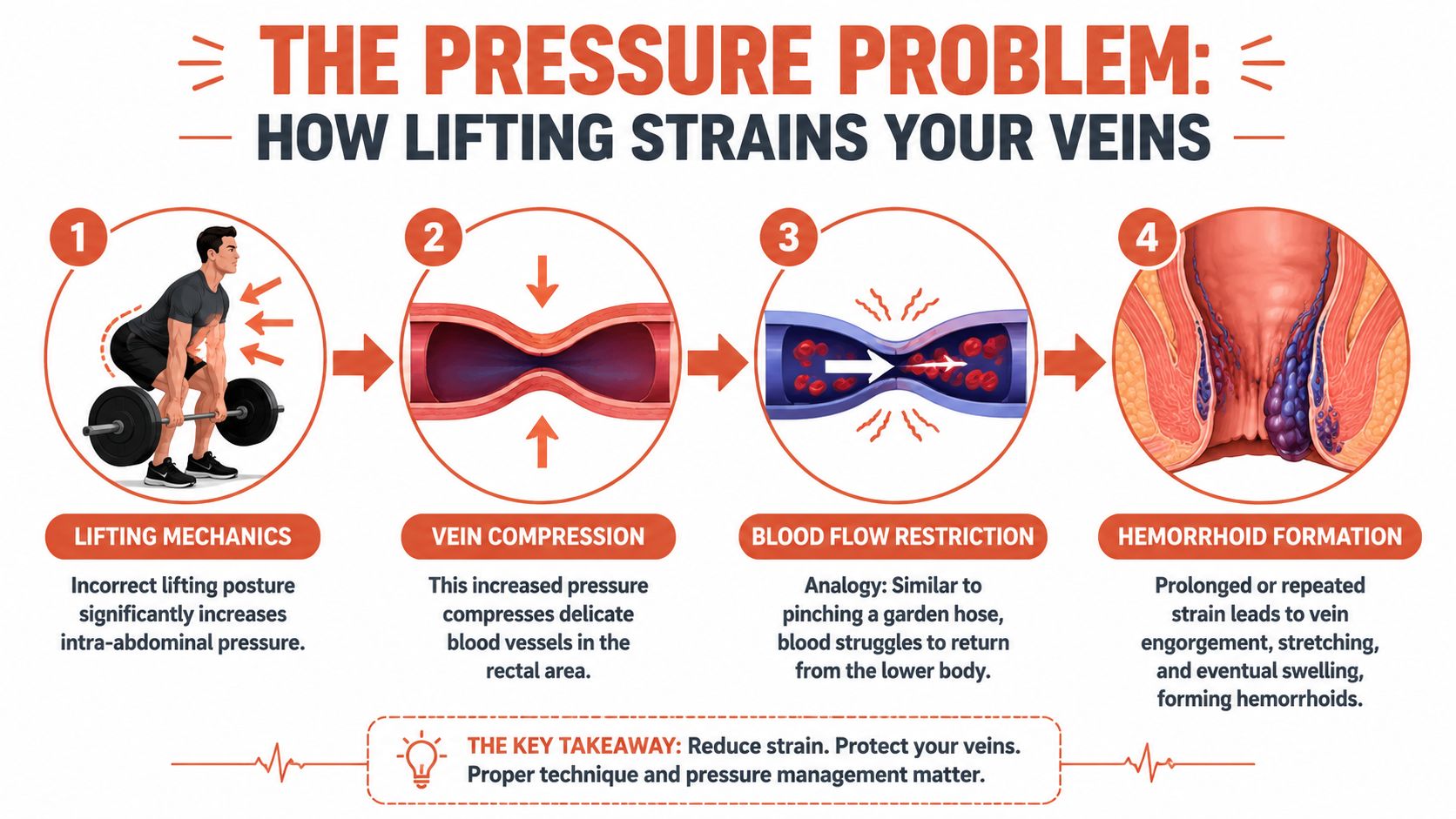
When you lift something heavy, your torso braces to create stability. That’s normal. The problem starts when bracing turns into prolonged breath-holding and straining, which can sharply raise intra-abdominal pressure. That pressure can affect the veins around the anus and lower rectum.
A simple way to picture it
Think of a garden hose. If you pinch part of the hose, flow through the system changes and pressure builds around that narrowed point. Something similar can happen when you repeatedly bear down during heavy lifts. Blood has a harder time moving back from the lower body, and the veins in the rectal area can become engorged.
That doesn’t prove every heavy lift causes hemorrhoids. It explains why symptoms can flare when form breaks down.
The Valsalva maneuver
The Valsalva maneuver is the pattern many lifters know well, even if they don’t know the name. You take a deep breath, hold it, brace hard, and push through the toughest part of the rep.
That can be useful in some lifting contexts, but it also increases pressure. According to GoodRx’s review of the evidence on weight lifting and hemorrhoids, heavy lifting is best understood as a triggering or exacerbating factor rather than a proven primary cause. The same review notes that a WorkSafeBC systematic review found no relevant studies and concluded there’s currently insufficient evidence to support a positive association between heavy lifting and hemorrhoids.
So the science has nuance. The mechanism makes sense. The broad epidemiologic proof is still limited.
What matters in real workouts
For most adults, the practical question isn’t “Does lifting always cause hemorrhoids?” It’s “What lifting habits make pressure spike more than necessary?”
Common culprits include:
-
Holding your breath too long during the rep
-
Grinding through loads that force you to bear down
-
Losing position and compensating with strain
-
Stacking high-pressure moves in one session
If you want a broader look at activity choices during a flare, our guide on whether exercise makes hemorrhoids worse can help you sort out what to keep, modify, or pause.
Even when the evidence on direct causation is limited, pressure management is still a practical target because it changes what your body experiences on every rep.
Are You at Higher Risk Key Factors to Consider
You and your training partner can finish the same squat session and get very different outcomes. One person feels normal soreness. The other notices aching, swelling, or a streak of blood later on. That gap often comes from baseline risk factors that were already present before the workout started.
Your starting point matters
Hemorrhoids are already common in adults, especially with age. As noted earlier, lifting often acts more like a stress test than a sole cause. If the veins in that area are already irritated, stretched, or prone to swelling, a hard training session may be the thing that brings symptoms to the surface.
A simple way to picture it is this. Heavy lifting adds pressure to a system that may already be under load. The barbell is not always the whole problem. Sometimes it is the last straw.
Risk factors tend to pile up
Symptoms are more likely when gym strain overlaps with bathroom strain or daily habits that keep pressure high.
Your risk may be higher if you also deal with:
-
Constipation or hard stools
-
Low fiber intake that dries stool out
-
Repeated straining on the toilet
-
Pregnancy or postpartum changes
-
A family history of hemorrhoids or vein issues
-
Long hours of sitting at work, while driving, or both
Each factor adds a little more load. Put several together, and even a well-planned lifting program can become more irritating to the veins around the rectum.
GLP-1 medications can shift your risk
This matters more now because some people taking GLP-1 medications for weight loss or diabetes notice slower digestion or constipation. If stool becomes harder to pass, pressure is no longer coming only from deadlifts, squats, or pressing. It is also happening during bowel movements.
That combination can catch people off guard. They blame the gym, but the bigger pattern is often gym pressure plus constipation pressure. If that sounds familiar, our guide on how long stool softeners are safe to use can help you prepare for a discussion with a provider.
Equipment and technique choices matter too
Belts can be useful tools, but they are not magic protection. A belt helps you create trunk stiffness. If you already strain hard during heavy reps, that added bracing can still raise pressure in the places you do not want it. If you use one, spend some time choosing a weightlifting belt that fits your training style and learn how to brace without turning every rep into an all-out push.
A quick self-check
These questions can help you spot patterns:
| Question | Why it matters |
|---|---|
| Do symptoms show up after your heaviest sets? | Pressure-related flares often track with the hardest efforts. |
| Do you strain during bowel movements too? | That suggests pressure is building in more than one setting. |
| Have your stools gotten harder or less frequent lately? | Constipation often makes lifting-related symptoms more likely. |
| Are you using near-max loads often? | Longer, harder bracing usually means more vein stress. |
More than one “yes” does not mean you need to stop lifting. It usually means your risk is manageable if you lower pressure from several angles at the same time.
Smart Lifting Strategies to Prevent Hemorrhoids
Most prevention comes down to one goal: reduce unnecessary pressure without abandoning training.
For people who already have hemorrhoids, Colorado Colon & Rectal Specialists’ guidance on weightlifters and hemorrhoids points to the highest-risk pattern as lifting that increases abdominal bracing time and repeated pressure spikes, especially near maximal loads or with poor form. They also advise avoiding heavy lifting during symptomatic flares.
Breathing changes the whole rep
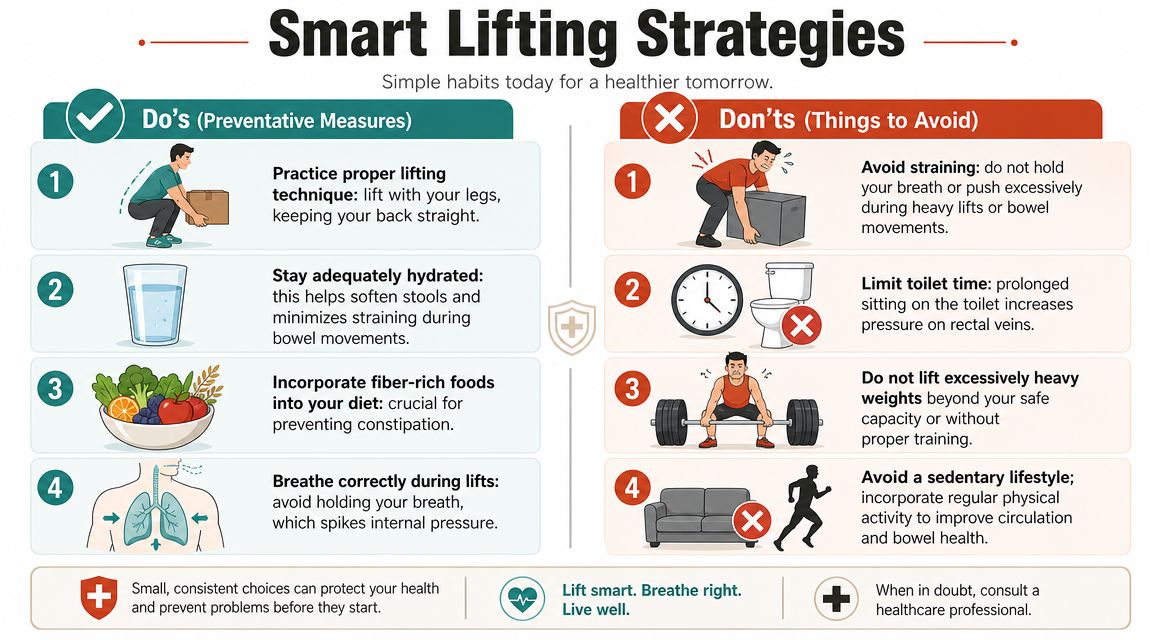
The fastest adjustment for many lifters is simple: exhale through the effort instead of locking down and pushing against a closed throat.
That doesn’t mean lifting without tension. It means controlling pressure so the rep is strong without turning your pelvis and rectal veins into the place where all that force lands.
Practical rule: If you catch yourself turning every working set into a breath-holding contest, the load is probably asking more from your body than it needs to.
Change the session, not just the exercise
You don’t always need to cancel lower body training. Often, you need to lower the pressure cost of the workout.
Try these adjustments:
-
Use submaximal loads so reps stay crisp and don’t turn into long grinders.
-
Shorten sets if the final reps consistently force breath-holding.
-
Slow the descent and stay controlled instead of dropping into the bottom position and straining out.
-
Rest longer between hard sets so fatigue doesn’t wreck form.
-
Swap high-pressure moves for variations that let you train the same pattern with less bracing demand.
Examples can help. If heavy back squats trigger symptoms, front-loaded goblet squats, split squats, machine work, or controlled leg presses at a lower effort may be easier to tolerate. If deadlifts are the issue, lighter Romanian deadlifts or hinge accessories may give you room to train without the same all-out pressure spike.
Technique tools can help, but they aren’t magic
Some lifters also revisit setup gear. If you’re learning about choosing a weightlifting belt, focus on fit, comfort, and how it affects your breathing pattern. A belt can improve awareness and trunk stability for some people, but it won’t fix poor pressure management on its own.
During a flare, think temporarily
If symptoms are active, this is usually the wrong time to test your limits. Walking, light cardio, and lower-strain movement often make more sense than trying to prove you can power through.
Our guide on if exercising makes hemorrhoids worse can help you decide what to keep doing while symptoms calm down.
Recognizing Symptoms and When to See a Provider
A mild flare can feel annoying but manageable. A more serious problem can look similar at first, which is why symptom recognition matters.
Common symptoms of hemorrhoids
Many adults notice one or more of these:
-
Itching around the anus
-
Pain or soreness, especially after bowel movements or training
-
Swelling or a palpable lump
-
Bright red blood on toilet paper or in the bowl
-
A feeling of fullness or irritation when sitting
These symptoms can happen with internal or external hemorrhoids. They can also overlap with other anorectal conditions, which is one reason persistent symptoms deserve attention.
Signs that deserve prompt evaluation
Some symptoms should push you to contact a provider rather than guessing.
Seek medical care promptly if you have:
-
Bleeding that keeps happening or seems heavy
-
Severe pain, especially if it starts suddenly
-
A lump that becomes very painful or hard
-
Tissue that protrudes and won’t go back in
-
Symptoms that don’t improve with basic care and activity changes
A provider can help confirm whether this is a hemorrhoid flare, a thrombosed external hemorrhoid, an anal fissure, or something else entirely.
Don’t normalize symptoms just because you lift
Gym culture can make people shrug off pain they’d take seriously in any other body part. That’s a mistake.
If you had repeated bleeding from your elbow every time you trained, you wouldn’t call that normal adaptation. The same logic applies here. Recurring pain, swelling, or bleeding deserves a real answer.
Ongoing anorectal symptoms are common, but “common” doesn’t mean you have to self-diagnose forever.
Modern Discreet Treatment for Hemorrhoid Relief
Hemorrhoids can feel awkward to talk about, which is one reason many adults wait too long to get help. That’s especially true for active people who are busy, embarrassed, or convinced they should just tough it out.
That delay doesn’t always make sense. A 2024 PMC study on sport practice and hemorrhoidal disease found that 34% of the overall sample reported hemorrhoidal disease, while 48% of those practicing bodybuilding reported hemorrhoids. When a problem shows up that often in a fitness-related group, accessible treatment matters.
What treatment can look like now
Depending on symptoms, treatment may involve home measures, changes to bowel habits, activity modification, or prescriptions reviewed by a provider. Telehealth has made that process more private and far easier to fit into real life.
Bummed’s hemorrhoid treatment guide covers practical symptom relief, and Bummed also offers online intake with provider review for prescription treatment when appropriate. That can be useful for adults who want care without waiting weeks for an in-person visit.
What to expect from a practical plan
A solid treatment plan usually addresses more than the bump or bleeding itself. It also looks at the habits that keep the area irritated.
That often includes:
-
Calming symptoms so pain, itching, or swelling improve
-
Reducing bowel strain by addressing constipation
-
Adjusting training temporarily so healing isn’t interrupted
-
Watching for patterns such as flare-ups after specific lifts or medication changes
For many people, the goal isn’t just short-term relief. It’s getting back to training with fewer setbacks and less guessing.
Frequently Asked Questions About Lifting and Hemorrhoids
Can lifting cause hemorrhoids, or just make them worse?
For most adults, heavy lifting is better viewed as a trigger or aggravating factor. It can increase pressure and bring symptoms to the surface, especially if you already have hemorrhoids or are prone to constipation.
Which exercises are most likely to flare symptoms?
Exercises that involve prolonged bracing and high pressure are often the biggest problem. Heavy squats, deadlifts, leg press, and hard core movements can all be rough during a flare, especially if your form slips or you hold your breath.
Should we stop lifting completely during a flare?
Not always. Many people do better by temporarily reducing load, shortening sessions, and choosing lower-strain movements. Walking is often a smart option when symptoms are active. If pain or bleeding is significant, pause heavy compound lifting until a provider weighs in.
Can hemorrhoids from lifting go away on their own?
They can. Mild hemorrhoid symptoms sometimes settle with rest, hydration, softer stools, and less straining. If symptoms keep returning, get evaluated instead of repeating the same cycle.
How do we know when it’s safe to return to heavy lifting?
A reasonable sign is when pain, swelling, and bleeding have settled and you can have bowel movements without significant straining. Start back with lighter loads and cleaner breathing before returning to heavy work.
Does a belt prevent hemorrhoids?
Not by itself. A belt can support lifting mechanics for some people, but it won’t cancel out poor breathing, excessive load, or constipation.
Bummed content is for general education and should never replace professional medical advice that considers your individual health. If you think you’re experiencing a medical emergency, call 911 or head to the nearest emergency department.
Prescription products require an online consultation with a physician who will determine if a prescription is appropriate.
If lifting and hemorrhoids keep colliding, Bummed offers a private way to get evaluated and, if appropriate, receive prescription treatment reviewed by a provider without putting your routine on hold longer than necessary.