
A fissure can make a normal bowel movement feel like a fresh injury. The pain is often sharp, then followed by burning, throbbing, or spasm that lingers long after you leave the bathroom. Many adults start changing how they eat, delaying bowel movements, or reaching for random creams just to get through the day.
That cycle usually makes healing harder, not easier. The right fissure heal plan is simpler than commonly believed. Protect the tear, keep stool soft, relax the internal anal sphincter, and know when symptoms are improving versus merely fluctuating.
Understanding Anal Fissures and Your Healing Path
An anal fissure is a small tear in the lining of the anal canal, but the symptoms feel much bigger than the size of the wound. The reason is physiology. A fissure triggers spasm in the internal anal sphincter. That tight muscle reduces blood flow to the area, and lower blood flow makes it harder for the tear to close. Then the next hard stool or straining episode reopens it.
That is why people often say, “I felt better for a day, then it came right back.” They are not imagining it. A fissure can be temporarily calmer without being fully healed.
Why the pain keeps repeating
Most patients benefit from thinking about fissure healing as a three-part job:
Soften the stool: Hard or bulky stool causes repeat trauma.
Relax the muscle: Spasm keeps the wound under tension.
Improve local blood flow: Better perfusion gives the tissue a chance to repair itself.
When any one of those is missing, the fissure often stalls. That's why over-the-counter products aimed at “rectal discomfort” frequently disappoint. They may numb the area for a short time, but they usually don't address the tight sphincter that keeps the fissure open.
Practical rule: Less pain does not always mean the fissure is healed. A healing fissure usually shows a pattern of easier bowel movements, less spasm afterward, and gradually less bleeding over time.
A major gap in online advice is expectation setting. Mayo Clinic and Johns Hopkins note that acute fissures often heal within weeks with conservative care, but complete healing can still take 6 to 12 weeks in practice, which is why people need a clearer framework for what progress looks like (Mayo Clinic guidance on diagnosis and treatment).
For adults recovering after pregnancy and delivery, bowel-related pain can overlap with broader pelvic recovery.
If you're sorting out whether your symptoms fit a fissure, hemorrhoids, or another source of anal pain, this guide to hemorrhoids, anal fissures, and anal itching can help you separate the patterns.
Immediate Relief Your First 72 Hours At-Home Care Plan
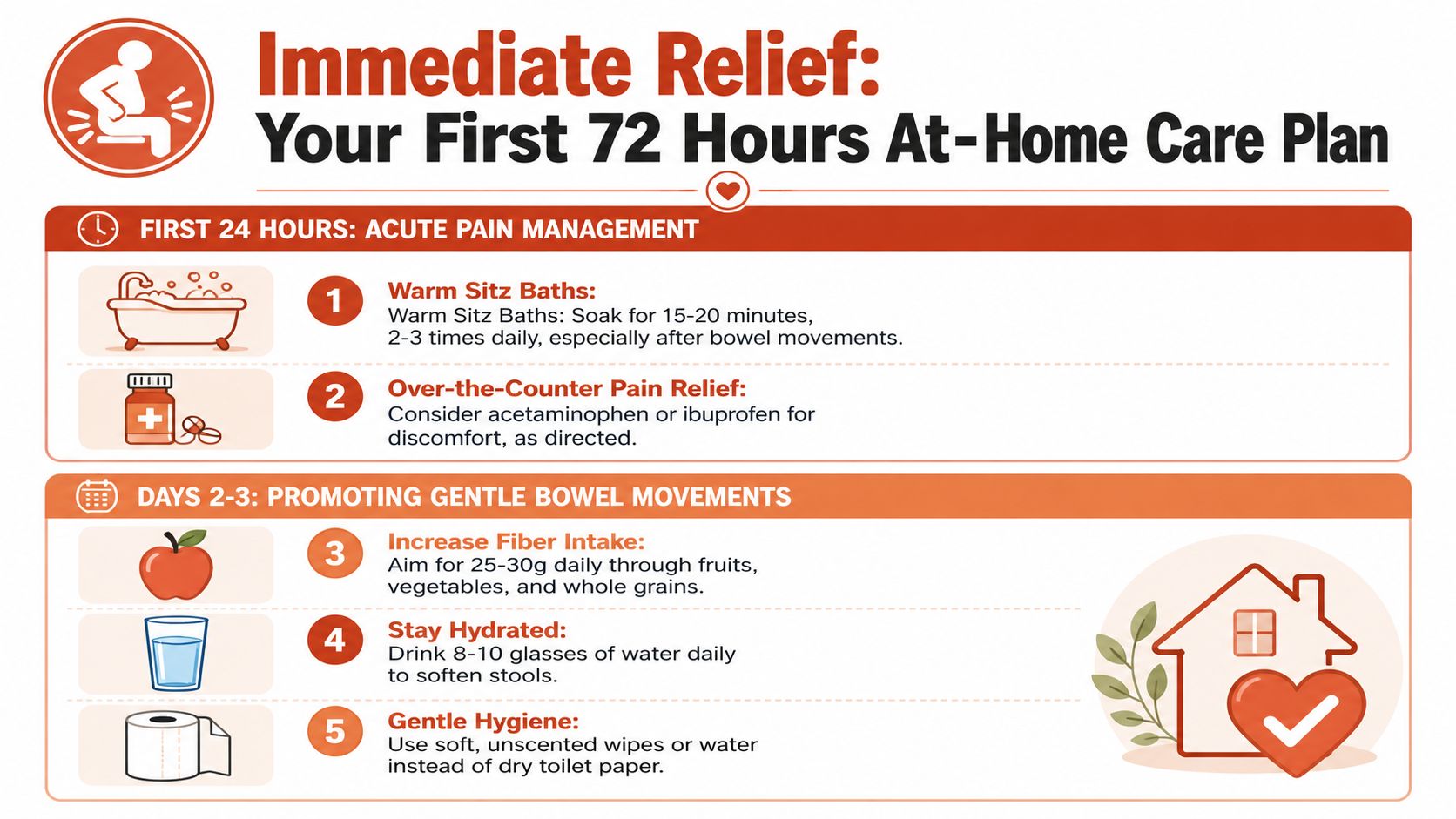
The first three days matter because this is when many people either calm the cycle or make it worse. The job is not to “fix everything” immediately. The job is to stop fresh tearing and reduce sphincter spasm enough that healing can start.
What to do in the first day
Start with warmth, hydration, and gentleness.
Use warm sitz baths: Soak for about 15 to 20 minutes, especially after bowel movements and again later in the day if spasm persists. Warmth helps the muscle relax.
Drink steadily through the day: Don't try to “catch up” with a large amount all at once. The goal is softer stool over the next several bowel movements.
Eat for softness, not volume: Favor foods that pass gently. Oatmeal, fruit, cooked vegetables, soups, and other easy-to-tolerate high-fiber foods are usually better than a sudden jump into very heavy bran intake.
Clean the area gently: Water, a bidet, or soft unscented wipes are often better tolerated than dry toilet paper.
What to focus on during days two and three
By this point, the next bowel movement becomes the key event. You want it soft, unforced, and fast.
Don't strain: If you're sitting and pushing, the fissure is losing.
Don't linger on the toilet: Waiting, scrolling, and repeated pushing all increase pressure.
Keep walking: Light activity helps bowel motility and often reduces the sense of pelvic “clenching.”
Stay consistent: One soft bowel movement does not erase the need for careful habits the rest of the week.
We would recommend, as soon as you feel a fissure, to complete our online quiz to determine if it's a fissure and to get your prescription sent as quickly as possibly to you, if deemed appropriate by our medical providers. Both Rapid Relief Hemorrhoid & Fissure Rx Cream, which contains nitroglycerin, and Long-Acting Hemorrhoid & Fissure Rx Cream, which contains diltiazem, are clinically proven to help heal fissures. Bummed's Sensitive Care Hemorrhoid & Fissure Rx Cream contains nifedipine, which is also effective and can be more gentle for those who experience adverse side effects to nitroglycerin and diltiazem. More on this below.
In a cohort of 623 patients with acute anal fissure managed conservatively, the fissure healed completely in 70.5%, and another 18.0% healed with an epithelialized scar. The median time to being free of symptoms was 11 weeks, and recurrence still occurred in 28.9% overall (study of conservative management outcomes). That's why early home care matters, but patience matters too.
The best early plan is boring on purpose. Warmth, soft stool, gentle hygiene, and no straining work better than cycling through random products.
Many adults also find that a structured routine helps them follow through. This overview of sitz bath benefits is useful if you want a simple comfort measure that fits easily into the first few days.
What usually slows healing
People lose time here.
Over-the-counter hemorrhoid creams: These don't treat the core problem in a fissure, which is sphincter spasm and reduced blood flow.
Aggressive wiping: Mechanical irritation can keep the area inflamed.
Ignoring constipation: A fissure won't reliably heal if every bowel movement reopens it.
Skipping food to avoid bowel movements: That often backfires and leads to harder stool later.
Beyond Basics Topical Treatments That Actually Heal
Once the immediate flare is calmer, the next question is whether your treatment is just numbing pain or truly helping the fissure heal. That difference matters. A fissure is not merely irritated skin. In many persistent cases, the internal anal sphincter is too tight. That tightness keeps the wound under stress and limits blood flow.
That's where prescription topicals make sense. They are designed to change the local physiology, not just distract you from symptoms.

Why effective topicals work differently
There are two broad treatment categories people often confuse.
| Type | What it mainly does | Limitation |
|---|---|---|
| Temporary comfort products | Numbs, coats, or soothes the surface | Usually does not relax the sphincter |
| Prescription fissure treatments | Relaxes muscle and supports blood flow | May need consistent use and monitoring |
The classic prescription ingredients used for fissures target sphincter hypertonicity.
Nitroglycerin: Helps relax the internal sphincter through nitric oxide effects. It can be useful when quicker sphincter relaxation is needed, though headaches can limit tolerance in some people.
Diltiazem: A calcium channel blocker used topically to relax the sphincter with a side-effect profile many adults tolerate better than nitrates. Evidence shows it reduces maximum resting pressure by approximately 28% for 3 to 5 hours after application and yields healing rates of 67-73% in chronic cases, as described in this review of topical diltiazem for chronic fissures.
Nifedipine: Another calcium channel blocker that helps reduce anal sphincter tightness and is often a reasonable option when nitrates are not well tolerated.
Metronidazole: Not a primary fissure-healing medicine on its own, but sometimes included when local inflammatory pain is part of the problem.
What works and what usually doesn't
What works is matching treatment to mechanism. If the fissure keeps retearing because the sphincter is tight, then a topical that relaxes the muscle can make sense. If the area is only being numbed, the muscle may still clamp down after every bowel movement.
That's why we don't view all creams as interchangeable. They are not.
A fissure usually heals faster when treatment addresses the reason it's stuck open.
A practical example is a compounded prescription approach. Bummed offers prescription anorectal creams that may combine evidence-based ingredients such as diltiazem, nitroglycerin, nifedipine, or metronidazole when a board-certified provider determines they're appropriate. The logic is straightforward: some adults have a fissure plus hemorrhoidal irritation, spasm, or inflammatory pain at the same time, and a single custom formula can address more than one factor. A licensed medical provider will review your symptoms and determine what treatment is best for you.
Where chronic fissure data becomes important
Once a fissure becomes chronic, treatment selection matters much more. According to StatPearls, lateral internal sphincterotomy has durable healing in more than 90% of cases, and some studies report about 96% complete resolution within 3 weeks, with recurrence estimated at 4% to 6%. For botulinum toxin (otherwise known as botox injections), a long-term study reported 73.8% complete healing at 5 years, and outcomes were better with 50 to 100 IU than 25 IU or less, and better with anterior than posterior injection (StatPearls review of anal fissure treatment).
If you want a closer look at one of the most commonly used topical options, this overview of diltiazem for anorectal pain and fissures explains why it's often chosen before procedural treatment.
Tracking Your Progress and Expected Healing Timelines
People often ask the same question in different words: “Is this healing?” The only useful answer is to look for trends, not single days. Fissures can fluctuate. What matters is whether the overall pattern is moving toward easier bowel movements and less post-bowel-movement pain.
An acute anal fissure is usually a newer tear. Johns Hopkins Medicine says acute fissures typically heal within 6 weeks with conservative treatment. A 2025 study of 72 patients with acute anal fissure found an 88% overall healing rate, while the median time to being free of symptoms was 11 weeks and 11.6% had no healing observed during follow-up (Johns Hopkins overview of anal fissures).
Signs that your fissure heal plan is working
Look for these changes together, not one in isolation:
Pain changes character: Sharp tearing pain becomes shorter, less intense, or less frequent.
Bleeding decreases: You may still see a small amount at first, but it should trend down.
Spasm eases after bowel movements: Less lingering throbbing usually means the muscle is less reactive.
Daily life gets easier: Sitting, walking, and exercising lightly become less noticeable.
Signs you're only having a better day
A temporary improvement often looks like this:
One easy bowel movement followed by another painful one
Less pain but ongoing bleeding with no downward trend
Relief only on days you skip bowel movements
Repeated tearing sensation despite careful hygiene
Healing tends to be gradual, not dramatic. Most adults notice the bowel movement itself gets less punishing before they feel “normal” again.
If your symptoms have lasted longer than expected, or you're trying to decide whether your fissure is still in the healing window, this guide on how fissures heal over time can help you judge the pattern more accurately.
When At-Home Care Is Not Enough Advanced Therapies
A persistent fissure is not a personal failure. It usually means the muscle spasm, tissue changes, or underlying bowel pattern are strong enough that home care alone won't close the wound. At that point, the discussion shifts from “What else can I try at home?” to “Which next treatment has the best trade-off for my situation?”
Botulinum toxin
Botulinum toxin (Botox) is a reasonable next step for many chronic fissures because it temporarily relaxes the internal sphincter without cutting the muscle. That gives the fissure a better environment to heal.
A 5-year outcomes study found healing after the first botulinum toxin injection was 65.8%, rising to 73.8% after a second injection. It also found better 2-month healing with 50 to 100 IU than with lower doses, and better outcomes with an anterior injection site than a posterior one (5-year botulinum toxin outcomes study).
That detail matters because it shows botulinum toxin is not one uniform treatment. Dose and injection approach influence results.
Lateral internal sphincterotomy
For chronic fissures that won't heal with conservative measures or prescription topicals, lateral internal sphincterotomy, often shortened to LIS, remains the gold standard. The operation works because it reduces the sphincter tension that keeps the fissure trapped in the spasm-injury cycle.
A practical way to understand this is:
Botulinum toxin: Temporary muscle relaxation, no cutting, useful when a less invasive option is preferred.
LIS: Procedural correction of the core physiology, usually chosen when the fissure is stubborn or recurrent.
How to decide when to escalate
These are common signs that it's time to speak with a provider about advanced therapy:
Symptoms keep returning: You improve, then retear repeatedly.
Bleeding or severe pain persists: Especially after a full course of bowel management and topical treatment.
The fissure has become chronic: Longstanding fissures often need more than supportive care.
You're avoiding bowel movements because of fear: That pattern tends to worsen constipation and further delay healing.
The right next step depends on your symptoms, exam findings, and bowel pattern. But advanced therapies are established, rational tools. They are not last-ditch measures reserved for extreme cases.
Preventing Recurrence Keeping Fissures from Coming Back
The best fissure heal result is staying healed. That requires a prevention plan, not just a rescue plan. The target is not “more fiber” in the abstract. The target is consistently soft, easy-to-pass stool.
For many adults, recurrence happens when life gets busy and bowel habits drift. Travel, stress, low fluid intake, changes in diet, heavy lifting, and medication-related constipation can all push the anal canal back into the same injury pattern.
The prevention habits that matter most
Prioritize stool consistency: Your bowel movement should pass without straining or a sense of dragging.
Respond to the urge: Holding stool often makes it drier and harder.
Stay active: Walking helps many adults keep bowel function more predictable.
Use warm soaks early: If you feel spasm returning, don't wait for a full flare.
Avoid random rectal products: If symptoms are recurring, get the diagnosis right rather than self-treating indefinitely.
The GLP-1 issue many articles skip
A major modern recurrence trigger is medication-induced constipation, especially with GLP-1 weight-loss drugs. Cleveland Clinic notes constipation as a common adverse effect, and one 2025 report estimated 47.3 million current GLP-1 users worldwide while projecting 700 million by 2035, making recurrence-prevention guidance increasingly important (Cleveland Clinic overview of anal fissures).
If you're on a GLP-1 medication, prevention usually means being more proactive, not just more patient. Review bowel habits early, adjust hydration and fiber thoughtfully, keep moving, and talk with your prescribing provider if constipation is becoming routine. We would also recommend to have Bummed meds on hands so you can tackle a fissure flare-up early, and not have to suffer.
Frequently Asked Questions About Fissure Healing
How do we know if a fissure is healing or just less irritated today?
Look for a trend across multiple bowel movements. Real healing usually means less sharp pain, less lingering spasm, and less bleeding over time. A single good day doesn't prove the fissure has closed.
Can a fissure bleed even while it's healing?
Yes. Small amounts of bleeding can still happen during healing, especially if stool is firmer than ideal. What matters is whether bleeding is becoming less frequent and less noticeable. If it persists or worsens, get re-evaluated.
Is a fissure the same as a hemorrhoid?
No. A fissure is a tear in the anal lining. Hemorrhoids are swollen vascular tissue. They can cause overlapping symptoms, which is why so many adults treat the wrong problem first.
What usually helps the fastest at home?
Warm sitz baths, careful hydration, soft stools, gentle hygiene, and avoiding straining give the quickest early relief for many adults. The fastest durable improvement usually happens when treatment also addresses sphincter spasm.
What home remedy commonly delays real healing?
Over-the-counter hemorrhoid creams are a common detour. They often don't address the underlying fissure physiology, and they can delay proper diagnosis and treatment. Bummed's medications include clinically-proven fissure healing ingredients, like Diltiazem and Nitroglycerin. We recommend consulting with a Bummed provider to find out if these creams are right for you, and to have on-hand the next time you have a fissure flare-up.
When should we stop trying home care alone?
If pain, bleeding, or retearing keeps happening despite a consistent bowel regimen and appropriate topical treatment, it's time to speak with a provider about next-step options such as prescription therapy, botulinum toxin, or procedural treatment.
If you need a more structured treatment path, Bummed offers online evaluation by a board-certified provider for anorectal conditions, including anal fissures, with prescription treatment if appropriate.
Bummed content is for general education and should never replace professional medical advice that considers your individual health. If you think you're experiencing a medical emergency, call 911 or head to the nearest emergency department.
Prescription products require an online consultation with a physician who will determine if a prescription is appropriate.