

Hemorrhoids often make people feel stuck. You want relief, but the idea of moving your body — even something as simple as a walk — can sound risky when sitting already hurts, bowel movements are frustrating, and workouts seem like they might make things worse.
The short answer is yes, exercise and walking can both help with hemorrhoids. The important detail is that the right kind of movement helps, and the wrong kind can aggravate symptoms. Walking in particular is one of the safest, most accessible places to start: it’s gentle, easy to scale up or down depending on how you feel, and it directly supports the two things that matter most here — steadier circulation and easier bowel movements. Other gentle, steady movement (swimming, pelvic floor work) supports the same goals. High-pressure activities tend to do the opposite.
A lot of people also assume exercise only matters if they’re trying to lose weight. That’s too narrow. Even a daily walk can help your body move stool along more smoothly and reduce the straining that commonly sets off hemorrhoid flares — which is exactly why it’s worth its own close look before we get into the rest of your exercise options.
The Role of Exercise in Managing Hemorrhoids
Walking is the clearest example of this, but the same logic applies to exercise more broadly. Exercise can be one of the most useful non-surgical tools for hemorrhoid care. Not because it “fixes” swollen veins overnight, but because it helps address the daily habits that often keep hemorrhoids irritated. If you’ve been looking for something beyond wipes, creams, and wishful thinking, movement is a reasonable place to start.
The key is choosing gentle, low-pressure activity. Walking, swimming, and pelvic floor work usually support recovery. Heavy lifting, hard straining, and activities that press directly on the rectal area often don’t.
People often ask whether rest is better than exercise during a flare. Usually, total inactivity isn’t the answer. Long periods of sitting can add pressure and slow bowel movement patterns. Thoughtful movement tends to work better.
Practical rule: Think “steady and comfortable,” not “intense and sweaty.”
That same principle shows up in other conditions that get worse with the wrong mechanics. For example, people modifying workouts for back pain often do better with guided form changes rather than stopping all movement.
Hemorrhoids also have a circulation component. Better blood flow and less constipation often go hand in hand, which is why bowel habits and vein health are linked. We’ve written more about that connection in this explanation of diosmin, circulation, and hemorrhoid health.
How Gentle Movement Eases Hemorrhoid Symptoms
Gentle exercise helps in a few different ways at once. That’s why a simple habit like walking can matter more than people expect.

It helps stool move with less straining
One of the biggest drivers of hemorrhoid symptoms is constipation and straining. Moderate movement helps the intestines keep things moving. That can make bowel movements more regular and less forceful.
The CDC recommends adults get 150 minutes of moderate aerobic activity weekly, and Harvard Health notes that as little as 20 to 30 minutes of brisk walking daily can help stimulate bowel function — one of the more direct ways movement supports hemorrhoid prevention and relief.
If your digestion feels sluggish, movement is often one part of the solution. So is understanding how your gut physically moves food and waste along. This guide on how to improve gut motility can help connect those dots.
It improves circulation to the area
A simple analogy helps here. Think of circulation like traffic flow on a highway. When traffic keeps moving, there’s less backup. When it stalls, pressure builds.
The same basic idea applies to the tissues around the rectum. Moderate movement supports blood flow, and better blood flow helps deliver oxygen and nutrients to irritated tissue. That doesn’t mean exercise magically shrinks hemorrhoids in one session. It means your body often handles inflammation and healing better when you aren’t completely sedentary.
Better movement habits often help because they reduce the conditions that let pressure build day after day.
It can reduce ongoing pressure on pelvic tissues
Exercise also supports weight management and general muscle function. For some adults, that means less chronic pressure through the abdomen and pelvic region over time.
People often get confused. They hear “exercise helps” and assume harder exercise must help more. With hemorrhoids, that isn’t usually true. Gentle movement works because it supports the body without forcing more pressure downward.
Best Exercises for Hemorrhoid Prevention and Relief
The best exercise plan for hemorrhoids is usually boring in the best way. It’s repeatable, low impact, and unlikely to trigger more pressure where you don’t want it.
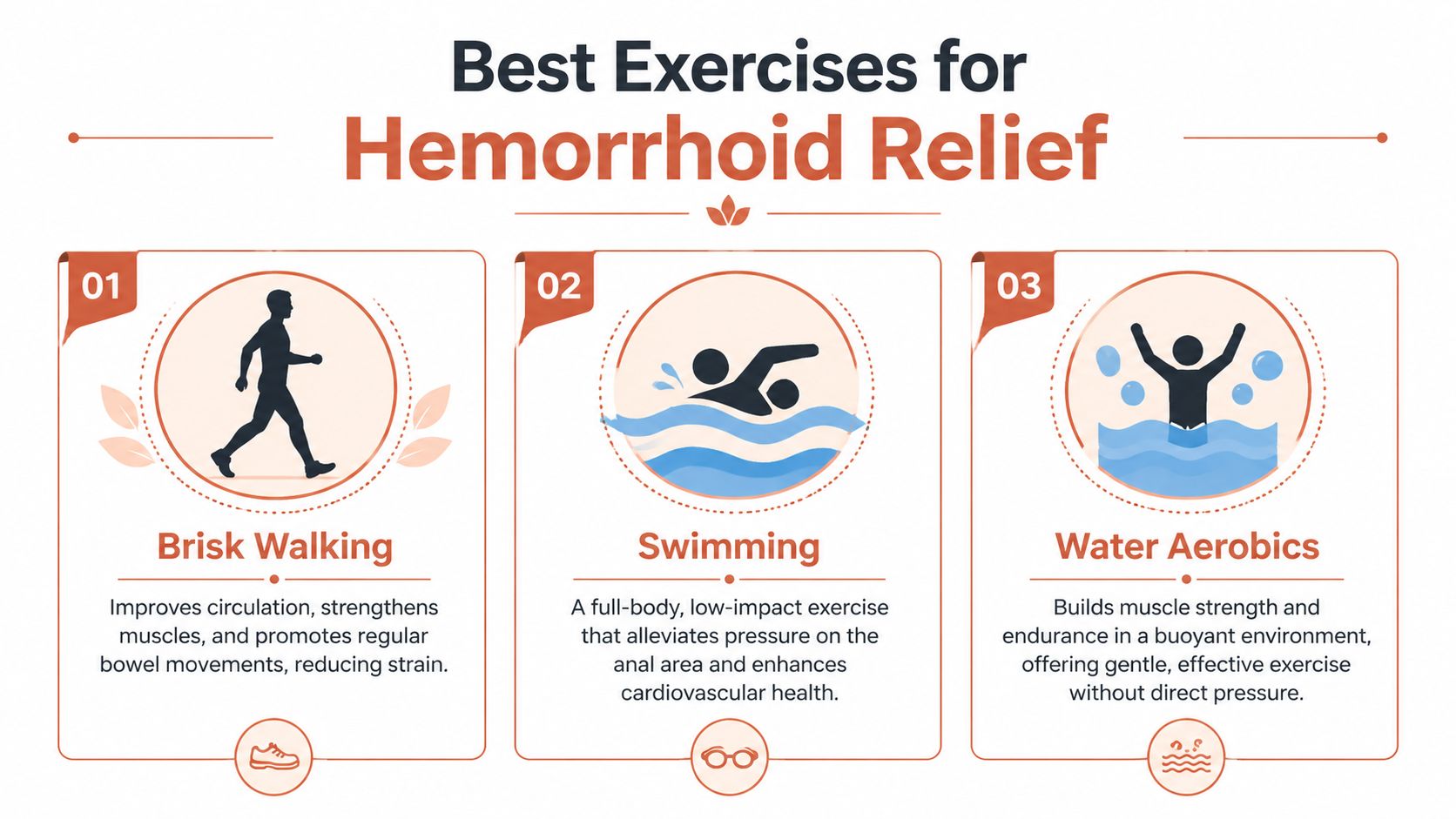
Walking is usually the best place to start
If someone asks us for the single most practical option, we usually say walking. It’s accessible, easy to scale, and less likely to increase rectal pressure than heavy gym sessions.
A brisk walk after meals can help your digestive tract stay active. It also breaks up long stretches of sitting, which many people notice makes them feel worse.
Match your walk to where you are in a flare
How you walk should shift depending on whether you’re mid-flare or just maintaining a routine.
During a flare-up, keep it easy and controlled: a relaxed pace you could hold a conversation through, a short distance to start, flat and smooth ground, loose and breathable clothing, and cushioned shoes. Stop if pain changes character — mild awareness is very different from a sharp increase in discomfort.
For prevention, between flares, consistency matters more than intensity. Start from your current baseline and build slowly. A short walk after meals can help keep digestion moving. Keep your posture upright rather than slouched, since slouching adds abdominal pressure.
A simple rule of thumb: during a flare-up, walk for relief. Between flares, walk for regularity.
Pelvic floor work can help with bowel mechanics
Pelvic floor exercises matter because hemorrhoids aren’t just about veins. They’re also about pressure and coordination during bowel movements.
Pelvic floor exercises like Kegels work by strengthening the muscles that support the rectum and help control the anal sphincter during a bowel movement. Better control here generally means less pushing and straining — one of the most consistent contributors to hemorrhoid flares. A simple starting point is 10 to 15 gentle contractions daily, holding briefly before fully releasing.
That sounds technical, but the practical takeaway is simple. If the muscles around the pelvic outlet work better, you may push less.
A few practical options:
-
Kegels: Gently contract the pelvic floor, hold briefly, then release fully.
-
Pelvic tilts: Useful for people who feel tension through the lower back and pelvis.
-
Deep diaphragmatic breathing: Helps avoid breath-holding, which can increase pressure.
Swimming and water aerobics are good low-pressure options
Water supports body weight, which makes movement feel easier for many adults during a flare. Swimming and water aerobics can raise your heart rate without putting direct pressure on the anal area.
For people who can’t comfortably tolerate land workouts, water-based exercise can be a smart bridge back into regular movement.
Gentle food changes help these workouts work better. If you’re trying to move more but still strain on the toilet, start with high-fiber foods for constipation.
Gentle yoga can be helpful if you choose the right poses
Not every yoga class is hemorrhoid-friendly. But some poses can help reduce tension and encourage relaxation.
Common examples include Child’s Pose, gentle stretching, and positions that don’t require bearing down. The goal isn’t to “stretch out” a hemorrhoid. The goal is to calm the surrounding muscles and lower pressure.
Hemorrhoid-friendly exercises vs exercises to avoid
| Exercises That Help | Why It Works | Exercises to Avoid or Modify | Why It’s Risky |
|---|---|---|---|
| Brisk walking | Supports bowel regularity and circulation without much direct pressure | Heavy weightlifting | Often increases abdominal and rectal pressure |
| Swimming | Low-impact movement with minimal pressure on the area | Deep squats with straining | Can increase downward pressure during a flare |
| Water aerobics | Gentle cardio in a supported environment | Cycling during active symptoms | Adds direct pressure to a sensitive area |
| Pelvic floor exercises | May reduce straining and improve muscle control | Intense core workouts | Breath-holding and bracing can aggravate symptoms |
| Gentle yoga | Can relax tight muscles and improve comfort | High-impact jumping workouts | Repeated force may worsen discomfort |
Workouts That Can Make Hemorrhoids Worse
Some exercise helps hemorrhoids. Some exercise irritates them for the same reason straining on the toilet does. It raises pressure where the tissue is already swollen and sensitive.

Heavy lifting and bracing are common triggers
Exercises that involve hard bracing, breath-holding, or bearing down can worsen a flare. That includes heavy deadlifts, heavy squats, leg press variations, and some intense core training.
When you hold your breath and push through effort, pressure rises inside the abdomen. That pressure can also increase stress on the rectal veins.
Direct pressure sports can also be a problem
Cycling is a common example. Even if your cardio fitness is good, the seat pressure can be a bad match for irritated hemorrhoids. Horseback riding may create a similar issue.
A 2024 pilot study of 312 athletes found that 34% overall reported hemorrhoidal disease — but that rate rose to 57% among those who practiced cycling or horseback riding, and 48% among those who did bodybuilding. The study’s authors were careful to note this was a self-reported, cross-sectional design, so it shows an association rather than proof that these sports directly cause hemorrhoids — but it’s a reasonable basis for caution during a flare.
That doesn’t mean every rider or lifter will develop hemorrhoids. It does mean these activities deserve caution if symptoms are already active.
If a workout makes you brace, grind, or sit on a painful area, it’s probably the wrong workout for a flare.
If you want a deeper breakdown of symptom flares during training, see whether exercise can make hemorrhoids worse.
Building a Safe and Effective Exercise Routine
The safest routine usually starts smaller than people expect. That’s a good thing. Hemorrhoid-friendly exercise should feel sustainable, not punishing.
Start with consistency, not intensity
A short daily walk is often better than one ambitious weekend workout. Your body usually responds better to regular, calm movement than to big bursts followed by long periods of sitting.
You can also build a simple routine around symptoms:
-
On good days: Walk, swim, or do gentle pelvic floor work.
-
On tender days: Choose shorter walks, stretching, or rest from pressure-heavy exercise.
-
After sitting for long periods: Stand up and move for a few minutes before discomfort builds.
Pair exercise with hydration and fiber
Exercise works better when stool is easier to pass. If you’re moving more but still pushing hard in the bathroom, you’re missing part of the picture.
Hydration helps keep stool softer. Fiber helps give stool form and improve bowel regularity. Some adults also use stool-softening strategies under a provider’s guidance when constipation keeps recurring.
Watch your body’s signals
A little awareness goes a long way. Ask simple questions after activity. Did pain rise during the workout? Did bleeding start or worsen? Did you clench your core the entire time?
Those clues matter more than whether the workout looked productive on paper.
The best routine is the one you can repeat without paying for it later in the bathroom.
If symptoms keep returning, a pelvic floor therapist can help tailor movement to your body rather than relying on generic advice.
When Exercise Is Not Enough to Find Relief
Exercise is helpful, but it has limits. If your hemorrhoids are mild and mostly tied to constipation or sitting too much, better movement habits may make a noticeable difference. If symptoms are severe, persistent, or escalating, exercise alone probably won’t solve the problem.
Signs you shouldn’t ignore
It’s time to talk to a provider if you have symptoms such as:
-
Ongoing bleeding: Especially if it keeps happening or seems heavier than a light streak.
-
Significant pain: Hemorrhoids are often uncomfortable, but sharp or severe pain deserves evaluation.
-
A lump that won’t settle down: A prolapsed or thrombosed hemorrhoid can need more direct care.
-
Symptoms that don’t improve: If home care keeps failing, you may need a different plan.
Cleveland Clinic and Mayo Clinic both emphasize that rectal bleeding shouldn’t automatically be assumed to be “just hemorrhoids.” Other conditions can cause similar symptoms, so getting evaluated matters.
Some adults also need help managing constipation itself, because that’s the force driving the flare. Along with hydration, food changes, and movement, some people might need additional prescription-based care for constipation.
If pain is severe, bleeding is heavy, or you feel faint, urgent in-person evaluation is the safest next step.
Frequently Asked Questions About Exercise and Hemorrhoids
Can walking really help hemorrhoids
Yes, for many adults it can. Walking is often the simplest and safest starting point because it supports bowel movement patterns, reduces long periods of sitting, and usually doesn’t put direct pressure on the rectal area.
It’s also easy to adjust. A slow walk may be enough during a flare. On better days, a brisker pace may feel fine.
Are pelvic floor exercises worth trying
Often, yes. Pelvic floor work can help if you tend to strain, clench, or feel like bowel movements take too much effort.
The key is balance. These exercises shouldn’t become another way to tense up. Gentle contraction followed by a full release is usually more helpful than gripping hard. If you’re unsure whether you’re doing them correctly, a pelvic floor therapist can guide you.
How should pregnant or postpartum adults approach exercise
Pregnancy and the postpartum period can make hemorrhoids more likely because pressure on the pelvic area changes so much. In that setting, low-impact movement is usually the safest lane.
Walking, water-based exercise, pelvic tilts, and gentle breathing work are often more comfortable than anything that involves deep straining or prolonged pressure. Progress slowly. If a workout creates pelvic heaviness, increased rectal pain, or a sense of bulging pressure, scale back and ask a provider about pelvic floor support.
Deep squats and intense prenatal workout apps aren’t always a good fit for someone with active hemorrhoid symptoms. Comfort and pressure control matter more than pushing through a routine.
Does exercise help if you take a GLP-1 medication and feel constipated
It can help, but sometimes it isn’t enough by itself. GLP-1 medications can slow digestion for some people, which may make constipation more stubborn. In that situation, walking and gentle movement still make sense, but they usually work best when paired with careful hydration, fiber, and a bowel plan from a provider if symptoms persist.
A useful approach is to think in layers. Movement helps. Food and fluid choices help. If constipation still keeps triggering hemorrhoids, it may be time for medical guidance instead of adding harder exercise.
When should you stop exercising and talk to a provider
Stop and check in with a provider if exercise repeatedly increases bleeding, pain, or swelling. Also pause if you’re forcing through workouts by breath-holding or straining, because that pattern tends to worsen symptoms rather than build resilience.
You should also seek care if you’re not sure the problem is hemorrhoids at all. Rectal symptoms can overlap with fissures, skin irritation, pelvic floor dysfunction, and other conditions. Bummed.co is often a great place to start.
Bummed offers discreet online care for hemorrhoids, fissures, pruritus ani, and constipation-related anorectal concerns. Through Bummed, you can complete a brief intake from home and a board-certified provider will review your symptoms the same day to see whether a personalized prescription treatment plan is appropriate.
Bummed content is for general education and should never replace professional medical advice that considers your individual health. If you think you’re experiencing a medical emergency, call 911 or head to the nearest emergency department.
Prescription products require an online consultation with a physician who will determine if a prescription is appropriate.