

Diltiazem cream is a prescription treatment that helps heal the underlying cause of anal fissures by relaxing the anal sphincter muscle and improving blood flow. It’s most often used as a 2% cream, and in one regulatory review the maximum recommended daily dose was 25.5 mg of diltiazem hydrochloride across three applications per day.
A lot of people who look up diltiazem cream are in the same place. Bowel movements hurt. The pain can linger for hours. You may feel a tearing or burning sensation, then tighten up because you’re bracing for the next trip to the bathroom.
That cycle is exactly why this treatment matters. Diltiazem cream isn’t just meant to dull the area for a short time. It works on the muscle spasm that keeps a fissure from healing. In modern practice, it’s also often compounded with other ingredients to support pain relief, calm irritation, and make it easier to stick with treatment long enough for real healing.
Bummed’s best-selling Long-Acting Hemorrhoid & Fissure Rx Cream features diltiazem cream as it’s key ingredient, because of its gentle but powerful ability to help the body repair itself from the inside out.
Your Guide to Healing Anal Fissures with Diltiazem Cream
An anal fissure is a small tear in the lining of the anus. Small doesn’t mean minor. These tears can cause severe pain, bleeding, and a lot of anxiety around bowel movements.
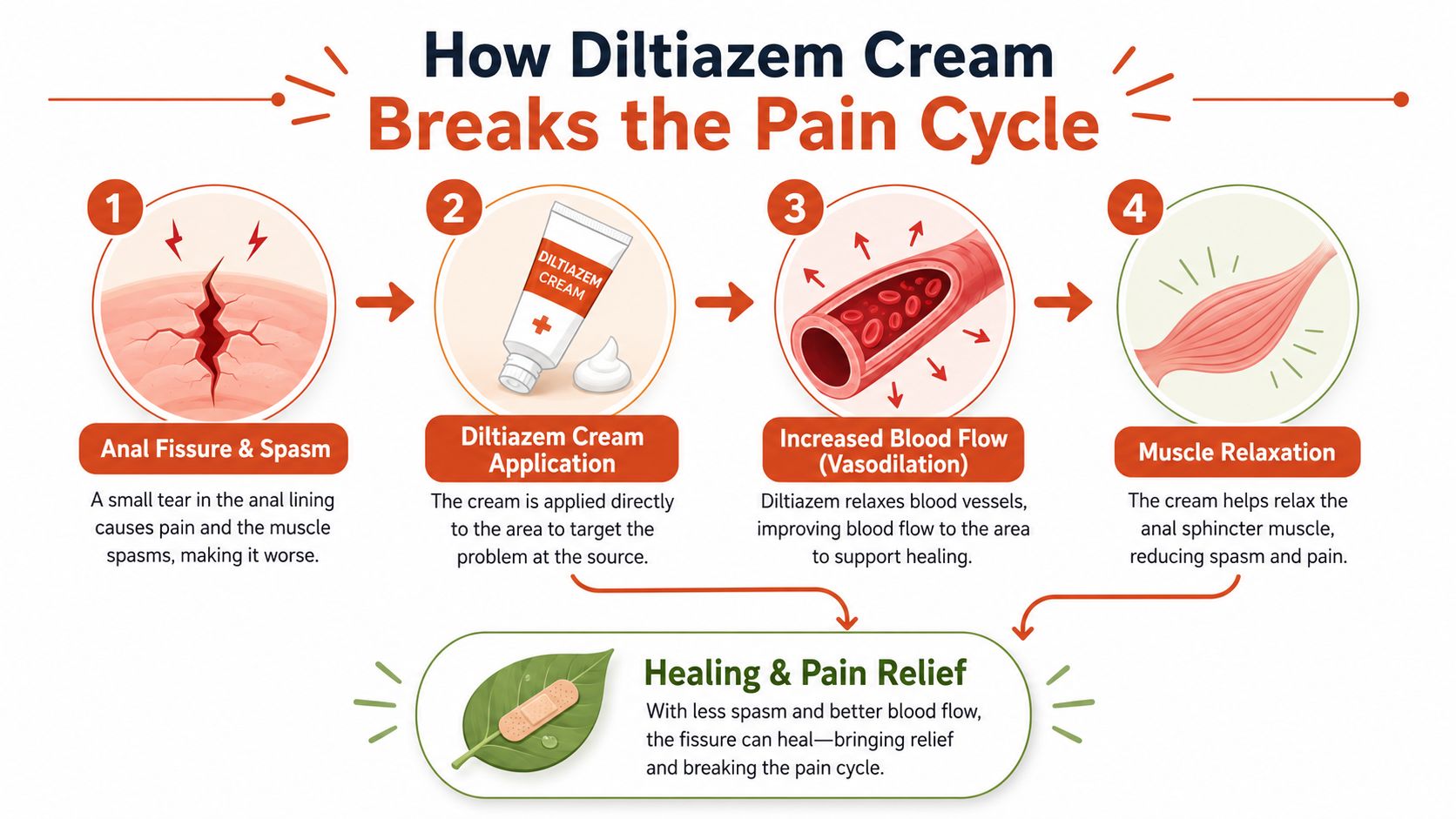
What makes fissures frustrating is that they often don’t heal like a simple skin cut. The muscle underneath can stay tight. That tightness reduces blood flow. Less blood flow means slower healing. More pain causes more tightening. The cycle continues.
Diltiazem cream helps break that cycle. It’s a prescription medicine that relaxes the anal sphincter so the tissue can get the blood supply it needs to recover. That’s why many providers use it for chronic fissures instead of relying only on products that numb the area for a few hours.
Some people also need a more complete strategy. A compounded formula, like those offered through Bummed, pairs diltiazem with ingredients for pain control, itch relief, inflammation support, and skin comfort. That approach can be especially helpful when pain is making it hard to apply treatment consistently.
For people who want a broader understanding of fissure recovery, our guide on how to heal an anal fissure can help you connect medications, bowel habits, and skin care.
How Diltiazem Cream Breaks the Pain Cycle
A chronic fissure often behaves like a paper cut in a body area that won’t stop clenching. That’s the key problem.
Think of the muscle like a clenched fist
If you cut the skin over your knuckles and then keep your hand balled into a fist all day, the skin stays under tension. It hurts more. It gets less chance to close. Healing slows down.
The anal sphincter can do something similar. Pain makes the muscle tighten. That tighter muscle can reduce blood flow to the fissure. The tissue then struggles to repair itself. You feel more pain, and the muscle tightens again.
Diltiazem is a calcium channel blocker. In this setting, it’s used topically to help that muscle relax. When the muscle relaxes, blood flow improves. Better blood flow brings the oxygen and nutrients the tissue needs to heal.
Why this is different from a numbing cream
A numbing ingredient can help with comfort. That can be useful. But numbing alone doesn’t address the muscle spasm that keeps the fissure open.
Diltiazem targets the reason the fissure gets stuck in a chronic state. That’s why it has an established role in chronic fissure care. The UK’s NICE notes that 2% topical diltiazem hydrochloride is unlicensed there for chronic anal fissure but supported by evidence from randomized trials and a Cochrane review. NICE also notes that headache was less common than with topical glyceryl trinitrate, while effectiveness was not statistically significantly different between the two options. The same review describes 2% w/w diltiazem cream and a maximum recommended daily dose of 25.5 mg given as three perianal applications per day, with about 8.5 mg per application in a 30 g tube, and cites a post-hoc analysis with p = 0.0120 in support of benefit (NICE evidence summary on topical diltiazem).
What that means in practice
For many adults, this treatment sits in the middle ground between simple symptom relief and more invasive procedures. It’s topical. It’s targeted. It’s meant to support healing.
Bummed’s Long-Acting Hemorrhoid & Fissure Rx Cream, is a prescription option with long-term healing for hemorrhoids and chronic anal fissures featuring diltiazem, with relief that starts right away.
The Power of a Multi-Ingredient Prescription
Diltiazem may be the engine of healing, but some people need more than one tool. That’s where a compounded prescription can make sense.
What each ingredient is doing
In Bummed’s multi-ingredient formulation, each component has a different job.
-
Diltiazem helps relax the anal sphincter and support blood flow to the fissure.
-
Lidocaine provides fast numbing relief.
-
Bupivacaine is used for longer-lasting local pain control.
-
Hydrocortisone helps calm swelling, itching, and irritation.
-
Metronidazole is included for antimicrobial support during tissue recovery.
-
Aloe adds a soothing element for sensitive skin.
That combination can be practical for adults who are dealing with both fissure pain and surrounding irritation. It can also help people who stop treatment early because the area feels too raw, too itchy, or too uncomfortable to keep applying cream.
Why compounding needs thoughtful oversight
Compounding can be useful because it allows providers to combine ingredients around a specific problem. It also needs care. These products aren’t all interchangeable.
If you’re exploring compounded prescriptions for anorectal symptoms more broadly, this overview of prescription hemorrhoid cream options explains how providers think about matching ingredients to symptoms.
How to Use Your Prescription Cream for Best Results
How you use diltiazem cream matters almost as much as getting the right prescription. Applied correctly, most people notice early signs of improvement within about a week — though full healing takes longer, and the medicine only works if you stick with the full course.
Getting the technique right matters more than people expect: too much cream, the wrong placement, or rubbing instead of dabbing can all make the area feel worse without improving how well the medication works. For a full walkthrough — including hand positioning, how much to use, what to do if it stings, and troubleshooting common mistakes — see our complete guide on how to apply diltiazem cream.
Understanding Effectiveness and Safety
Diltiazem cream has been used for chronic fissure care for a long time, and it’s supported in guideline-level evidence. That gives us a good foundation for discussing safety in a calm, realistic way.
What we know about effectiveness
The main reason providers choose diltiazem is simple. It addresses the muscle tension that blocks healing, rather than only masking discomfort.
For many adults, that makes it a practical prescription option before moving to injections or surgery. It’s especially useful when the story sounds like a classic chronic fissure. Sharp pain with bowel movements. Ongoing spasm. Fear of using the bathroom because you know what’s coming.
Side effects and what they usually mean
The most commonly discussed side effects are local irritation, itching, dermatitis, and mild headache. Those can be frustrating, but they’re often manageable.
There’s another point that surprises people. Even though the medicine is applied locally, the body can still absorb some of it. One regulatory dossier for 2% cream described a nominal 450 mg application delivering 8.5 mg diltiazem hydrochloride per dose, with a median Tmax of 4.04 hours after topical perianal use (Australian regulatory assessment of topical diltiazem). That doesn’t mean systemic effects will be commonly felt. It does mean the medicine isn’t purely “surface only.”
Let your provider know about heart medicines, blood pressure treatment, pregnancy, breastfeeding, and any reaction you’ve had to compounded creams before.
Special situations
Many adults ask about pregnancy or the postpartum period. Treatment decisions in that setting should always go through a licensed provider who knows your full history and your specific formula.
We can say this clearly. It’s reasonable to ask. It’s common to need support during that time. A provider can help weigh ingredients, symptoms, and feeding considerations in a way that a generic internet answer can’t. Bummed’s medical advisors, which includes OBGYNs, have deemed Bummed’s Long-Acting Hemorrhoid & Fissure Rx Cream with diltiazem to be pregnancy and breast-feeding safe, however always check with your own medical provider before starting a new medication.
Diltiazem Cream Compared to Other Treatments
When people hear “prescription cream,” they often assume all fissure creams work the same way. They don’t. If you’re still deciding between prescription options, our full anal fissure cream comparison covers diltiazem alongside nitroglycerin, Botox, and surgery.

Diltiazem cream and nitroglycerin
Topical glyceryl trinitrate, often called GTN or nitroglycerin, is another medicine used to relax the anal sphincter. The big difference for many patients is tolerability.
As noted earlier in the NICE evidence summary, the available evidence found that effectiveness was not statistically significantly different between topical diltiazem and topical glyceryl trinitrate, but diltiazem was associated with less headache. That matters because headache is one of the main reasons people struggle with nitroglycerin. Nitroglycerin is the key ingredient found in Bummed’s Rapid Relief Hemorrhoid & Fissure Rx Cream.
Where injections and surgery fit
Botox injections and lateral internal sphincterotomy are usually considered later when topical treatment isn’t enough or when the fissure is especially persistent. Those treatments can be very important in the right setting, but they’re more invasive than applying a cream at home.
A simple comparison looks like this:
| Treatment | Main role | Typical place in care |
|---|---|---|
| Diltiazem cream | Relaxes muscle and supports healing | Common prescription starting point |
| Topical nitroglycerin | Also relaxes muscle | Another topical option |
| Botox | Temporarily reduces sphincter spasm | Next step for selected cases |
| Surgery | Definitive mechanical treatment | Considered for refractory fissures |
Some patients also ask about related topical options such as nifedipine. If you want a side-by-side look at another calcium channel blocker used in fissure care, this article on nifedipine and anal fissure treatment is a useful companion read. Nifedipine is the key ingredient found in Bummed’s Sensitive Care Hemorrhoid & Fissure Rx Cream.
How to Get a Diltiazem Cream Prescription Safely
Diltiazem cream is a prescription because the right treatment starts with the right diagnosis. Not every painful anorectal symptom is a fissure. Hemorrhoids, dermatitis, infection, and other conditions can overlap.
Why the source matters
With compounded medicines, consistency matters. One major quality study of compounded topical 2% diltiazem hydrochloride found that retail pharmacy preparations were misbranded for potency about 50% of the time, lacked content uniformity about 40% of the time, and were subpotent in roughly one third of cases (quality study of compounded diltiazem cream). That doesn’t mean every compounded product is poor quality. It does mean you should care where it comes from. This is why Bummed works with highly vetted, compliant compounding pharmacies.
What a safe telehealth process looks like
A careful online prescribing process should include:
-
A symptom review that screens for red flags and checks whether a fissure is likely.
-
Provider oversight so the medication matches your symptoms and health history.
-
Clear instructions on how to apply the cream and what side effects to watch for.
-
Reliable compounding and shipping so the formula is prepared and dispensed through established channels.
If you want to understand the process before starting, Bummed explains how to get prescribed online. In general, you complete an intake, a board-certified provider reviews it, and treatment is prescribed if appropriate.
Frequently Asked Questions About Diltiazem Cream
How long does diltiazem cream take to work
Some people notice early improvement within about a week, especially a little less spasm after bowel movements. Full healing usually takes longer. Keep following your provider’s plan even if pain starts improving early.
Do I put diltiazem cream inside or outside
It is typically applied to the affected area and just at the entrance of the anus, not deep inside. Your prescription instructions matter most. If they’re vague, ask your provider for a very specific application plan.
Is it normal for diltiazem cream to sting at first
A mild brief sting can happen, especially if the fissure is raw. Worsening burning, a spreading rash, or severe irritation deserves a message to your provider.
Can I miss a dose
If you miss a dose, use it when you remember unless it’s close to the next scheduled dose. Don’t double up unless your provider told you to handle missed doses that way. Consistency is helpful, but one missed application doesn’t mean the treatment has failed.
Is compounded diltiazem cream the same everywhere
No. Compounded products can differ in quality, base, storage needs, and exact ingredient mix. That’s why the pharmacy and prescribing process matter, and is essential to how Bummed operates. We ensure all of our products use quality ingredients, freshly batched, in the exact amounts prescribed.
Why would someone use a multi-ingredient prescription instead of diltiazem alone
Because some people need more than muscle relaxation. They may also need fast pain relief, longer local comfort, less itching, or support for inflamed skin. A compounded formula, such as Bummed’s Long-Acting Hemorrhoid & Fissure Rx Cream, can be designed around that real-life symptom cluster.
When should I contact a provider right away
Reach out promptly if pain becomes severe, bleeding increases, you develop a new lump, you have fever, or the diagnosis doesn’t seem to fit your symptoms. It’s also important to check in if treatment is too irritating to continue.
If you’re dealing with fissure pain and want a discreet way to get evaluated, Bummed offers online intake reviewed by a board-certified provider, with prescription treatment if appropriate. Bummed content is for general education and should never replace professional medical advice that considers your individual health. If you think you’re experiencing a medical emergency, call 911 or head to the nearest emergency department. Prescription products require an online consultation with a physician who will determine if a prescription is appropriate.