

If you’ve ever been jolted awake by a sudden, stabbing pain in your rectum, you already know the first question: how do I make this stop?
That pain is likely proctalgia fugax, a short, sharp spasm of the muscles around your anus. There isn’t one definitive treatment. episodes pass on their own within seconds to minutes. But there’s a lot you can do, both to get through a spasm and to make them happen less often.
Think of it in two parts: relief right now, and fewer spasms later.
Quick relief during a spasm
When a spasm hits, the goal is to help the muscle let go. These are the go-to options:
- Use warm water. Sit in a warm bath, or stand under a warm shower. Warmth helps tight muscles relax (Jeyarajah et al.).
- Try heat or cold. A heating pad or a wrapped ice pack on the area helps some people (Cleveland Clinic).
- Breathe low and slow. Take slow breaths deep into your belly. As you breathe out, let your pelvic floor drop and soften, the opposite of squeezing to hold in gas.
- Change position. Some people find relief curling into a knees-to-chest position or child’s pose. [Reviewer: confirm.]
- Try to pass gas or have a bowel movement. For some people, going to the bathroom helps the sphincter relax But don’t force it if you don’t have to go.
- Remind yourself it will pass. It sounds simple, but panic makes muscles tighter. Proctalgia fugax is painful, not dangerous, and every episode ends.
An over-the-counter pain reliever won’t kick in fast enough for a seconds-long spasm, but it can help with any lingering soreness afterward (Cleveland Clinic).
Fewer spasms: treat what’s behind them
Here’s the part most articles skip. According to Dr. Carmen Fong, Bummed’s Chief Medical Officer and a colorectal surgeon, rectal spasms are often related to something else going on, and good bowel health goes a long way toward calming them down.
Stop straining, and stop holding it in
Your anal sphincter and pelvic floor are built to squeeze and then relax. Two very common habits throw that rhythm off:
- Pushing too hard on the toilet loads your pelvic floor with pressure.
- Holding in your poop keeps the sphincter clenched far longer than it should be.
Do either one often enough, and the muscles can get stuck in “tight” mode, which makes spasms more likely. A few changes help:
- Go when you feel the urge. Don’t put it off until a more convenient time.
- Get enough fiber and water so stools are soft and easy to pass. A fiber supplement can help fill the gap.
- Prop your feet up on a small stool. It straightens the path out and makes pushing unnecessary.
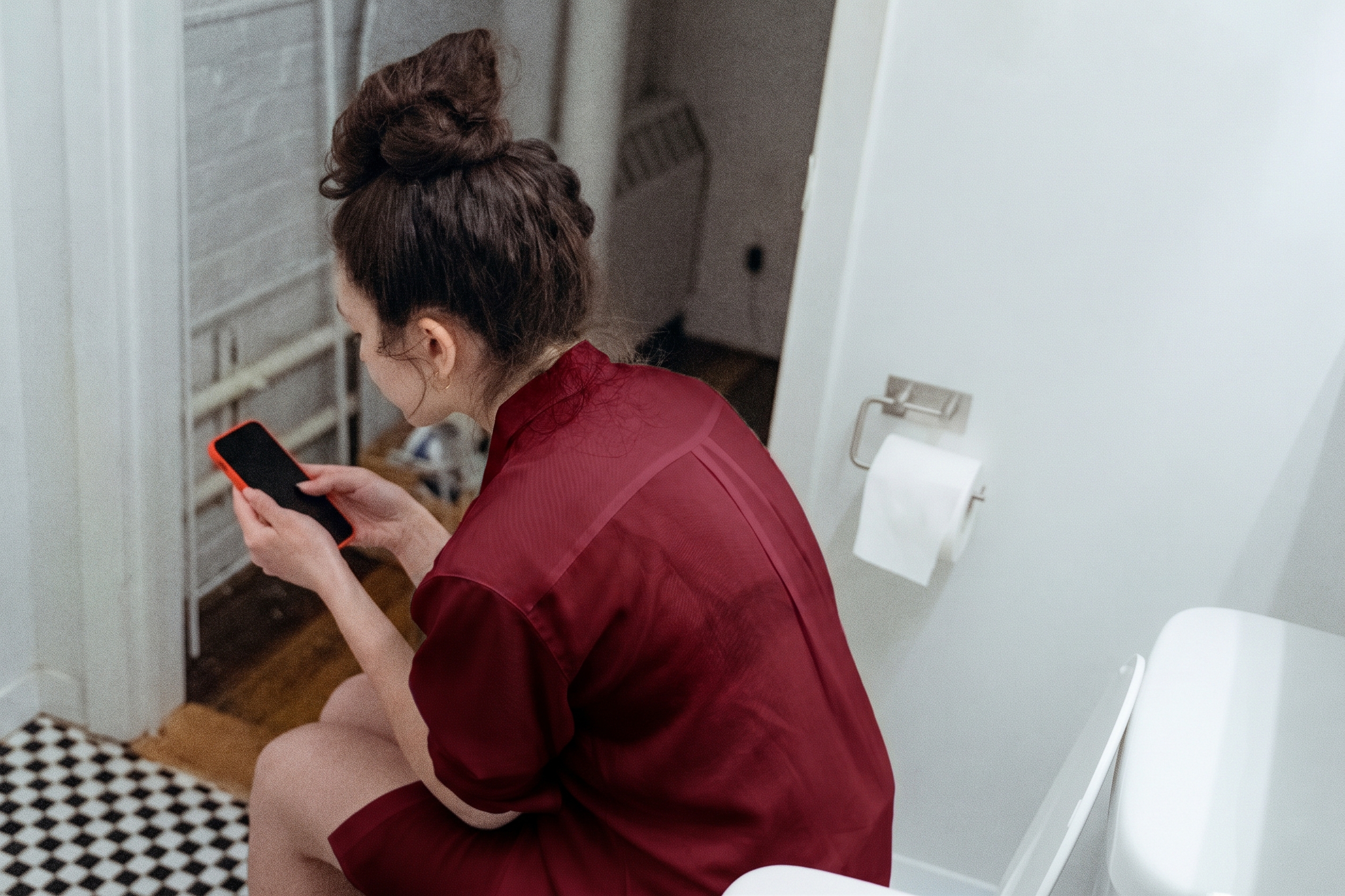
- Don’t linger. Scrolling on the toilet for 15 minutes adds pressure for no benefit.
- Track your habits. Our 7-day bowel habit tracker makes patterns easier to spot.
If constipation is the root of it
If you’re constipated more often than not, lifestyle changes may not be enough on their own. Prescription options can get things moving without the strain:
Lactulose Rx is an oral solution that draws water into your stool to soften it. It’s pregnancy-friendly and available for local pharmacy pickup. Please talk to your OB provider prior to starting lactulose.
Lubiprostone (Amitiza) Rx is a daily capsule that helps your intestines release more fluid so stools pass more easily.
If you have an anal fissure
An anal fissure is a small tear in the lining of your anus. It can keep your sphincter in a constant state of tension, and that tension can show up as spasms. Signs of a fissure include:
- Sharp or tearing pain during a bowel movement
- Pain or a deep ache that lingers for minutes to hours afterward
- Bright red blood on the toilet paper
The good news: fissures are very treatable. Prescription creams that relax the anal sphincter help ease the pain and give the tear room to heal. Interestingly, two of these same medicines, diltiazem and nitroglycerin, have also been studied as topical treatments for proctalgia fugax itself (CMAJ appendix; Jeyarajah et al.).
When a fissure is behind the spasms:
Long-Acting Rx Cream uses diltiazem to help relax the anal sphincter, easing pain and giving the tear room to heal. Pregnancy-friendly and HSA/FSA eligible.
Sensitive Care Rx Cream uses nifedipine, another sphincter-relaxing medicine, in a formula made for sensitive bodies. Pregnancy-friendly and HSA/FSA eligible.
For more, see our guides to anal fissure cream and how to heal an anal fissure.
If hemorrhoids are part of the picture
Hemorrhoids and rectal spasms often travel together, especially if straining is part of your routine. When spasms come with hemorrhoid symptoms like swelling, itching or bleeding, Bummed clinicians may prescribe a sphincter-relaxing cream like Long-Acting or Sensitive Care, or a formula like Rapid Relief, depending on your symptoms. Learn more in our hemorrhoid treatment guide.
Compounded medications are not FDA-approved. All prescriptions require a clinician review. Consult with a medical provider before starting any medications.
Prescription options for frequent spasms
If spasms are frequent or severe, a doctor may suggest a prescription. Researchers have tested several options, though most of the evidence comes from small studies and case reports rather than large trials (CMAJ):
- Topical creams that relax the sphincter. Diltiazem and nitroglycerin ointments applied to the anus are the most commonly suggested first step (CMAJ appendix).
- Inhaled salbutamol. This asthma inhaler is the only treatment studied in a randomized controlled trial for proctalgia fugax, where it shortened episodes for people with frequent, long-lasting attacks (CMAJ).
- Procedures for stubborn cases. A specialist may try nerve blocks, Botox injections to relax the sphincter, or electrical stimulation (Cleveland Clinic).
When spasms come with other symptoms, like a fissure or hemorrhoids, a Bummed clinician can review your symptoms and decide whether a sphincter-relaxing cream like Long-Acting or Sensitive Care makes sense for you. Find My Treatment
Pelvic floor physical therapy and exercises
Because proctalgia fugax is so often a muscle problem, retraining those muscles can make a real difference. A pelvic floor physical therapist can use biofeedback, which shows you in real time when your muscles are tense, to teach you how to relax them on command (Cleveland Clinic). Our partners at Origin specialize in pelvic floor physical therapy.
A few gentle stretches you can try at home (stop if anything hurts):
- Pelvic floor drops. Lie on your back with knees bent. Breathe into your belly and, as you exhale, gently let your pelvic floor lengthen and relax, like you’re about to pass gas. Hold 5 seconds, repeat 10 times.
- Child’s pose. Kneel, sit back on your heels, and fold forward with your arms out in front. Breathe deeply for 30 to 60 seconds.
- Happy baby. Lie on your back, bring your knees toward your armpits, and hold the outsides of your feet. Rock gently side to side for 30 to 60 seconds.
- Deep supported squat. Hold onto a counter and lower into a deep squat with your heels down. Breathe and let your pelvic floor relax for 30 seconds.
The key across all of these: relax, don’t squeeze. Kegels strengthen the pelvic floor, but if your muscles are already too tight, they can make spasms worse.
Calming stress
Stress and anxiety are commonly linked to proctalgia fugax (Cleveland Clinic). Practices like meditation, yoga or regular exercise can help, and if anxiety is a big part of the picture, talking with a therapist can help too.
When to see a doctor
Get checked if you notice any of these, rather than treating at home:
- Bleeding from your rectum or blood in your stool
- Pain that lasts longer than 30 minutes or doesn’t fully go away
- Fever, swelling or a hard lump near your anus
- A change in your bowel habits lasting more than a few weeks
- Spasms that are getting more frequent or intense
Proctalgia fugax treatment FAQs
How long does proctalgia fugax last?
Most episodes last a few seconds to a few minutes, and almost always less than 30 minutes (Cleveland Clinic).
What’s the fastest way to relieve proctalgia fugax?
Warm water, like a sitz bath or warm shower, combined with slow belly breathing to relax your pelvic floor, is the quickest thing most people can do at home.
Can a cream help rectal spasms?
Topical creams that relax the anal sphincter, like diltiazem or nitroglycerin, have been studied for proctalgia fugax and are commonly used for anal fissures (CMAJ appendix). Talk with a clinician about whether one is right for you.
Does Bummed treat proctalgia fugax?
Bummed clinicians treat the conditions that often come with rectal spasms, including anal fissures, hemorrhoids, and constipation. When spasms come with those symptoms, a clinician can prescribe a treatment that fits. If your pain doesn’t match any of them, we’ll point you toward the right next step.
Can I treat proctalgia fugax while pregnant?
Warm baths, gentle stretching and staying regular are generally safe ways to ease spasms during pregnancy. Check with your OB or midwife before starting any medication. Long-Acting, Sensitive Care and Lactulose are all labeled pregnancy friendly, but your provider should still sign off.
Will Kegels help?
Usually not. Proctalgia fugax is about muscles that won’t relax, so the focus should be on relaxing your pelvic floor, not strengthening it.
Spasms keeping you up at night? We’ve got your back(side).
Bummed clinicians can help figure out what’s driving your rectal pain, whether that’s a fissure, hemorrhoids or constipation, and prescribe a treatment made for you. Rx creams start at $22/month after a one-time $49 consult. Find My Treatment
This article is for informational purposes only and isn’t a substitute for professional medical advice. Consult with a medical provider before starting any medications. If you’re pregnant or breastfeeding, talk to your OB first. Compounded medications are not FDA approved.
References
- Jeyarajah S, Purkayastha S. Proctalgia fugax. CMAJ. 2013;185(5):417.
- Jeyarajah S, Purkayastha S. Suggested management pathway for proctalgia fugax (appendix). CMAJ.
- Jeyarajah S, Chow A, Ziprin P, Tilney H, Purkayastha S. Proctalgia fugax, an evidence-based management pathway. Int J Colorectal Dis. 2010;25(9).
- Cleveland Clinic. Proctalgia fugax.